
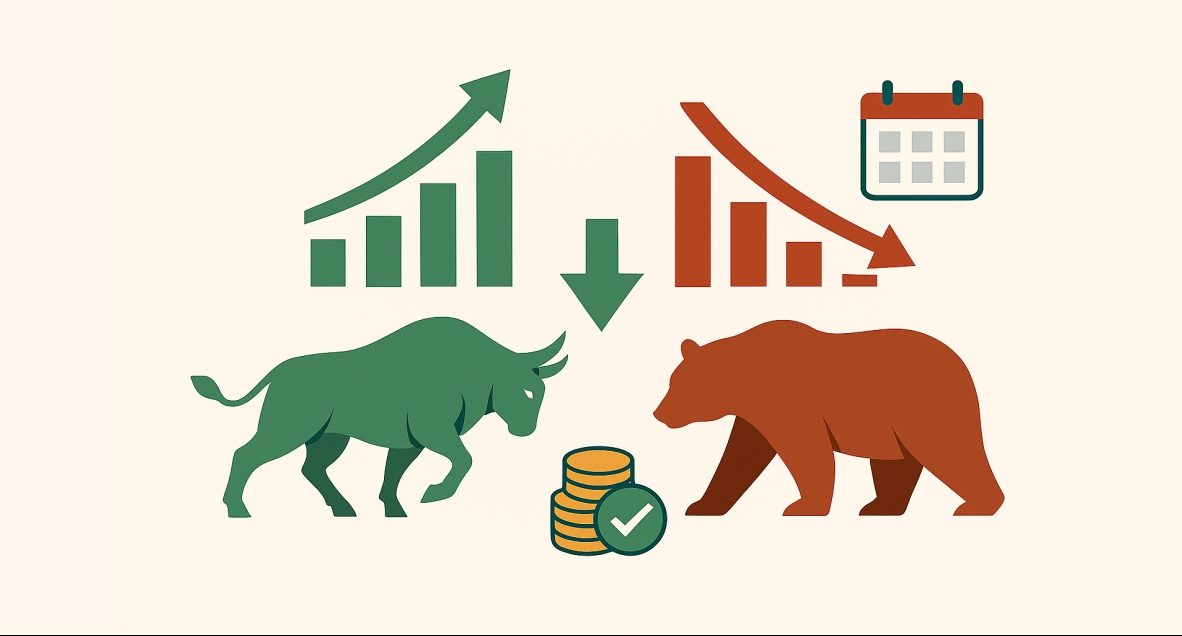

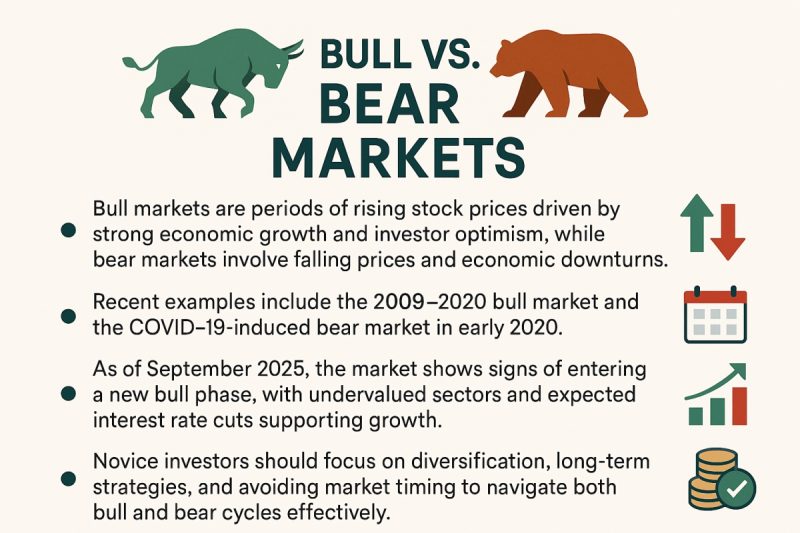
- Bull markets are periods of rising stock prices driven by strong economic growth and investor optimism, while bear markets involve falling prices and economic downturns
- Recent examples include the 2009–2020 bull market and the COVID-19-induced bear market in early 2020
- As of September 2025, the market shows signs of entering a new bull phase, with undervalued sectors and expected interest rate cuts supporting growth
- Novice investors should focus on diversification, long-term strategies, and avoiding market timing to navigate both bull and bear cycles effectively
Whether you’re a seasoned investor or just starting out, understanding the difference between a bull market and a bear market is essential to navigating the stock market.
These terms describe broad market trends and can significantly influence investment strategies, risk tolerance, and portfolio performance.
This article is a journalistic opinion piece which has been written based on independent research. It is intended to inform investors and should not be taken as a recommendation or financial advice.
What Is a bull market?
A bull market is a period when stock prices are rising or expected to rise. It’s typically defined as a 20 per cent increase in major stock indexes (like the S&P 500) from a recent low. Bull markets are driven by:
- Strong economic growth
- High investor confidence
- Low interest rates
- Rising corporate earnings
Historical example:
The longest bull market in U.S. history lasted from March 2009 to February 2020, following the Great Recession. During this time, the S&P 500 rose over 400 per cent.
What Is a bear market?
A bear market is the opposite: a period when stock prices fall by 20 per cent or more from recent highs. Bear markets are often associated with:
- Economic recession
- High inflation
- Rising interest rates
- Negative investor sentiment
Historical example:
The COVID-19 pandemic triggered a bear market in March 2020, with the S&P 500 dropping over 30 per cent in just a few weeks before rebounding.
Key differences
| Feature | Bull market | Bear market |
| Market Trend | Rising prices | Falling prices |
| Investor Sentiment | Optimistic | Pessimistic |
| Economic Indicators | Strong GDP, low unemployment | Weak GDP, rising unemployment |
| Investment Strategy | Buy and hold, growth investing | Defensive investing, diversification |
Where are we now? (September 2025)
The current market shows signs of a transition into a new bull market, though risks remain:
- Small-cap and value stocks are outperforming and remain undervalued, with small caps trading at a 15 per cent discount to fair value
- The Federal Reserve is expected to cut interest rates, which historically supports bull market conditions
- The Morningstar US Market Index rose 2.15 per cent in August, with strong gains in value and small-cap segments
- However, tariffs and global trade tensions are distorting GDP figures and could slow economic growth into early 2026
Sector highlights:
- Undervalued: Communications, Real Estate, Energy, Healthcare
- Overvalued: Utilities
Tips for novice investors
- Stay diversified: Spread investments across sectors and asset classes.
- Avoid market timing: It’s nearly impossible to predict tops and bottoms.
- Focus on fundamentals: Invest in companies with strong earnings and growth potential.
- Think long-term: Bull and bear markets are part of the cycle—patience pays off.
Join the discussion: Find out what the Bullboards are saying about stock market performance on Stockhouse’s stock forums and message boards.
Stockhouse does not provide investment advice or recommendations. All investment decisions should be made based on your own research and consultation with a registered investment professional. The issuer is solely responsible for the accuracy of the information contained herein. For full disclaimer information, please click here.