
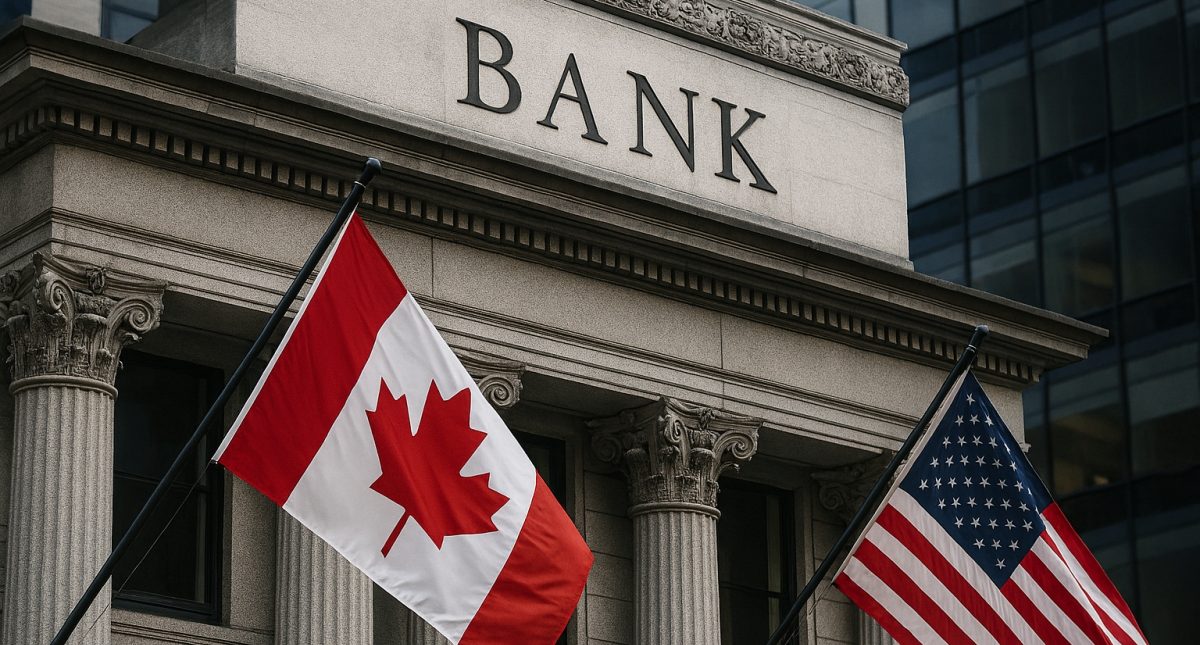

- The Bank of Canada holds steady with the policy rate unchanged at 2.25 per cent as global risks offset easing core inflation
- Inflation bump from higher energy prices in the near term, with inflation expected to return to 2 per cent in 2027
- Muted growth as Canada’s economy recovers slowly, with GDP growth around 1–2 per cent through 2028
- Fed in focus as markets await Jerome Powell’s guidance on energy‑driven inflation and future rate cuts
The Bank of Canada opted to stay on the sidelines Wednesday, holding its target for the overnight rate at 2.25 per cent, with the Bank Rate at 2.50 per cent and the deposit rate at 2.20 per cent, as policymakers navigated a complex mix of easing domestic inflation trends and intensifying global shocks.
The decision reflects a Governing Council increasingly confident that underlying inflation pressures in Canada are moderating, but unwilling to declare victory amid mounting uncertainty stemming from the war in Iran, volatile energy markets, and ongoing disruptions to global trade driven by U.S. tariff policy.
In its April outlook, the Bank explicitly acknowledged that geopolitical risks have re‑emerged as a central force shaping the global economy. The evolving conflict in the Middle East has injected renewed volatility across commodity markets and global financial conditions, while U.S. trade policy continues to reshape supply chains and investment decisions worldwide.
This article is a journalistic opinion piece that has been written based on independent research. It is intended to inform investors and should not be taken as a recommendation or financial advice.
Global economy: resilient, but increasingly uneven
The Bank’s base‑case assumptions remain conservative. Its April forecast assumes tariffs remain unchanged and that the global benchmark price of oil declines to US$75 per barrel by mid‑2027. That assumption stands in stark contrast to near‑term realities. Since the outbreak of the Iran war, energy prices have surged sharply, and transportation disruptions through key routes have intensified.
Those developments are weighing on the global outlook in uneven ways. Higher oil prices are dampening growth in oil‑importing economies while pushing inflation higher worldwide. In the euro area, policymakers are bracing for weaker economic activity as elevated oil and natural gas prices squeeze households and industrial margins. By contrast, the United States continues to show resilience. U.S. growth is still expected to remain solid over the projection horizon, supported by strong consumption and a powerful wave of AI‑related investment.
China’s economy, meanwhile, is being propped up by robust export performance, even as domestic weaknesses persist. On balance, the Bank expects the global economy to grow at roughly 3 per cent annually in 2026, 2027, and 2028, although inflation projections for the coming year have been revised higher in light of the energy shock.
Markets digest war, inflation, and shifting rate expectations
Financial markets have reflected this tug‑of‑war between resilience and risk. Since January, bond yields are modestly higher, tracking both stronger‑than‑expected growth and renewed inflation concerns tied to energy. Equity markets, which sold off sharply in the early days of the Iran conflict, have largely recovered as investors reassessed earnings prospects and geopolitical tail risks.
Currencies have also adjusted. The U.S. dollar has strengthened against most major peers since the war began, a typical safe‑haven response. The Canada–U.S. exchange rate, however, has remained relatively stable, supported in part by Canada’s status as a major energy exporter.
Canada: growth steadies, labour remains soft
At home, the Bank described an economy that is regaining its footing but still facing meaningful headwinds. The outlook for Canadian growth is little changed from the January Monetary Policy Report, even as the composition of growth evolves.
After contracting in the fourth quarter of 2025, economic growth is expected to have resumed in early 2026. Consumer spending and government expenditures are providing support, but exports and business investment remain under pressure from tariffs and trade uncertainty. Housing activity declined late last year and continues to be restrained by slow population growth, affordability constraints, and elevated economic uncertainty.
The labour market remains a weak spot. Employment growth has been subdued for more than a year, with job losses concentrated in sectors directly affected by U.S. tariffs. The unemployment rate is holding in a 6½ per cent to 7 per cent per cent range, reflecting both soft hiring and a shrinking pool of job seekers.
Looking ahead, the Bank projects GDP growth of 1.2 per cent in 2026, rising to 1.6 per cent in 2027 and 1.7 per cent in 2028 as exports and business investment gradually recover along what the Bank described as a “lower trajectory” than in past cycles. With growth edging slightly above potential, excess supply in the economy is expected to be absorbed over time.
Importantly, while the war in Iran may alter the composition of growth, Canada’s overall GDP outlook is little changed. As a large net exporter of oil, Canada benefits from higher global energy prices through increased national income, even as households grapple with higher gasoline costs.
Inflation: a gasoline-driven bump, for now
Inflation data remain at the heart of the Bank’s policy calculus. CPI inflation rose to 2.4 per cent in March, driven primarily by sharply higher gasoline prices. That increase followed several months of encouraging inflation prints.
Core inflation has been easing and is holding just above 2 per cent, while the share of CPI components rising faster than 3 per cent has declined. For now, the Bank sees little evidence that higher oil prices are feeding broadly into goods and services inflation, though officials stressed that this channel “warrants close attention.”
Near‑term inflation expectations have ticked higher alongside gasoline and food prices, but longer‑term expectations remain well anchored. CPI inflation is expected to climb further in April to around 3 per cent, before easing back to the 2 per cent target early next year, assuming oil prices moderate as projected.
Policy on hold, but vigilance remains
Against this backdrop, the Bank judged that holding policy steady was the prudent course. Governing Council emphasized that it is “looking through” the near‑term inflation impact of the war, but remains unequivocal that it will not allow elevated energy prices to become a persistent inflationary force.
“We are closely monitoring the impact of the conflict in the Middle East and how the economy is responding to U.S. tariffs and trade policy uncertainty,” the Bank said, reiterating its commitment to price stability amid global upheaval.
All eyes on the Fed
Investors are also looking south. The U.S. Federal Reserve concludes its April meeting and moved to hold its rate at 3.50 per cent to 3.75 per cent. All eyes are on Chair Jerome Powell, who said he will remain at the Fed as a governor after his term as chair ends next month. Going forward, how will the Fed frame inflation risks linked to higher energy prices? Will policymakers offer any clues on the timing of eventual policy easing?
With both central banks grappling with the same global shocks—but from very different economic starting points—the coming months are likely to test the delicate balance between patience and action on both sides of the border.
Join the discussion: Find out what the Bullboards are saying about the banks and check out Stockhouse’s stock forums and message boards.