


Québec’s Raw Materials Wild Card: How Strategic Resources Aims to Redefine Critical Supply Chains
Global industry is in the midst of a tectonic shift in its raw material flows, as supply security has long since become a strategic issue. How can Western sources of supply be intelligently secured? At this intersection, Strategic Resources is positioning itself as a developer of critical metals. At the heart of a dynamic industrial movement are global decarbonization, the new boom in electromobility, and, of course, the development of modern defence systems. The demand for metals is enormous!
For Strategic Resources, this is a dream environment for tangible forward momentum. At the center is the BlackRock project in Québec, Canada, which combines vanadium, titanium, and high-purity iron, thereby addressing several critical raw material issues at once. Particularly noteworthy is the combination of mining project, processing, and planned further processing, as the company does not intend to limit itself to traditional raw material exports but rather to establish an integrated value chain. Plans include a pelletizing plant in the Port of Saguenay with a capacity of 4 million tonnes of DR-grade pellets per year.
These high-quality pellets are required for electric arc furnaces, which are considered a key technology for the production of green steel. The location offers significant advantages: affordable hydropower, access to deep-water ports, and direct connections to North America and Europe.
There is also movement within the company on the financing front. At the end of April, Strategic Resources adjusted its ongoing capital raise. The plan is to issue up to 40 million units at CAD 0.25 each, including a CAD 0.40 warrant, to raise up to CAD 10 million. The funds are primarily intended for final planning and construction readiness of the pelletizing plant. For a company with a market capitalization of only about CAD 17 million, this financing appears remarkably ambitious. It demonstrates that Strategic Resources intends to actively accelerate its transition from an explorer to an industrial developer.
The collaboration with Tyfast Energy remains particularly exciting from a strategic perspective. Together, the two companies are working on a North American supply chain for battery-grade vanadium oxide, which is intended for use in lithium-vanadium oxide anodes. These batteries are considered extremely durable, fast-charging, and cold-resistant—properties that are particularly in demand for off-road vehicles, mining equipment, and military systems. This positions Strategic Resources in a market that extends far beyond the traditional steel industry and is increasingly shaped by geopolitical interests. Added to this is the partnership with Javelin Global Commodities, which is not only intended to support Strategic Resources in global distribution but also to provide a line of working capital of up to USD 150 million. Given the already tangible progress in development, the stock is a true bargain and has recently been listed in Germany as well. Get in now!
IIF host Lyndsay Malchuk in conversation with CEO Sean Cleary about the upcoming construction of the mining facility in Québec.
BYD Builds Factories, NIO Builds Networks: The Power Struggle in the Electric Vehicle Market in 2026
Vehicle manufacturers worldwide have been the primary consumers of critical metals, and this demand has been growing rapidly since the advent of e-mobility. Two aggressive players from China are now conquering Europe as well, but with different agendas. While BYD is rapidly driving its global expansion, NIO is focusing more on technology and premium positioning. With a well-thought-out plan, BYD is currently gaining significant advantages. The new plant in Szeged, Hungary, is set to produce up to 200,000 vehicles annually starting in mid-2026, strengthening its proximity to European customers and local suppliers. In addition, the group is investing in battery assembly, research capabilities, and additional production sites in Eastern Europe and Turkey. Most recently, BYD attracted attention with new fast-charging technologies capable of up to 1,500 kW, which is expected to reduce charging times to under 10 minutes. With a European market share now at around 1.2%, the group is increasingly challenging established manufacturers such as Volkswagen and Stellantis. Despite its expansion course, the valuation appears comparatively cheap with an expected 2026 P/E ratio of about 11.2. Analysts on the LSEG Refinitiv platform assign an average 12-month price target of around EUR 12.80, representing 24% upside potential for the agile EV maker.
NIO, on the other hand, is pursuing a technology-driven premium strategy. In the first quarter of 2026, the company delivered 83,465 vehicles, achieving 98% year-over-year growth. New brands such as Onvo and Firefly are still in the development phase, while the core NIO brand has dominated the business so far. At the same time, the group is continuing to expand its battery swap stations in China and Europe to differentiate itself technologically from the competition. However, intense price competition continues to weigh on margins. While BYD impresses primarily with scale and cost leadership, NIO focuses more on innovation and user experience. After a build-up phase of just over 12 years, NIO shareholders can expect the first operating profit in 2027. A valuation of EUR 10 billion currently seems a bit high, but the company will likely grow into this valuation very quickly.
VW in Q1 Review: Billion-Euro Restructuring Underway, E-Mobility Gains Momentum
Volkswagen, the world’s second-largest automaker, is currently undertaking a major restructuring program. By 2030, 50,000 jobs are set to be cut in Germany, and production capacity is expected to decrease by 700,000 vehicles. Despite growing competition from China, the group delivered 2.04 million vehicles in the first quarter (down 4%), of which 10% were battery-electric vehicles (BEVs). This means the Volkswagen Group remains the clear BEV market leader in Europe and continues on its growth trajectory. In terms of total sales, China saw a 14.8% decline, and North America fell by 13.3% due to tariffs; however, the main market, Europe, grew by 4.7%, and South America by 7.0%. The share of e-mobility in Western Europe rose from 19% to 20%, and this trend could intensify in the coming quarters. Strategically, Volkswagen benefits from its broad model mix, as the Group continues to generate strong cash flows from its internal combustion engine business in parallel. It is precisely this dual structure, combining the traditional powertrain business with a growing electric division, that is currently stabilizing the balance sheet. Nevertheless, the market continues to view the Group very defensively. With an expected 2026 P/E ratio of just 4.4 and a dividend yield of over 6.5%, Volkswagen is currently one of the cheapest major automakers worldwide. 12 out of 25 analysts on the LSEG Refinitiv platform have issued a “Buy” recommendation, with the median 12-month price target at EUR 112.30—a full 25% above Friday’s closing price.
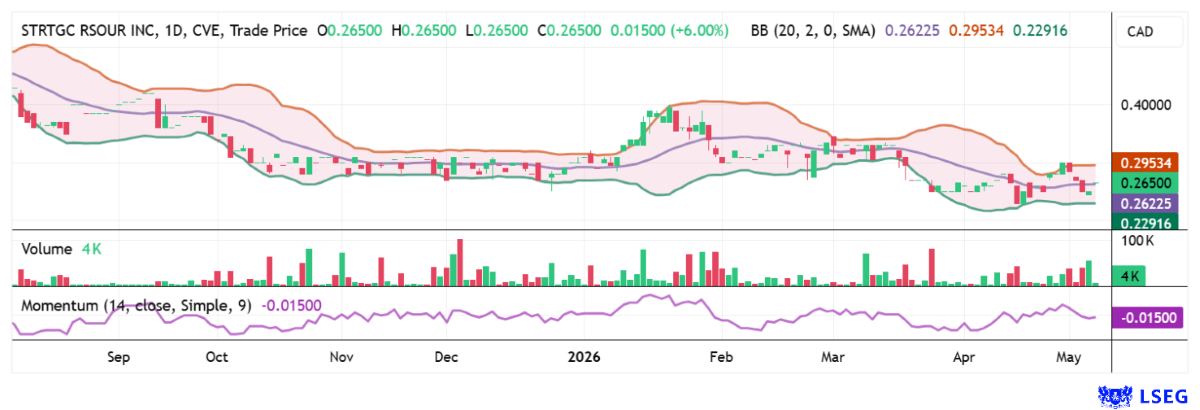
The stock markets are in constant stress mode. The pressures from the Middle East conflict are weighing on industry, but a new psychological incentive to buy electric vehicles is now emerging. Despite a massive increase in fossil fuel prices, electricity prices have so far barely reacted. Future suppliers of critical metals are a major focus. Strategic Resources already has a strong track record in this area!
Conflict of interest
Pursuant to §85 of the German Securities Trading Act (WpHG), we point out that Apaton Finance GmbH as well as partners, authors or employees of Apaton Finance GmbH (hereinafter referred to as “Relevant Persons”) currently hold or hold shares or other financial instruments of the aforementioned companies and speculate on their price developments. In this respect, they intend to sell or acquire shares or other financial instruments of the companies (hereinafter each referred to as a “Transaction”). Transactions may thereby influence the respective price of the shares or other financial instruments of the Company.
In this respect, there is a concrete conflict of interest in the reporting on the companies.
In addition, Apaton Finance GmbH is active in the context of the preparation and publication of the reporting in paid contractual relationships.
For this reason, there is also a concrete conflict of interest.
The above information on existing conflicts of interest applies to all types and forms of publication used by Apaton Finance GmbH for publications on companies.
Risk notice
Apaton Finance GmbH offers editors, agencies and companies the opportunity to publish commentaries, interviews, summaries, news and the like on news.financial. These contents are exclusively for the information of the readers and do not represent any call to action or recommendations, neither explicitly nor implicitly they are to be understood as an assurance of possible price developments. The contents do not replace individual expert investment advice and do not constitute an offer to sell the discussed share(s) or other financial instruments, nor an invitation to buy or sell such.
The content is expressly not a financial analysis, but a journalistic or advertising text. Readers or users who make investment decisions or carry out transactions on the basis of the information provided here do so entirely at their own risk. No contractual relationship is established between Apaton Finance GmbH and its readers or the users of its offers, as our information only refers to the company and not to the investment decision of the reader or user.
The acquisition of financial instruments involves high risks, which can lead to the total loss of the invested capital. The information published by Apaton Finance GmbH and its authors is based on careful research. Nevertheless, no liability is assumed for financial losses or a content-related guarantee for the topicality, correctness, appropriateness and completeness of the content provided here. Please also note our Terms of use.
Stockhouse does not provide investment advice or recommendations. All investment decisions should be made based on your own research and consultation with a registered investment professional. The issuer is solely responsible for the accuracy of the information contained herein. For full disclaimer information, please click here.