
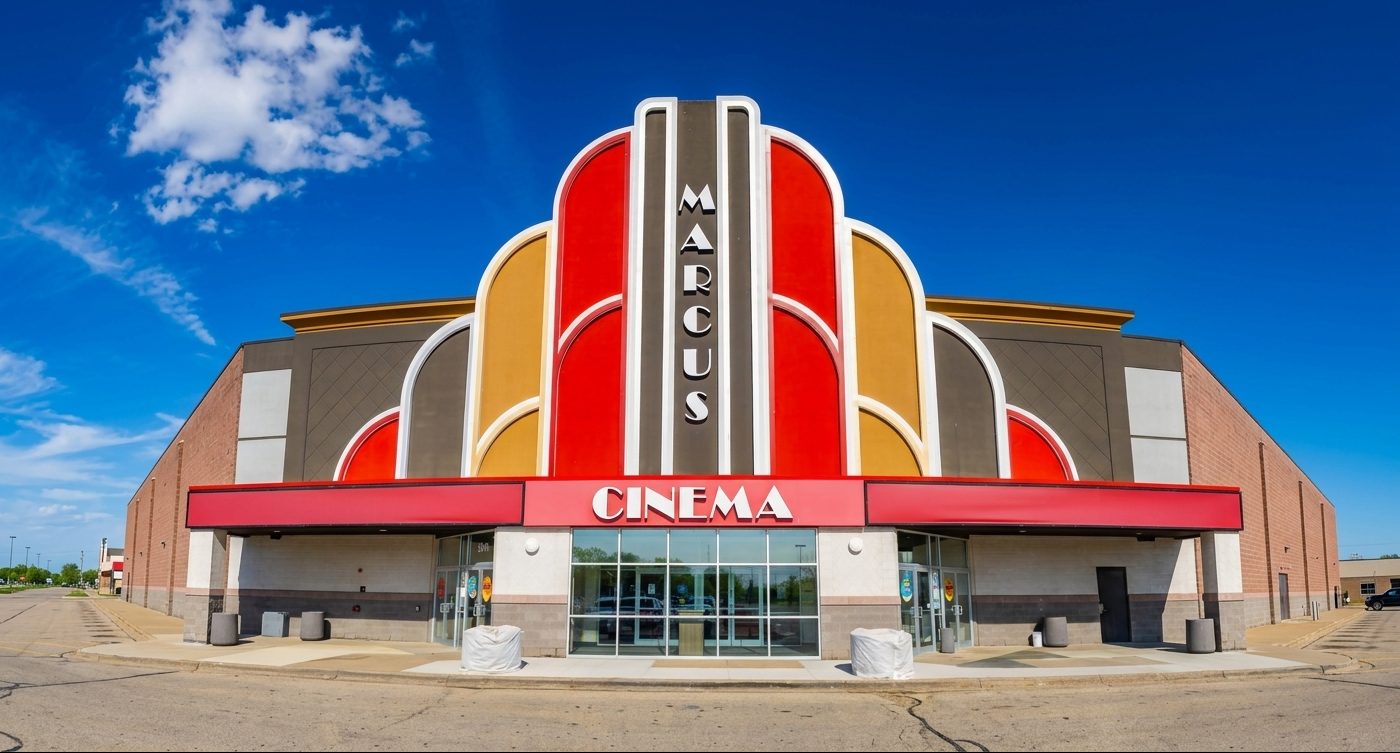

According to a recent report from Reuters, US movie theatre revenue is rising because of higher ticket and concessions prices, not higher attendance, with the 470.9 million tickets sold through the first 30 weeks of 2026 still comfortably below the 747.3 million sold in 2019. Concurrently, Cinema United found that habitual moviegoers, who see a minimum of six movies per year, are up by 8 per cent year-over-year (YoY).
This article is a journalistic opinion piece which has been written based on independent research. It is intended to inform investors and should not be taken as a recommendation or financial advice.
Taken together, these two pieces of data support a US cinema market that’s incentivizing premium experiences over growth initiatives focused purely on volume, despite what the recent string of billion-dollar releases may suggest about the size of the country’s moviegoing audience.
The Marcus Corporation
A cinema stock that fits this demand environment like a glove is The Marcus Corporation, market cap US$917.87 million, a Milwaukee-based company, founded in 1935, that diversifies its ranking as the fourth-largest US movie theatre exhibitor with a growing, high-quality hotel and resort division.
Marcus Theatres
Marcus Theatres owns or operates 975 screens at 77 locations across 17 US states under the Marcus Theatres, Movie Tavern by Marcus and BistroPlex brands. The company owns 62 per cent of its theatres, compared to less than 10 per cent for its peer group (see slide 8 of Marcus’ latest investor deck), differentiating itself through significant underlying credit support, lower lease payments and enhanced free cash flow.
Marcus’ approach to the moviegoing experience rests on an unwavering dedication to quality, a lofty ambition the company backs up with:
- 87 per cent of company-owned theatres and 89 per cent of screens offering premium DreamLounger seats, the highest percentages among top movie theatre chains.
- 84 per cent of company-owned theatres offering premium large-format screens, also the highest among top chains.
- 70 per cent of company-owned theatres offering expanded food and beverage options, with 26 per cent hosting in-theatre dining and 63 per cent offering full liquor through bars and lounges.
- The introduction of The Wall, a premium sports viewing auditorium, as well as a 4DX auditorium, ScreenX technology in four auditoriums and D-BOX haptic and motion seating in three auditoriums.
This combination of cutting-edge tech and alignment with customer needs has yielded positive average ticketing and concessions revenue growth since 2019, excluding the onset of the COVID pandemic in 2020 and a minor dip in 2024 (see slide 15 of the investor deck).
Financial strength was also evident in Marcus’ most recent quarter, Q2 FY2026, with the division bringing home US$150.6 million in revenue, up by 14.4 per cent YoY, operating income of US$26.7 million, up by 69.8 per cent YoY, and adjusted EBITDA of US$36.3 million, up by 36.8 per cent YoY, reflecting price optimization and same store admission revenue outperforming the broader industry by 5.1 per cent.
Marcus Hotels and Resorts
Unlike pure-play cinema stocks that must live and die by the sway of popular sentiment, Marcus Corp. further differentiates itself through a hotels and resorts division made up of 8 company-owned properties and 9 properties managed for other owners (totaling more than 4,650 rooms), including well-known brands such as Hilton and Marriott.
The division has been a scorcher as of late, posting revenue per available room (RevPAR) growth for seven straight months ending June 2026, currently representing about 38 per cent of total revenue and 26 per cent of operating income, leveraging a growing list of amenities including championship golf courses, spas, a ski hill and premier brand restaurants.
During Q2 2026, this superior performance looked like record revenue of US$70.8 million, up by 9.6 per cent YoY, operating income of US$6.7 million, up by a staggering 59.8 per cent YoY, and record adjusted EBITDA of US$14.7 million, up by 31.1 per cent YoY, bolstered by RevPAR from company-owned hotels outperforming the industry by 8.2 per cent during the quarter.
Finances
On a consolidated basis, Marcus Corp. has been a value-accretive force in the industry from a financial perspective, rewarding shareholders with 45 years of consecutive dividends pre-COVID, increasing its annual payout from US$0.35 in 2014 to US$0.64 in 2019. Marcus went on to become the first major theatre company to reinstate its dividend post-pandemic, which has grown from US$0.10 in 2022 to US$0.34 to date.
Taking a mid-term view, we find a similarly prospective picture, including revenue growth from US$458.2 million in 2021 to US$758.5 million in 2025, paired with adjusted EBITDA growth from US$35.1 million to US$99.3 million, respectively, while cutting net-debt-to-adjusted-EBITDA from 7x in 2021 to 1.1x in Q2 2026, showing leadership’s capital allocation skills to be squarely aligned with long-term profitability.
The snapshot in the first half of 2026 is also liable to enhance investor conviction, with the company taking in revenue of US$242.1 million, up by 11.3 per cent YoY, operating income of US$23.8 million, up by 153.1 per cent YoY, adjusted EBITDA of US$44.3 million, up by 46.6 per cent YoY, and net income of US$15.8 million, up from US$7.3 million YoY, supported by healthy demand for leisure and in-theatre experiences alike.
Looking ahead
Marcus’ long-tenured leadership team, the majority of which have served the company for at least 20 years, brings considerable property management and business building experience to the table, including tenures with the likes of MGM Resorts International, Hyatt Hotels & Resorts and Great Wolf Resorts, all of which considerably de-risks its ability to allocate Marcus’ US$245.6 million in cash and revolving credit as of Q2 2026 into a variety of growth initiatives designed to further establish the Marcus brand.
In the Marcus Theatres division, these include:
- Leveraging insights from the Marcus Movie Rewards loyalty program.
- Optimizing pricing strategies.
- More efficiently monetizing lobby, screens, website and mobile app.
- Growing membership programs, including the Marcus Movie Club launched in November 2024.
- Acquire and build new theatres contingent on market conditions, with a strong slate of movies lined up in Q4 2026, including Focker In-Law, Avengers and Dune III, and into 2027 with Ice Age, Narnia and a new Simpsons movie.
In the Marcus Hotels and Resorts division, these include:
- Investing in human resources to drive operational efficiency.
- Deploying technology, including management software, towards higher-quality customer interactions.
- Attractive acquisitions through investment or joint venture as they arise.
- Sourcing additional management contracts with established owners.
In this way, Marcus Corp. is marching confidently towards a century in business, focused on strengthening the relationship between continuous improvements to the client experience, whether in the theatre or in the pool, and the creation of long-term shareholder value.
Marcus Corporation stock (NYSE:MCS) last traded at US$30.26, adding 99.87 per cent year-over-year, but only 106.41 per cent since 2021, taking an overly pessimistic view of the company’s post-pandemic growth.
Join the discussion: Find out what investors are saying about this cinema stock on the Marcus Corp. Bullboard and make sure to explore the rest of Stockhouse’s stock forums and message boards.