
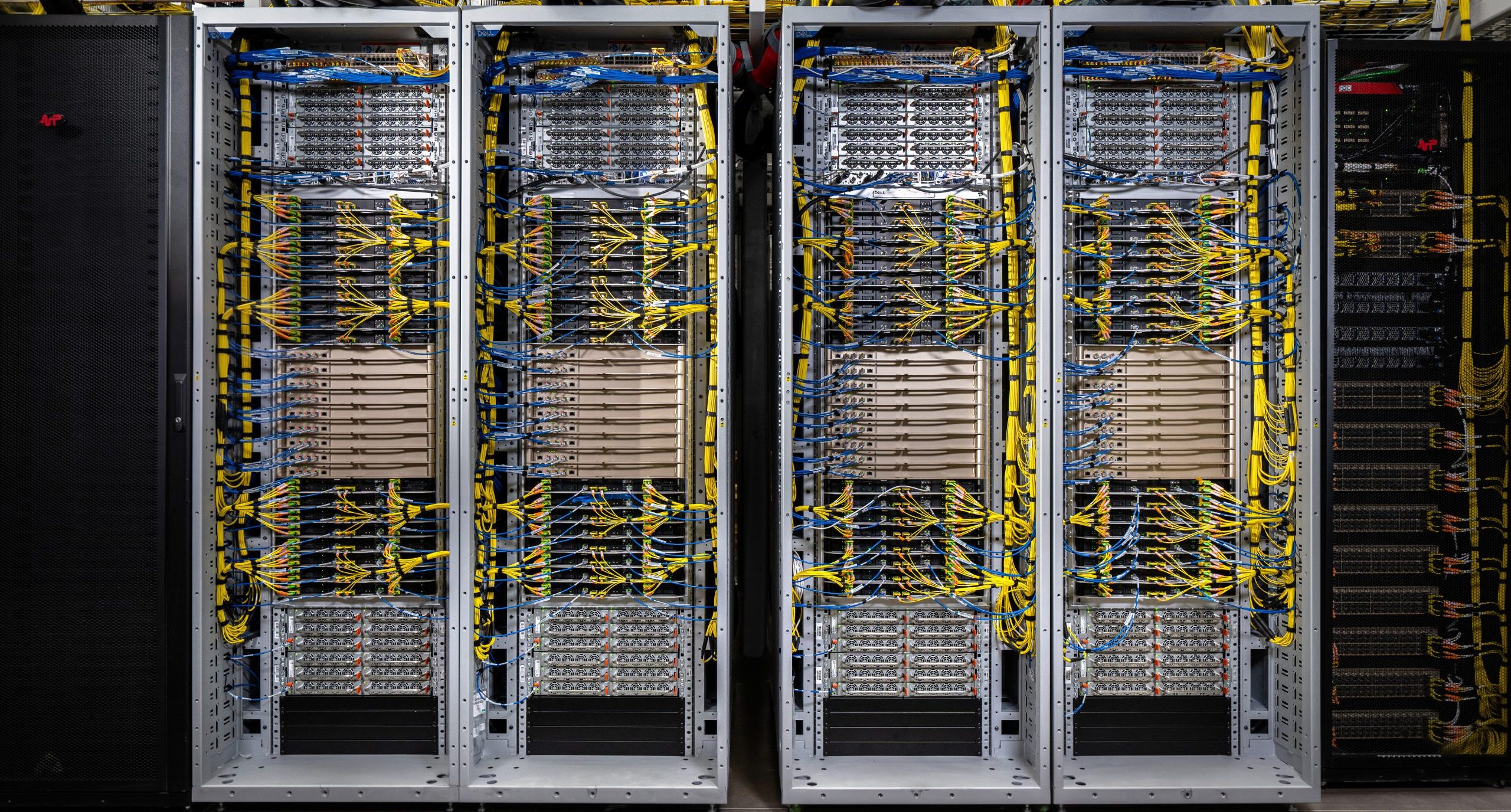

- Core Weave (NASDAQ:CRWV) shares are attempting to rebound after a steep selloff, as investors weigh strong AI demand and rapid revenue growth against concerns about the company’s roughly US$52 billion debt load
- The company continues to post impressive operating results, including triple-digit revenue growth, a backlog exceeding US$100 billion, and rising customer commitments, prompting some analysts to call the recent pullback a buying opportunity
- Credit markets remain cautious, with default insurance pricing implying elevated risk, highlighting the ongoing tension between Core Weave’s growth story and the challenge of funding its massive AI infrastructure expansion
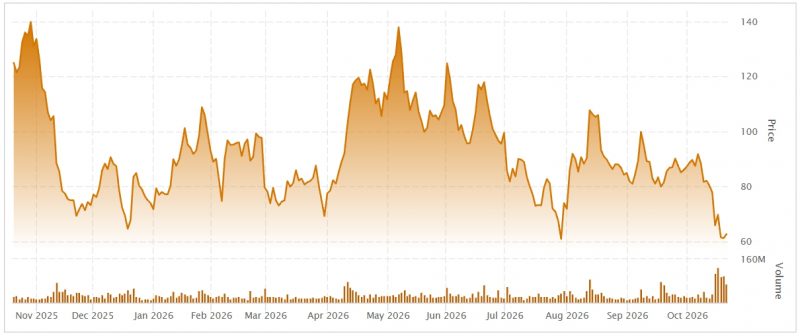
- Core Weave stock (NASDAQ:CRWV) last traded at US$62.35
Core Weave (NASDAQ:CRWV) shares are attempting to stabilize this week after one of the most dramatic selloffs in the AI sector this year. Following a roughly 25% decline last week and a slide of more than 40% since early October, the stock has found some buyers willing to bet that fears surrounding the company’s debt burden have become overdone.
The debate now dividing Wall Street is straightforward: Is Core Weave an AI infrastructure leader suffering from temporary credit-market anxiety, or is its massive debt load a warning sign that investors cannot ignore?
This article is a journalistic opinion piece that has been written based on independent research. It is intended to inform investors and should not be taken as a recommendation or financial advice.
A sharp selloff meets a technical rebound
Core Weave shares plunged to their lowest level since May 2025 early Tuesday before recovering above Monday’s low of US$59.25. Technical traders are watching closely because the move has the characteristics of a potential bear trap, a situation where a breakdown below support lures in short sellers before the stock quickly reverses higher.
For the bullish case to gain credibility, traders will likely want to see the stock maintain levels above US$59.25 and eventually reclaim resistance near US$66 and then US$70. Conversely, a renewed breakdown below Tuesday’s low of US$57.24 could put the May 2025 lows near US$53 back into focus.
Stock investors and bond investors see different futures
Perhaps the most fascinating aspect of the recent volatility is the stark contrast between signals coming from equity and credit markets.
While some stock investors have been buying the dip, credit markets remain deeply skeptical. Core Weave’s five-year credit default swaps (CDS), contracts used to insure debt against default, recently traded near 1,090 basis points. Those levels imply a roughly 50% to 60% probability of default over the next five years based on market pricing.
That does not mean bond investors are predicting a default with certainty. CDS pricing reflects risk perceptions and investor demand for protection. However, the unusually high cost highlights the seriousness of concerns surrounding the company’s balance sheet.
At the same time, some of those fears have eased modestly. The yield on Core Weave’s 2031 bonds recently fell to approximately 15.1% after climbing above 16% during last week’s selloff, suggesting some stabilization in credit sentiment.
Debt, not demand, is driving the concern
The recent weakness in Core Weave’s stock appears far more connected to financing concerns than operational performance.
The AI infrastructure provider reported second-quarter revenue of US$2.6 billion, representing growth of 112% year-over-year. Its backlog reached US$104.2 billion, while management disclosed more than US$25 billion in additional commitments early in the third quarter.
Those figures suggest customer demand remains exceptionally strong as enterprises race to secure AI computing capacity.
The company also continues to improve profitability metrics. Adjusted operating income reached US$128 million, and management expects margins to expand further through the second half of the year. Reflecting that momentum, Core Weave raised its full-year revenue guidance to between US$12.4 billion and US$13.2 billion.
Management maintains that demand continues to exceed available capacity and has indicated that much of its near-term infrastructure supply is effectively sold out.
The US$52 billion question
The challenge for investors is balancing those impressive growth numbers against an equally impressive debt burden.
Core Weave now carries roughly US$52 billion of debt, accumulated as the company aggressively builds out AI data center infrastructure and acquires expensive GPU hardware needed to support customer demand.
The financial impact of that borrowing is becoming more visible. Interest expense totaled US$640 million during the second quarter and is expected to rise to between US$860 million and US$940 million in the third quarter.
Despite strong revenue growth, the company reported a net loss of US$626 million in the second quarter. Meanwhile, management now expects 2026 capital expenditures of US$35 billion to US$39 billion, underscoring the scale of investment still underway.
As a result, Core Weave remains highly sensitive to interest rates and broader credit conditions. Rising borrowing costs were a key factor behind the recent selloff in AI and technology stocks after stronger-than-expected inflation data renewed concerns about additional rate hikes.
Goldman Sachs sees opportunity
Not everyone on Wall Street is focused on the debt story.
Goldman Sachs (NYSE:GS) recently upgraded Core Weave to “Buy” from “Neutral,” arguing that the market may be overlooking the company’s competitive advantages. The firm believes tight industry-wide computing capacity and Core Weave’s performance advantages over rival neocloud providers could support significant improvements in annual recurring revenue per megawatt over the coming years.
Goldman characterized the recent share-price decline as a potential buying opportunity rather than a deterioration in the company’s fundamental outlook.
Adding support to management’s position, Core Weave says its average cost of debt has fallen by nearly 300 basis points over the past year despite the company’s rapid growth.
JPMorgan says banks appear protected
Another key question raised by investors is whether a potential Core Weave debt problem could spread through the banking sector.
According to JPMorgan (NYSE:JPM) analyst Kian Abouhossein and his team, the answer appears to be no.
The analysts argue that bank exposure to Core Weave is generally well-managed and secured. Much of the financing consists of delayed-draw term loans, allowing Core Weave to access funding gradually as projects reach specific construction milestones.
Major lenders involved in these arrangements reportedly include large U.S. investment banks, European institutions such as Barclays and Deutsche Bank, and Japanese banking groups including Mitsubishi UFJ and Mizuho.
JPMorgan estimates that the largest banks likely have individual exposures ranging between US$1 billion and US$3 billion, while many other participating banks hold less than US$500 million each.
Importantly, lenders hold security interests in Core Weave’s physical GPU assets, and much of the debt is supported by contracted customer demand. The analysts also noted that the company’s maturity schedule appears manageable, with only about 17% of debt due next year and roughly 42% maturing after 2030.
Time is not on your side
Even JPMorgan’s relatively constructive assessment highlights an important challenge.
The issue is not necessarily whether demand exists. The issue is whether cash generated by that demand arrives quickly enough to offset the enormous capital investments being made today.
Core Weave continues to spend aggressively to build infrastructure ahead of future revenue generation. This creates what analysts describe as a cash-flow mismatch, where spending occurs immediately while revenue materializes over time.
That timing gap remains the central risk for investors evaluating the stock.
A defining moment for the AI trade
Core Weave has become one of the market’s highest-profile tests of the AI infrastructure investment thesis. The company is producing exceptional growth, signing large customer commitments, and rapidly expanding its footprint. At the same time, it is financing that expansion with one of the largest debt loads in the sector.
For now, equity investors and credit investors are sending very different messages. Stock buyers appear increasingly willing to view the recent selloff as an opportunity. Bond investors continue to demand unusually high compensation for perceived risk.
Ultimately, one side of that debate will prove closer to the mark. Until then, Core Weave remains a company defined by two powerful forces moving in opposite directions: surging AI demand and substantial financial leverage. For investors, determining which force wins may be the most important question surrounding the stock over the coming months.
Core Weave stock (NASDAQ:CRWV) closed trading 2.01% higher at US$62.35 but has lost 13.25% since the year began and is down 50.32% from this time last year.
Join the discussion: Find out what the Bullboards are saying about Core Weave and check out Stockhouse’s stock forums and message boards.