

B2Gold: Expansion For Long-Term Dominance
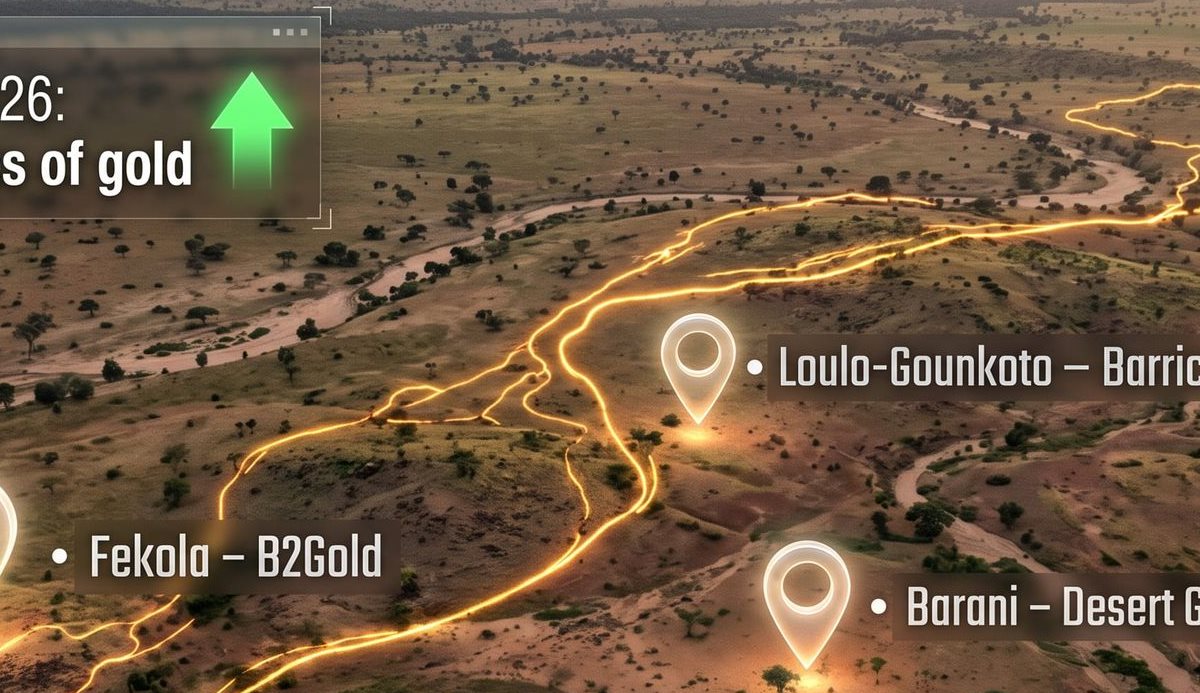
With the Fekola complex, B2Gold is cementing its undisputed leading position in Mali. The mine delivered an outstanding 8.85 t of gold in the first half of 2026 and thus dominates national production volumes. To maintain this dominance beyond the life of the main pit, management is accelerating regional growth. In August 2026, the Malian government granted the final mining permit for the Menankoto project. After more than a year of negotiations, B2Gold accepted the new state stake of 35 % and thereby avoided an open legal dispute of the kind pursued by Barrick. B2Gold will integrate high-grade ores into the existing mill. According to B2Gold, Fekola Regional is expected to contribute more than 150,000 ounces per year from 2028, extending the complex’s expected life to the end of the 2030s.
Barrick Mining: Production Under Constant Stress
Barrick Mining has endured years of stress. In the dispute over the new mining code, the group temporarily lost control of Loulo-Gounkoto in 2025. In November 2025, Barrick settled the dispute with a payment of around USD 430 million and withdrew its arbitration claim. In the first half of 2026, the complex delivered 6.9 metric tons of gold, more than the entire previous year, and remains a key pillar of Mali’s export economy. At the end of September 2026, management averted a last-minute strike by local trade unions through a new collective agreement. Barrick’s decision to keep the mine despite these pressures underscores the importance of the Senegal-Mali Shear Zone to the industry.
Desert Gold: Pilot Plant for the Vast SMSZ Property
Not far from the major producers, Desert Gold is currently making significant progress. With SMSZ, the company controls a vast land package covering 38 km of the highly productive Senegal-Mali Shear Zone. Previous drilling programmes defined a resource of approximately 1.2 million ounces of gold, including 336,800 ounces in the more reliable resource categories. A further programme comprising 4,250 m of reverse-circulation drilling has been under way since April 2026. Rather than raising around USD 20 million in equity in one go for the larger expansion phase in a challenging market environment, Desert Gold is opting for a pragmatic starter approach. A modular processing plant for 200 tons of rock per day has been delivered to the Barani mine site together with a generator. According to the September 16 announcement, commissioning is scheduled to be completed by the end of October, with ramp-up and initial processing to follow in November. Desert Gold is targeting first gold in the fourth quarter. Sea freight delays and local fuel shortages previously forced a schedule postponement. The plant extracts gold from oxidised rock through gravity separation without cyanide, providing real-world recovery data. The cash flow generated is intended to reduce equity financing risk and support the company’s transition into a gold producer.

Volatile trading as the Barani plant approaches commissioning.
Desert Gold: Bigger Plans for Even More Growth
Despite the focus on the compact Barani plant, Desert Gold’s much bigger plans for its SMSZ property remain in place. The November 2025 preliminary economic assessment (PEA) evaluates a long-term expansion to 1,200 t/d using carbon-in-leach technology, expected to produce over 11,000 ounces of gold annually. Based on a moderate assumed gold price of USD 2,850, the study calculates an after-tax net present value of USD 61 million and an internal rate of return of 57%. Desert Gold financed the first expansion phase in February 2026 with a capital increase of around CAD 7.18 million; cash flow from the plant is intended to avoid further dilution. The team is stockpiling processing residues (tailings) from the gravity plant for later processing in a potential CIL expansion. If production starts successfully, Desert Gold will likely attract the attention of industry majors.
Desert Gold: Optimistic Analysts and an Initial Assessment
Many observers and investors are now wondering whether initial gold flows can finance the bigger plans. Analysts at GBC AG set a price target of CAD 0.93 for Desert Gold and see the transition to production as a valuation catalyst. However, certain risks remain. Threats from terrorist groups and blockades of the Dakar-Bamako corridor continually jeopardise fuel supplies and logistics chains in the region. Desert Gold’s success now depends on navigating ramp-up hurdles and consistently achieving the projected throughput rates in the fourth quarter. If the plant delivers the hoped-for results, the company will show that pragmatism in Mali adds leverage to the already excellent geology. Desert Gold is in an exciting phase – experienced investors are putting the stock on their watchlist.
Conflict of interest
Pursuant to §85 of the German Securities Trading Act (WpHG), we point out that Apaton Finance GmbH as well as partners, authors or employees of Apaton Finance GmbH (hereinafter referred to as “Relevant Persons”) currently hold or hold shares or other financial instruments of the aforementioned companies and speculate on their price developments. In this respect, they intend to sell or acquire shares or other financial instruments of the companies (hereinafter each referred to as a “Transaction”). Transactions may thereby influence the respective price of the shares or other financial instruments of the Company.
In this respect, there is a concrete conflict of interest in the reporting on the companies.
In addition, Apaton Finance GmbH is active in the context of the preparation and publication of the reporting in paid contractual relationships.
For this reason, there is also a concrete conflict of interest.
The above information on existing conflicts of interest applies to all types and forms of publication used by Apaton Finance GmbH for publications on companies.
Risk notice
Apaton Finance GmbH offers editors, agencies and companies the opportunity to publish commentaries, interviews, summaries, news and the like on news.financial. These contents are exclusively for the information of the readers and do not represent any call to action or recommendations, neither explicitly nor implicitly they are to be understood as an assurance of possible price developments. The contents do not replace individual expert investment advice and do not constitute an offer to sell the discussed share(s) or other financial instruments, nor an invitation to buy or sell such.
The content is expressly not a financial analysis, but a journalistic or advertising text. Readers or users who make investment decisions or carry out transactions on the basis of the information provided here do so entirely at their own risk. No contractual relationship is established between Apaton Finance GmbH and its readers or the users of its offers, as our information only refers to the company and not to the investment decision of the reader or user.
The acquisition of financial instruments involves high risks, which can lead to the total loss of the invested capital. The information published by Apaton Finance GmbH and its authors is based on careful research. Nevertheless, no liability is assumed for financial losses or a content-related guarantee for the topicality, correctness, appropriateness and completeness of the content provided here. Please also note our Terms of use.
Stockhouse does not provide investment advice or recommendations. All investment decisions should be made based on your own research and consultation with a registered investment professional. The issuer is solely responsible for the accuracy of the information contained herein. For full disclaimer information, please click here.