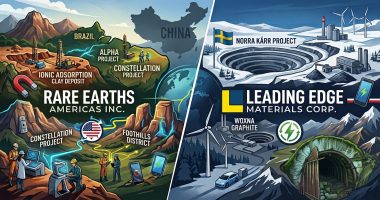
- Norra Kärr has secured a 25-year mining concession in Sweden.
- The project could become a significant European source of dysprosium, terbium and yttrium.
- Leading Edge Materials is targeting production within four years, subject to permitting, financing and development.
Europe’s push to secure its own critical mineral supplies is creating an opportunity for Leading Edge Materials Corp. (TSXV:LEM), which is advancing its wholly owned Norra Kärr heavy rare earth project in southern Sweden.
In the latest episode of The Capital Compass, Ricki Lee speaks with Leading Edge Materials CEO Kurt Budge about the project’s strategic importance, its recently granted 25-year mining concession and the milestones ahead.
According to the company’s 2021 preliminary economic assessment, Norra Kärr could produce approximately 248 tonnes of dysprosium oxide, 36 tonnes of terbium oxide and 1,800 tonnes of yttrium oxides annually over a projected 26-year mine life. Budge says the assessment covers only 30 per cent of the deposit.
This content has been prepared as part of a partnership with Leading Edge Materials and is intended for informational purposes only.
These materials are increasingly important to Europe’s industrial supply chains, particularly permanent magnets used in electric vehicles, wind turbines and defence technologies. Budge argues that China’s export restrictions have intensified the need for domestic sources.
Following the mining concession, the company plans to complete an updated pre-feasibility study and advance environmental permitting. Budge says its ambition is to bring Norra Kärr into production within four years, although further technical work, financing and approvals remain necessary.
He also highlights independent research from Edison Group that valued Norra Kärr at approximately $1.8 billion, compared with a company market capitalization he puts at around C$70 million. The valuation currency was not specified in the interview.
Watch the full interview above to hear Budge discuss Norra Kärr’s potential, Europe’s rare earth supply challenges, and the next steps towards development.
Transcript
This transcript has been lightly edited for clarity and readability.
Ricki: Europe currently produces no rare earths of its own, but one project in Sweden could potentially supply the continent with some of the hardest rare earth elements to source.
Hello, I’m Ricki Lee, and this is The Capital Compass. Today, we’re looking at Leading Edge Materials and its 100 per cent-owned Norra Kärr Heavy Rare Earth Elements project in southern Sweden.
And the word “heavy” is important here. Norra Kärr is particularly rich in dysprosium, terbium and yttrium, including materials essential to the high-performance permanent magnets used across electric vehicles, wind turbines and defence technologies.
With Europe looking to reduce its dependence on imported critical minerals, Norra Kärr could potentially become an important domestic source. And the project took a major step forward this summer with the granting of a 25-year mining lease.
Joining me now to discuss the opportunity and what comes next is Leading Edge Materials CEO Kurt Budge. Kurt, welcome to The Capital Compass.
Kurt: Hello, Ricki.
Ricki: Pleasure to have you with us, Kurt. So, for investors who may be less familiar with rare earths, what makes the heavy rare earths at Norra Kärr so important, particularly dysprosium and terbium, and why are they so difficult for Europe to source today?
Kurt: Well, fundamentally, they’re difficult for Europe to source because the Chinese, who have historically supplied Europe with both heavy rare earths and permanent magnets, introduced export restrictions in April 2025, and that really changed the game fundamentally.
Europe has no heavy rare earth mines, and after the Critical Raw Materials Act was introduced in 2024, Europe has gone on a mission of trying to find alternative sources of supply.
That’s not easy to do quickly. And I guess Norra Kärr has been one of those projects which has been known about for more than a decade in terms of reducing Europe’s overdependence on China.
And it’s not just me saying that. It’s the Swedish Geological Survey that has stated the importance of Norra Kärr on numerous occasions, discovering it, giving it national interest in 2011, and restating its support that Norra Kärr is one of the richest deposits of heavy rare earths in Europe.
Ricki: And Kurt, the scale is also interesting here, right? So your 2021 economic assessment estimated annual dysprosium oxide production of around 248 tonnes, potentially enough to cover current European demand.
Can you put the size and strategic importance of Norra Kärr into perspective and explain why you believe this deposit stands apart from other Western rare earth projects?
Kurt: Yeah, well, the PEA, as you said, was published in 2021. And we’ve got a 26-year mine life, so 248 tonnes of dysprosium oxide a year, 36 tonnes of terbium oxide and approximately 1,800 tonnes of yttrium oxides.
And that’s over a 26-year mine life. That only represents 30 per cent of the deposit, and the deposit is unconstrained by drilling.
So that’s in terms of scale. And as I touched on in the answer earlier, the Swedish Geological Survey has continued to repeat how important this deposit is both to Sweden and Europe.
And the Swedish minister, when the government awarded the exploitation concession, the 25-year mining lease, this summer, basically said that Norra Kärr on its own could supply most of Sweden and Europe’s needs.
And she has previously said that Sweden should consider rare earths as a security asset, and that’s really the nature of the game at the moment.
So it’s a significant deposit in scale. It’s quality. Its 52 per cent heavy rare earths makes it a standout deposit. And again, it’s not just me saying that, it’s both the Swedish Geological Survey and the government.
Ricki: And you sort of alluded to it earlier, but that strategic importance has arguably grown as Europe pushes to build its own critical mineral supply chains, particularly for permanent magnets used in EVs, wind power and defence, like I mentioned at the start.
How does Norra Kärr fit into that wider European push for supply security, and how significant could a domestic source of these materials become?
Kurt: Well, there’s a whole ecosystem in Europe. So what is a misnomer sometimes is that people think Europe doesn’t do rare earths. It does everything but mine them.
So Norra Kärr could be one of the first heavy rare earth mines in the region. We are one of the most significant projects.
Further downstream from us, you’ve got the separators, you’ve got metallization, and then you’ve got magnet manufacturing. So you have all the steps that follow.
What you don’t have is regional supply of the dysprosium, terbium, yttrium and some of the other important heavy rare earths as well.
So what it presents is the ability for regional production of the raw materials that Europe so desperately needs.
Ricki: And you’ve also reached a major milestone this summer when Norra Kärr was granted a 25-year mining lease.
How does that de-risk the project, and what work remains before you can move towards construction? What are the major milestones investors should be watching from now?
Kurt: Well, getting an exploitation concession, a 25-year mining lease in Sweden, should not be underestimated.
And to get to this stage, with the government making the final decision, we had to jump through several hoops.
The application was made, went through consultation, we responded to questions, and then what we had was the regional government endorsing the application and the Mining Inspectorate giving the final approval. So we’ve passed a lot of tests.
Looking forward from here, a new pre-feasibility study. You touched on the scoping study, the PEA, back in 2021, but there’s actually a PFS from 2015 on Norra Kärr for rare earths only, with a flowsheet as well.
So it’s about producing a new pre-feasibility study and environmental permitting.
The actual Norra Kärr site is a quarry. It’s not a complicated mining operation. So I’m optimistic that permitting should be fairly straightforward.
And then it’s a case of trying to rapidly move through both the technical stages, the financing and the build to get into production. And our ambition is within four years.
If we were producing now, we would be sold out.
And as I said at the beginning of this call, Norra Kärr has been part of the European conversation for over a decade in terms of reducing Europe’s overdependence on China.
The pull factor is really the downstream saying, “We need this supply.”
Ricki: And Kurt, given that 2021 PEA, this is potentially a very long-term source of supply.
If you successfully bring Norra Kärr into production, what could that ultimately mean for Leading Edge Materials and for Europe’s ability to build a rare earth supply chain of its own?
Kurt: It’s fundamentally transformational for Leading Edge.
We worked with the Edison Group earlier this year to do some independent research on the company and to put a valuation on Norra Kärr.
Edison’s valuation was $1.8 billion. Our market cap is around C$70 million at the moment. So it’s my job as CEO to close that gap.
And again, I keep restating it. Norra Kärr has been known about for more than a decade in terms of this security of supply issue.
It’s not just me saying it’s a strategically important asset, it’s the Swedish Geological Survey, and it’s our job to bring it on stream as quickly as possible.
Ricki: Well, Kurt, thank you so much for joining us and giving us a closer look at the opportunity at Norra Kärr today.
Kurt: Thanks, Ricki.
Ricki: For more information, you can visit leadingedgematerials.com or visit their LinkedIn or X page.
I’m Ricki Lee, and this has been The Capital Compass. Thank you for watching, and I’ll see you again next time.