
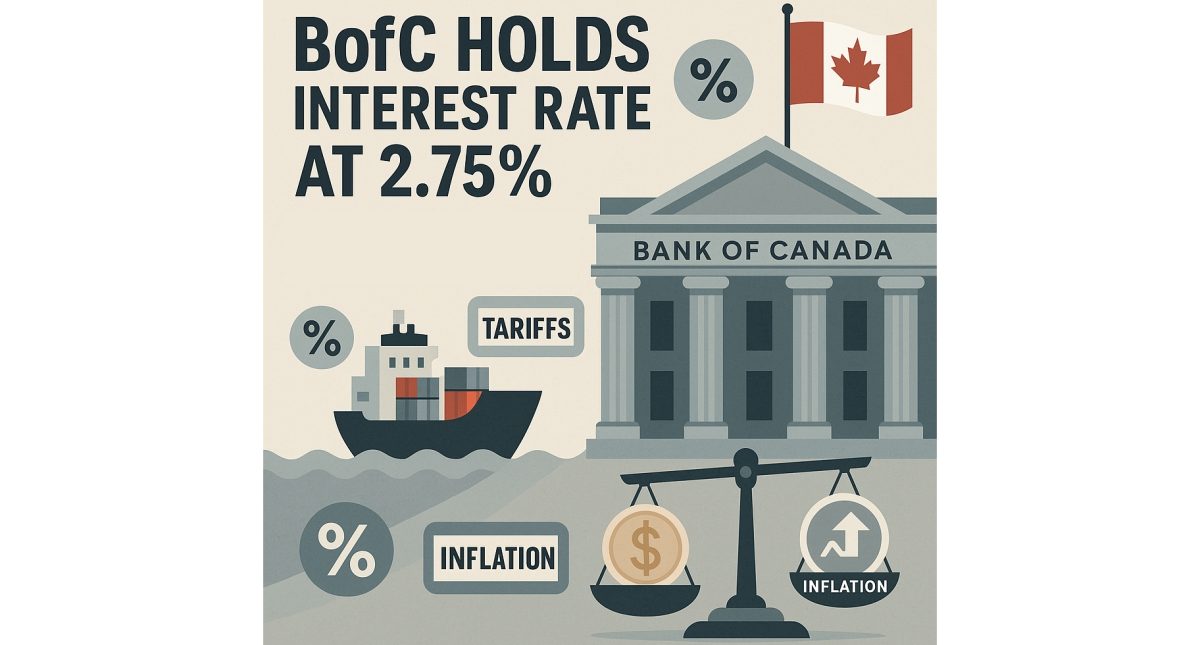

- The Bank of Canada maintained its overnight rate at 2.75 per cent, citing economic uncertainty and mixed inflation signals
- Ongoing U.S. tariff threats have led the bank to present scenario-based forecasts instead of traditional projections, reflecting high policy unpredictability
- After a Q2 contraction, Canada’s economy is expected to recover modestly, though growth remains vulnerable to trade developments and weak business confidence
- CPI inflation sits near 2 per cent, with underlying pressures from tariffs and supply chain shifts potentially pushing prices higher in the months ahead
The bank of Canada announced on Wednesday that it will maintain its target for the overnight rate at 2.75 per cent, with the bank rate at 3 per cent and the deposit rate at 2.70 per cent, citing persistent economic uncertainty and mixed signals from inflation and trade dynamics.
This article is a journalistic opinion piece which has been written based on independent research. It is intended to inform investors and should not be taken as a recommendation or financial advice.
In its July monetary policy report, the bank departed from its usual practice of presenting base case projections for GDP and inflation, opting instead for a scenario-based approach. This shift reflects the unpredictable nature of U.S. trade policy, which continues to evolve with threats of new sectoral tariffs and fluid negotiations.
Trade tensions and global outlook
The bank’s current tariff scenario—based on tariffs in place or agreed upon as of July 27—projects global growth to slow modestly to around 2.5 per cent by year-end, before rebounding to 3 per cent in 2026 and 2027. Despite volatility from U.S. tariffs, the global economy has shown resilience. U.S. growth moderated in early 2025, but the labour market remains strong. Inflation ticked up in June, with signs that tariffs are beginning to affect consumer prices.
In China, declining exports to the U.S. have been offset by gains elsewhere, while the Euro area posted modest growth. Global oil prices remain stable, equity markets have risen, and corporate credit spreads have narrowed. Canadian dollar strength against a weakening U.S. dollar adds another layer of complexity to the trade picture.
Domestic conditions: A mixed bag
Canada’s economy, while disrupted by U.S. tariffs, has shown signs of resilience. After a strong first quarter driven by pre-tariff export activity, GDP likely contracted by 1.5 per cent in Q2, largely due to a reversal in exports and weaker U.S. demand. Business and household spending are subdued amid uncertainty, and the unemployment rate rose to 6.9 per cent in June, with wage growth continuing to ease.
The bank’s current scenario sees GDP growth recovering to about 1 per cent in the second half of 2025, with slack persisting into 2026 and easing by 2027. Alternative scenarios suggest faster recovery if tariffs de-escalate, or further contraction if they escalate.
Inflation and policy outlook
CPI inflation rose to 1.9 per cent in June, with underlying inflation estimated at 2.5 per cent, driven by non-energy goods and shelter costs. The bank expects inflation to remain near 2 per cent under the current tariff scenario, though risks remain. Businesses are facing higher costs from supply chain reconfigurations, which could push prices higher.
Given the balance of risks, the Governing Council opted to hold rates steady. The bank emphasized its cautious approach, monitoring how trade disruptions affect investment, employment, and inflation expectations. A rate cut remains possible if economic weakness continues and inflation pressures ease.
The U.S. Federal Reserve also moved to hold its benchmark interest rate in the range of 4.25 per cent to 4.5 per cent as its meeting wrapped up on Wednesday.
Investor implications
For investors, this announcement underscores the importance of scenario planning and diversification. With trade policy in flux and inflation pressures evolving, sectors exposed to international trade and consumer goods may face volatility. Fixed income markets could see shifts if rate cuts materialize later this year, while equity markets may benefit from continued resilience in global growth.
The bank’s next moves will hinge on how trade tensions unfold and whether inflation remains contained. Investors should stay attuned to policy signals and global developments as Canada navigates this uncertain economic landscape.
Stockhouse does not provide investment advice or recommendations. All investment decisions should be made based on your own research and consultation with a registered investment professional. The issuer is solely responsible for the accuracy of the information contained herein. For full disclaimer information, please click here.