

It has been a rough week for Canadian markets, top to bottom. Investor sentiment is still sour since the U.S.–Iran negotiations have stalled, the ripple geopolitical effects from that, and a crowded slate of central‑bank decisions, including a policy update from the Bank of Canada.
With the U.S. Federal Reserve and several global peers opting to hold rates steady, markets are increasingly focused on how geopolitical shocks, commodity volatility, and shifting capital costs will shape corporate performance through the rest of 2026.
What the “Buzz”
Our Bullboards have up to 2 million pageviews a day. Get the inside scoop on conversations around the most significant trends and stock appreciations in our weekly wrap up.
Get “Buzz on the Bullboards” delivered to your inbox every third Thursday!
Buzz on the Bullboards | Sign Up Here
Nowhere is that uncertainty more evident than in energy markets. Renewed conflict in the Strait of Hormuz—through which roughly a fifth of the world’s oil supply flows—combined with the UAE’s decision to pull out of OPEC has added fresh strain to oil and gas prices. We also see several high‑profile Canadian and globally linked stocks making news in ways that really show how macro forces are colliding with company‑specific fundamentals.
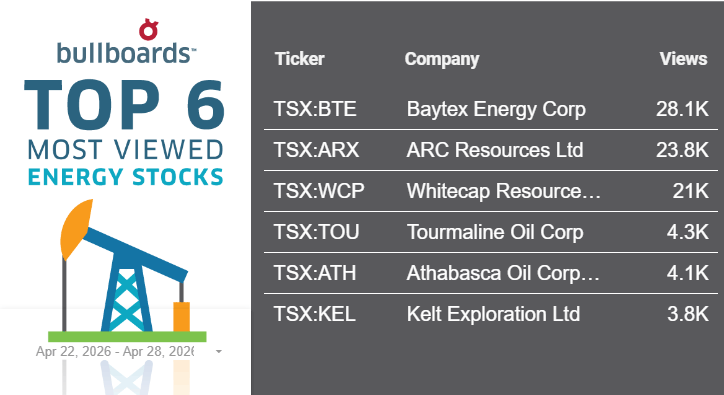
Energy producer ARC Resources Ltd. (TSX:ARX, Forum) has found itself squarely at the intersection of geopolitical risk and corporate consolidation. On April 27, 2026, ARC announced it had signed an agreement to be acquired by Shell (NYSE:SHEL, Forum), in a deal valued at approximately C$22 billion, including assumed net debt.
Under the terms of the transaction, ARC shareholders will receive C$32.80 per share, payable 75 per cent in Shell shares and 25 per cent in cash, representing a 27 per cent premium to ARC’s April 24 closing price on the TSX. The transaction, structured as a plan of arrangement under Alberta law, is expected to close in the second half of this year.
The timing is notable. Heightened risk in global energy supply chains has renewed interest in large, low‑cost, politically stable natural gas producers—making ARC’s Montney‑focused portfolio particularly attractive. That strategic appeal was reinforced by ARC’s first‑quarter 2026 financial results, which highlighted record production and robust cash generation.
ARC delivered average production of 418,522 barrels of oil equivalent per day, up 16 per cent per share year‑over‑year, with output split 61 per cent natural gas and 39 per cent liquids. Production was driven primarily by its core Kakwa, Attachie, and Greater Dawson assets. The company generated C$967 million in funds from operations and C$459 million in free funds flow, even after capital expenditures of C$508 million.
Balance sheet discipline remained a theme. ARC ended the quarter with net debt of C$2.9 billion, or just 0.9x funds from operations, while returning C$256 million to shareholders through dividends and share buybacks. For Shell, the acquisition offers scale, inventory depth, and exposure to premium Canadian gas at a time when global LNG markets remain structurally tight.
Safety‑critical AI amid market reassessment
While energy markets wrestle with geopolitics, technology investors are undergoing a different kind of recalibration. A recent report that OpenAI missed internal revenue and user growth targets sparked a sharp selloff across AI‑linked stocks, raising questions about whether the breakneck pace of AI investment can be sustained.
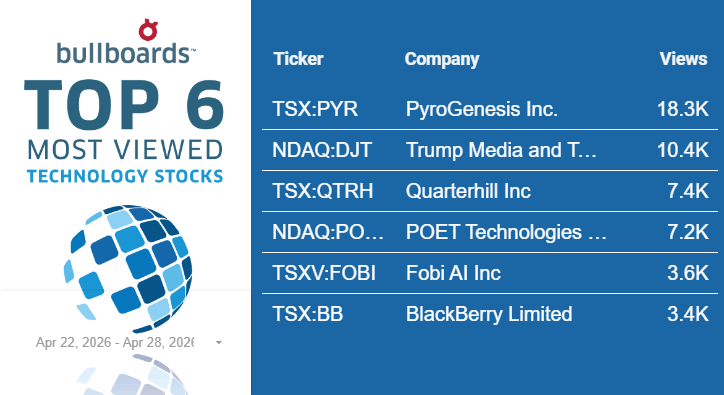
Yet beneath the market volatility, structural adoption of AI—particularly in regulated, safety‑critical environments—continues to advance. That dynamic was on display at Hannover Messe, where QNX, a division of BlackBerry Limited (TSX:BB, Forum), announced an expansion of its collaboration with NVIDIA (NASDAQ:NVDA, Forum).
The partnership centres on integrating QNX OS for Safety 8.0 with NVIDIA IGX Thor and its Halos Safety Stack, enabling developers to build and deploy next‑generation safety‑critical edge‑AI systems across robotics, medical technology, and industrial automation. This unified platform allows real‑time, deterministic control functions to coexist with NVIDIA‑accelerated AI workloads for perception, planning, and decision‑making—all within architectures designed to meet stringent regulatory and certification standards.
What does this mean for investors? This collaboration is out to build on a long‑standing relationship between QNX and NVIDIA, including recent automotive initiatives using the DRIVE AGX Thor platform. As AI narratives shift from speculative growth to real‑world deployment, BlackBerry’s positioning in mission‑critical systems offers a stark contrast to consumer‑facing AI models struggling to monetize at scale.
Interest rates, order momentum, and cash flow resilience
Interest‑rate policy remains another key variable for investors. On Wednesday, the Bank of Canada held its overnight rate at 2.25 per cent, while the U.S. Federal Reserve maintained its policy range at 3.50 to 3.75 per cent, reflecting a careful balance between easing domestic inflation and persistent global shocks.
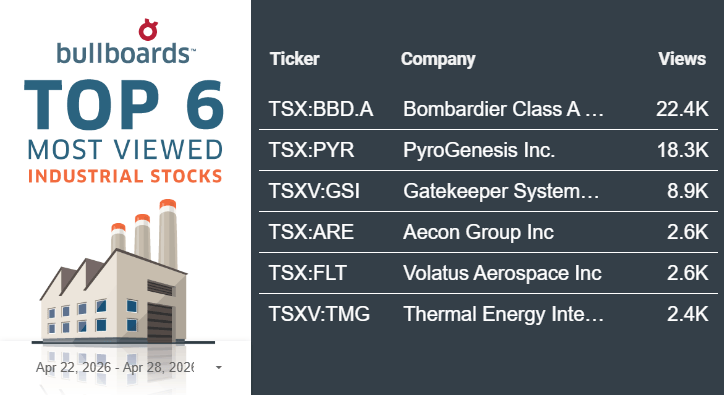
For companies like Bombardier Inc. (TSX:BBD, Forum), interest rates matter. Bombardier sells large, high‑value business jets—such as the Global 5500, 6500, and 8000—often financed through leasing or structured loans. Higher rates can delay purchases or weigh on lease economics, while lower or stabilizing rates tend to support fleet upgrades and new orders. While ultra‑high‑net‑worth and corporate demand is relatively resilient, rates still influence decisions at the margin.
Bombardier’s first‑quarter 2026 results suggest that demand remains robust. The company reported C$1.6 billion in revenue, supported by 24 aircraft deliveries and standout performance from its Services segment, where revenue rose 25 per cent year‑over‑year to C$617 million. Strong order activity—especially from fleet operators and for the Global 8000—drove an impressive book‑to‑bill ratio of 3.6x, lifting backlog to C$20.3 billion, up 43 per cent year‑over‑year.
Most notable was a sharp turnaround in cash generation. Bombardier delivered C$360 million in free cash flow, an improvement of C$664 million from the prior year, and revised its full‑year 2026 free cash flow guidance to more than C$1.0 billion. Liquidity remained solid at approximately C$2.0 billion, while the company continued to deleverage, reducing its adjusted net debt‑to‑EBITDA ratio to 1.8x. That financial discipline helped earn Bombardier a positive outlook upgrade from S&P Global Ratings in April.
Watching the signals that matter
From energy consolidation driven by geopolitical risk, to sober reassessments of AI economics, to the influence of interest‑rate policy on capital‑intensive industries, this market environment rewards investors who stay alert to both macro signals and company‑specific execution. ARC Resources, BlackBerry, and Bombardier each illustrate how headline news can translate into very different investment narratives.
As uncertainty remains a defining feature of 2026, closely tracking developments—across geopolitics, technology adoption, and monetary policy—may prove essential for investors seeking to optimize their portfolios for peak performance rather than simply riding the headlines.
Get “Buzz on the Bullboards” delivered to your inbox every other Thursday!
Buzz on the Bullboards | Sign Up HereFor previous editions of Buzz on the Bullboards, click here.
Join the discussion: Find out what everybody’s saying about these stocks on Stockhouse’s stock forums and message boards.
Stockhouse does not provide investment advice or recommendations. All investment decisions should be made based on your own research and consultation with a registered investment professional. The issuer is solely responsible for the accuracy of the information contained herein. For full disclaimer information, please click here.