
SFC Energy: A beneficiary for some time now
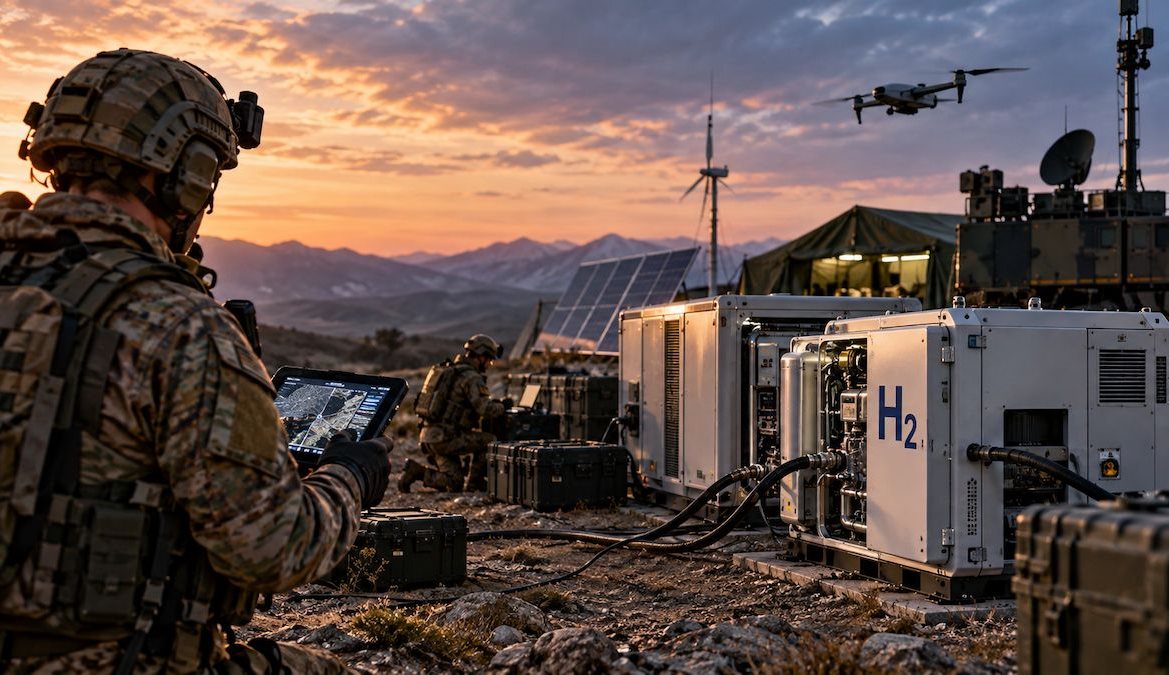
SFC Energy has long been known as a beneficiary of fuel cell technology in the defence industry. In May 2026, the German specialist in decentralised energy supply reported the largest single order in its corporate history, worth EUR 42.7 million. As part of a German government initiative, SFC is supplying Ukraine with mobile fuel cell-battery systems. They supply power to communications and reconnaissance equipment, among other things, and can also be used to charge drone batteries. One advantage over conventional generators is their almost silent operation. The deployed systems use methanol fuel cells. SFC also has hydrogen technologies and is developing more powerful solutions for military applications.
On Tuesday, SFC Energy announced the next step in expanding its defence business. A strategic partnership has been agreed with EDGE, the state-owned technology and defence group from the United Arab Emirates. Together, the companies aim to develop and market modern power supply systems for military applications and the protection of critical infrastructure. Existing SFC fuel cells and hybrid energy systems are to be adapted to supply power to high-energy lasers and other modern defence systems, among other applications. The first demonstration systems are already under development. In addition, the partners are examining local manufacturing and exports to other countries in the region. This could open up an additional growth market in the Middle East for SFC. However, specific order volumes have not yet been disclosed.
HPQ Silicon: Newcomer with share price potential
Positive news for HPQ Silicon and its strategic partner Novacium. The French technology company, along with Axel’One and AD-VENTA, has received government funding of just under EUR 1 million to further develop its METAGENE™ hydrogen technology. The funds come from the demanding RAPID programme run by the French Defence Innovation Agency (AID) and the Directorate General of Armaments (DGA). The project has a total budget of EUR 1.2 million and is supported at the maximum possible funding rate of 80%. It runs for 30 months and began on September 1, 2026. The aim is to advance the technology from the laboratory stage towards a demonstrator suitable for practical use. For Novacium, the funding provides important financial support and recognition of the technology’s potential from French government authorities.
The focus is on a patented process that produces hydrogen directly at the point of use, without an external power supply. For this, Novacium uses a solid fuel based on aluminium and silicon that releases hydrogen on contact with water and an activator. According to the company, the reaction produces no greenhouse gases. In addition, the metallic fuel is non-hazardous in solid form and relatively easy to transport and store. An autonomous high-pressure hydrogen station capable of supplying up to 20 kg of hydrogen per day is to be developed together with AD-VENTA. Novacium is thus targeting applications where a reliable power supply or hydrogen infrastructure is lacking in particular. These include drones, remote industrial sites and military facilities. An economic advantage could arise from eliminating the need for complex hydrogen delivery and storage.
HPQ Silicon benefits in several ways. The Canadian company holds a 36.8% stake in Novacium, and the value of this holding is likely to continue to rise. HPQ also holds the exclusive marketing rights for the jointly developed technologies in North America. HPQ could commercialise the METAGENE™ technology in North America in the future. Its potential use in the defence sector is particularly interesting, as the French RAPID programme specifically supports technologies with military and civilian applications. At the same time, Novacium remains an important development partner for HPQ in the field of silicon-based anode materials and high-performance lithium-ion batteries.
Rheinmetall turns to Nel ASA for hydrogen
Rheinmetall is also turning to hydrogen. In mid-October 2026, the company announced a collaboration with Norwegian hydrogen specialist Nel ASA. Together, the partners aim to develop decentralised plants for the production of synthetic fuels for military applications and critical infrastructure. The focus is on Rheinmetall’s Giga-PtX concept, which enables the production of climate-friendly fuels from water, CO₂ and renewable electricity. Nel is to contribute its electrolysis technology for the production of green hydrogen. The planned plants could produce between 5,000 and 7,000 tonnes of synthetic fuels annually. These can be used in existing vehicles and machinery. For the armed forces, this would be a significant advantage, as it could reduce dependence on centralised refineries and disruption-prone supply chains.
Initially, Rheinmetall and Nel intend to examine potential projects in Norway. The country has large quantities of renewable energy, but is partly dependent on foreign supplies of refined fuels. The two companies are now examining suitable locations, the technical requirements and the economic viability of decentralised production. Initial pilot plants are also conceivable. However, the agreement reached so far is still non-binding. For Nel, the cooperation could open up an additional sales market for its electrolysers. Rheinmetall, in turn, aims to position itself with Giga-PtX as a provider of a secure energy supply for armed forces.
Conclusion
The defence industry could develop into a surprising growth driver for hydrogen technologies. SFC Energy is already benefiting from firm orders and continues to expand its market position. For HPQ Silicon, government funding for Novacium opens up additional prospects. If the technology is successfully commercialised, this could give the share price fresh momentum, especially as HPQ is also involved in drones and batteries. Nel ASA too could tap into a new sales market through its cooperation with Rheinmetall. However, this will still take a long time and is unlikely to solve the Norwegian company’s current problems. For Rheinmetall, this is not a growth driver today, but a building block for the future.
Conflict of interest
This article is an advertisement and has been produced and published by Apaton Finance GmbH („Apaton“) on behalf of HPQ Silicon Inc. („Issuer“) For this service, Apaton receives compensation from the Issuer in the amount of EUR 821,43.
Pursuant to §85 of the German Securities Trading Act (WpHG), we point out that Apaton Finance GmbH as well as partners, authors or employees of Apaton Finance GmbH (hereinafter referred to as “Relevant Persons”) may hold shares or other financial instruments of the aforementioned companies in the future or may bet on rising or falling prices and thus a conflict of interest may arise in the future. The Relevant Persons reserve the right to buy or sell shares or other financial instruments of the Company at any time (hereinafter each a “Transaction”). Transactions may, under certain circumstances, influence the respective price of the shares or other financial instruments of the Company.
In addition, Apaton Finance GmbH is active in the context of the preparation and publication of the reporting in paid contractual relationships.
For this reason, there is a concrete conflict of interest.
The above information on existing conflicts of interest applies to all types and forms of publication used by Apaton Finance GmbH for publications on companies.
Risk notice
Apaton Finance GmbH offers editors, agencies and companies the opportunity to publish commentaries, interviews, summaries, news and the like on news.financial. These contents are exclusively for the information of the readers and do not represent any call to action or recommendations, neither explicitly nor implicitly they are to be understood as an assurance of possible price developments. The contents do not replace individual expert investment advice and do not constitute an offer to sell the discussed share(s) or other financial instruments, nor an invitation to buy or sell such.
The content is expressly not a financial analysis, but a journalistic or advertising text. Readers or users who make investment decisions or carry out transactions on the basis of the information provided here do so entirely at their own risk. No contractual relationship is established between Apaton Finance GmbH and its readers or the users of its offers, as our information only refers to the company and not to the investment decision of the reader or user.
The acquisition of financial instruments involves high risks, which can lead to the total loss of the invested capital. The information published by Apaton Finance GmbH and its authors is based on careful research. Nevertheless, no liability is assumed for financial losses or a content-related guarantee for the topicality, correctness, appropriateness and completeness of the content provided here. Please also note our Terms of use.
Stockhouse does not provide investment advice or recommendations. All investment decisions should be made based on your own research and consultation with a registered investment professional. The issuer is solely responsible for the accuracy of the information contained herein. For full disclaimer information, please click here.