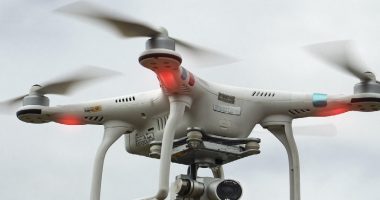


When drones become infrastructure, the scaling cycle begins
The drone market is at a turning point. What was once considered a technological gimmick is clearly evolving into critical infrastructure by 2026, comparable to satellite communications or cyber defense. Governments are no longer investing in autonomous systems on an ad hoc basis, but systematically—and it is precisely in this transitional space that Volatus Aerospace is positioning itself as an integrated provider of technology, operations, and training. The strategic logic is clear: whoever can not only build drones but also operate and maintain them becomes an indispensable part of a nation’s security architecture. And this is exactly where the real growth story begins.
April 2026: NATO Contract as a Ticket into the Security Architecture
The training contract with a NATO ally announced in April 2026 marks a strategically important milestone for Volatus Aerospace. While the initial volume of approximately CAD 2.1 million may seem modest, in the defense economy, access to long-term programs matters more than the initial contract. Training is the classic door-opener in this market because it creates a lasting operational relationship between the provider and the government client. Once personnel are trained on a specific technology, follow-on contracts for maintenance, software, and system integration arise almost automatically. For Volatus, this contract therefore represents less revenue and more institutional trust—and that is precisely the most important currency in the security sector.
Canada Follows Suit: National Defense Strategy Becomes a Growth Engine
Politicians must follow suit, and time is running out! The new Canadian defense strategy creates a structural demand stimulus for domestic suppliers, from which Volatus can benefit directly. Around 70% of procurement contracts are to be awarded to domestic companies in the future to build technological sovereignty and secure supply chains. This policy guideline acts as a government-mandated anchor for demand while simultaneously reducing competitive pressure from abroad. For Volatus, this means a more stable order base and better predictability for investments in production and infrastructure. At the same time, national prioritization strengthens the company’s international negotiating position in collaborations with NATO partners. From a strategic perspective, this creates a classic home-market advantage, which often tips the scales in the defense industry.
Dual-Use Model: The Bridge Between Civilian Logistics and Military Demand
A key competitive advantage of Volatus lies in its so-called dual-use approach – the use of the same technology for both civilian and military applications. This structure allows the company to operate systems economically even in peacetime and to scale up quickly as security demand rises. While pure defense contractors are often dependent on political budget cycles, Volatus simultaneously generates revenue from infrastructure projects, logistics, and data services. This diversification stabilizes cash flows and increases operational flexibility. In a market increasingly focused on operational readiness and availability, it is precisely this combination of technology and operations that becomes the decisive differentiator.
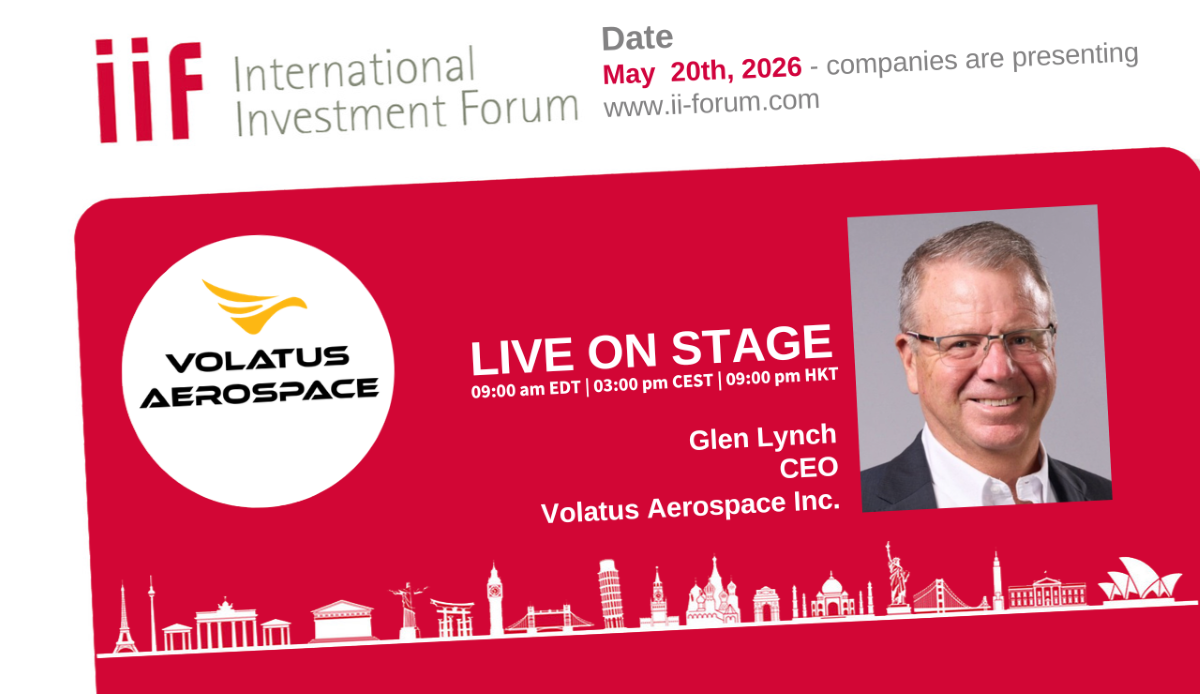
CEO Glen Lynch will explain the medium-term strategy at the 19th International Investment Forum (IIF). Click here to register.
Global Drone Supercycle: Billion-Dollar Budgets Drive a Structural Boom in Demand
The international security landscape is currently accelerating a massive investment cycle in autonomous systems. The United States alone plans to spend approximately USD 63 billion on unmanned technologies in 2027, a sharp increase over the previous year. In the logic of the defense industry, such a budget increase signals not short-term demand, but a long-term strategic priority. For providers of integrated drone solutions, this creates a market that is likely to grow over the coming years. Volatus is positioned precisely at the point where infrastructure and track records are in place, while demand is just beginning to scale. This is the classic starting point for disproportionate growth.
System business instead of hardware sales: Why recurring revenue drives value
The drone market is increasingly evolving from a product business to a platform business. Customers no longer buy just an aircraft, but a complete mission system including software, maintenance, data analysis, and training. It is precisely this structure that generates recurring revenue throughout the entire lifecycle of a system. For Volatus, this results in a scalable business model with rising margins once a critical customer base has been established. At the same time, integrated platforms significantly raise the barriers to entry for new competitors. In practice, this means that once a customer is in the system, they usually remain part of the supply chain for years to come. The moat actually widens over time as established relationships lead to success.
Conclusion: Volatus is at the forefront of a security infrastructure boom
The trends are clear! In 2026, the drone market will visibly evolve from a technology sector into a security-relevant infrastructure industry. Volatus Aerospace positioned itself early on across the entire value chain, from production and operations to training. Fueled by government demand programs and triggered by geopolitical tensions, such phases typically generate the greatest scaling effects for specialized providers. This presents a clear strategic perspective, especially for dynamic investors. It is not current revenue that matters, but the position in the emerging system market.
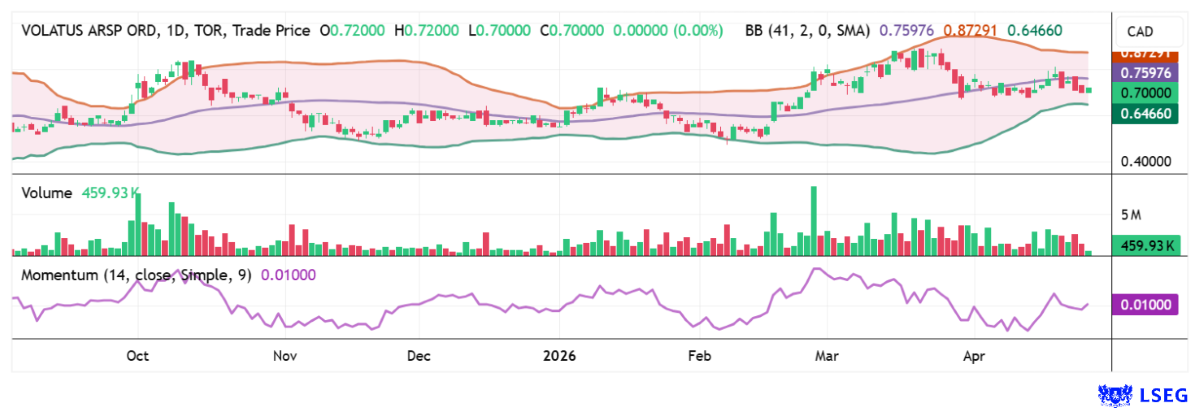
From a strategic perspective, Volatus Aerospace appears to be at a pivotal inflection point: the operational foundation is in place, initial government contracts provide validation, and demand is only beginning to accelerate. It is precisely in such phases that market leaders are often established. Because capital is not allocated cautiously but decisively, those investing in drone technology now are not betting on fleeting hype but on the next level of industrial value creation. The stock was most recently trading at EUR 0.44 (CAD 0.72), while analyst price targets range from CAD 0.90 to CAD 1.25. Those who position early participate directly in the next phase of growth.
Conflict of interest
Pursuant to §85 of the German Securities Trading Act (WpHG), we point out that Apaton Finance GmbH as well as partners, authors or employees of Apaton Finance GmbH (hereinafter referred to as “Relevant Persons”) currently hold or hold shares or other financial instruments of the aforementioned companies and speculate on their price developments. In this respect, they intend to sell or acquire shares or other financial instruments of the companies (hereinafter each referred to as a “Transaction”). Transactions may thereby influence the respective price of the shares or other financial instruments of the Company.
In this respect, there is a concrete conflict of interest in the reporting on the companies.
In addition, Apaton Finance GmbH is active in the context of the preparation and publication of the reporting in paid contractual relationships.
For this reason, there is also a concrete conflict of interest.
The above information on existing conflicts of interest applies to all types and forms of publication used by Apaton Finance GmbH for publications on companies.
Risk notice
Apaton Finance GmbH offers editors, agencies and companies the opportunity to publish commentaries, interviews, summaries, news and the like on news.financial. These contents are exclusively for the information of the readers and do not represent any call to action or recommendations, neither explicitly nor implicitly they are to be understood as an assurance of possible price developments. The contents do not replace individual expert investment advice and do not constitute an offer to sell the discussed share(s) or other financial instruments, nor an invitation to buy or sell such.
The content is expressly not a financial analysis, but a journalistic or advertising text. Readers or users who make investment decisions or carry out transactions on the basis of the information provided here do so entirely at their own risk. No contractual relationship is established between Apaton Finance GmbH and its readers or the users of its offers, as our information only refers to the company and not to the investment decision of the reader or user.
The acquisition of financial instruments involves high risks, which can lead to the total loss of the invested capital. The information published by Apaton Finance GmbH and its authors is based on careful research. Nevertheless, no liability is assumed for financial losses or a content-related guarantee for the topicality, correctness, appropriateness and completeness of the content provided here. Please also note our Terms of use.
Stockhouse does not provide investment advice or recommendations. All investment decisions should be made based on your own research and consultation with a registered investment professional. The issuer is solely responsible for the accuracy of the information contained herein. For full disclaimer information, please click here.