

MustGrow: Using Biology to Profit from Global Agricultural Change
Some trends are inevitable and cannot be stopped. One in particular affects global agriculture. According to UN projections, the world’s population is expected to grow to nearly 10 billion people by 2050. At the same time, farmers and food producers are under pressure from rising production costs, scarce resources, and increasingly extreme weather. Long since emerging from the organic niche, well-positioned agtech companies are now becoming rising stars when they can skillfully combine productivity and sustainability. Among the innovative leaders of this trend is the Canadian company MustGrow Biologics, which develops and markets biological solutions for regenerative agriculture.
At the heart of its business model are natural substances derived from mustard extracts, which are designed to improve soil fertility, strengthen plants, and reduce the use of conventional fertilizers and chemicals. The flagship biofertility product, TerraSante™, supports the activity of soil microorganisms, promotes root growth, and increases resilience to abiotic stress and nutrient deficiencies. The portfolio is complemented by the pre-registered mustard-derived biocontrol product TerraMG™, a biological solution for controlling soil-borne diseases and pests. MustGrow is part of a rapidly growing segment of biological agricultural products, whose global market volume could reach well over USD 35 billion by the early 2030s, according to industry estimates. Aware of the challenges associated with climate change, investors are currently turning to such alternative solutions to diversify beyond trending topics like high-tech and AI and to smooth out portfolio returns over the long term.
With approximately 108 granted and pending patents, MustGrow holds a substantial intellectual property portfolio that safeguards its technological lead and enables attractive licensing models. The collaboration with Bayer could become an international highlight, as the Leverkusen-based company holds exclusive development and marketing rights for Europe, the Middle East, and Africa. Milestone payments and revenue-based licensing fees are within reach here. MustGrow has intensified its independent sales efforts in the US, where TerraSante™ is now approved in 10 states and is expanding into key agricultural regions, including California, Texas, Utah, and Montana. Texas alone provides access to multi-billion-dollar crop markets for potatoes, citrus fruits, melons, and pecans, thereby significantly expanding the company’s commercial potential.
IIF moderator Lyndsay Malchuk speaks with COO Colin Bletsky about the future of biofertilizers and their advantages over conventional methods.
The first operational progress is now also reflected in the financial results. Following a successful market launch, TerraSante™ generated revenue for the first time, while the gross margin improved from 19.5% to 23.6% and operating expenses were significantly reduced. Although ongoing investments in research, production, and market launch continued to weigh on earnings, the net loss decreased year-over-year to approximately CAD 1.3 million, underscoring the company’s growing operational discipline. The recently completed LIFE financing round of CAD 3.74 million, which significantly exceeded the originally targeted offering volume, provides crucial support for the rollout. With these new funds, capacities can be expanded, and ongoing commercialization accelerated as production processes are increasingly converted to more efficient continuous production lines.
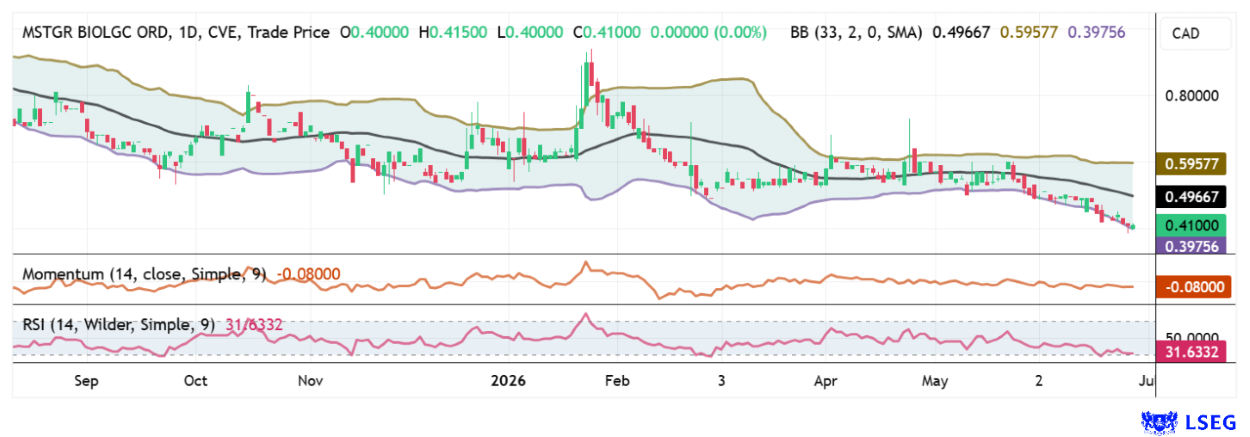
Measured against a market capitalization of just under CAD 30 million, MustGrow continues to appear undervalued relative to its technology portfolio and established international partnerships. After years of product development, management is now focused on scaling the business to capitalize on the megatrend toward sustainable agriculture. Even the next commercial milestones could provide a meaningful catalyst for the share price—investors looking to anticipate that potential may prefer to establish a position beforehand!
Kraft Heinz: The Titan of the Ketchup Industry
As the world’s largest purchaser of processing tomatoes, The Kraft Heinz Company—or simply Kraft Heinz—has set itself the central goal of sourcing 100% of its ketchup tomatoes from sustainable farms. The implementation of this strategy is based on the company’s own handbook for sustainable agricultural practices, which establishes binding criteria for selected contract farmers. The focus is primarily on improving soil health, efficient water management, and integrated pest management to reduce chemical use. Through this sustainable cultivation of the fields, the soil is also expected to store more carbon, which directly contributes to the company’s overarching goal of achieving net-zero greenhouse gas emissions by 2050.
Kraft Heinz owes its enormous success in the global food business primarily to an unbeatable portfolio of deeply rooted iconic brands and massive economies of scale. The 2015 merger of the long-established companies Kraft and Heinz created an industry giant that enjoys immense competitive advantages thanks to its global distribution channels and extreme production efficiency. A fundamental pillar of this successful empire is the sauces and condiments segment, which generates nearly half of the company’s USD 25 billion in revenue. Within this category, the world-famous Heinz Tomato Ketchup holds the top spot as the undisputed global market leader. Thanks to decades of customer loyalty and an almost ubiquitous presence in households and the foodservice industry, this red flagship product ensures the company stable and crisis-proof earnings. Extensive restructuring led to an operating loss in 2025; nevertheless, the bottom line remained a free cash flow of USD 3.7 billion. The stock, which offers a very high dividend yield of 6.6%, hit a three-year low of EUR 18.20 in March 2026. However, with CEO Steve Cahillane’s promises of a turnaround, things may now start looking up again.
Bayer: US Supreme Court Gives a Boost
Freed from the years-long burden of pending glyphosate lawsuits, Bayer shares continue to soar at the start of the week, trading at just under EUR 47. The latest ruling from Washington could mark a real turning point for Bayer. After years of legal uncertainty, a ruling by the US Supreme Court has now given the Leverkusen-based company some breathing room in the complex web of glyphosate lawsuits. By a clear majority of 7 to 2, the justices ruled that federal law takes precedence over state regulations. This means Bayer can no longer be sued for differing labelling requirements across individual US states. Crucial to this is the assessment by the US Environmental Protection Agency (EPA), which continues to not classify glyphosate as carcinogenic and does not require corresponding warning labels. Bayer is regaining strategic leeway, particularly regarding the planned realignment of its agricultural business and increased investments in digital agriculture and AI-driven yield optimization. CEO Bill Anderson expressed his relief and emphasized, “This ruling brings us a decisive step closer to legal clarity in the US. It allows us to refocus more strongly on innovation, our pipeline, and supporting farmers worldwide.” Analysts on the LSEG Refinitiv platform have calculated a consensus target price of approximately EUR 50; HSBC and mwb research are significantly more bullish at EUR 60 and EUR 65, respectively. Exciting!
The stock markets remain on high alert. After initial signs of recovery became visible last week, the new week begins with renewed hostilities in the Gulf region. So the old game continues: high oil prices, stock prices under pressure. Things are set to get volatile in sectors such as high-tech, AI, and defence. With strong earnings models, MustGrow and Kraft Heinz are poised to perform well, while Bayer can finally breathe a sigh of relief!
Conflict of interest
Pursuant to §85 of the German Securities Trading Act (WpHG), we point out that Apaton Finance GmbH as well as partners, authors or employees of Apaton Finance GmbH (hereinafter referred to as “Relevant Persons”) currently hold or hold shares or other financial instruments of the aforementioned companies and speculate on their price developments. In this respect, they intend to sell or acquire shares or other financial instruments of the companies (hereinafter each referred to as a “Transaction”). Transactions may thereby influence the respective price of the shares or other financial instruments of the Company.
In this respect, there is a concrete conflict of interest in the reporting on the companies.
In addition, Apaton Finance GmbH is active in the context of the preparation and publication of the reporting in paid contractual relationships.
For this reason, there is also a concrete conflict of interest.
The above information on existing conflicts of interest applies to all types and forms of publication used by Apaton Finance GmbH for publications on companies.
Risk notice
Apaton Finance GmbH offers editors, agencies and companies the opportunity to publish commentaries, interviews, summaries, news and the like on news.financial. These contents are exclusively for the information of the readers and do not represent any call to action or recommendations, neither explicitly nor implicitly they are to be understood as an assurance of possible price developments. The contents do not replace individual expert investment advice and do not constitute an offer to sell the discussed share(s) or other financial instruments, nor an invitation to buy or sell such.
The content is expressly not a financial analysis, but a journalistic or advertising text. Readers or users who make investment decisions or carry out transactions on the basis of the information provided here do so entirely at their own risk. No contractual relationship is established between Apaton Finance GmbH and its readers or the users of its offers, as our information only refers to the company and not to the investment decision of the reader or user.
The acquisition of financial instruments involves high risks, which can lead to the total loss of the invested capital. The information published by Apaton Finance GmbH and its authors is based on careful research. Nevertheless, no liability is assumed for financial losses or a content-related guarantee for the topicality, correctness, appropriateness and completeness of the content provided here. Please also note our Terms of use.
Stockhouse does not provide investment advice or recommendations. All investment decisions should be made based on your own research and consultation with a registered investment professional. The issuer is solely responsible for the accuracy of the information contained herein. For full disclaimer information, please click here.