


Siemens Energy and Nordex on a Record-Breaking Course
It was not that long ago that dark clouds hung over the German energy sector. But anyone looking at the stock ticker today sees a completely different picture. Siemens Energy, for example, has undergone a 180-degree turnaround that many had deemed impossible. After the deep valley of tears at its wind subsidiary Gamesa, the group now presents an impressive balance sheet. In April 2026, the stock hit a new all-time high of EUR 195.60. Even though there was a brief pause in XETRA trading recently and the price fell to just under EUR 170, the fundamental, overarching picture remains bullish. The “Grid Technologies” segment, in particular, is proving to be a gold mine. The world needs new grids, and Siemens Energy is delivering the technology. Concerns about US tariffs appear manageable, as the company is deeply rooted locally with 28 locations in the US. All eyes are now eagerly awaiting May 12, when the second-quarter figures are expected to confirm this trend.
Meanwhile, Nordex is enjoying a wonderful spring. The wind turbine manufacturer from Rostock has not only achieved a turnaround but appears to be solidifying it step by step. The start of 2026 was nothing short of a sensation. The stock not only jumped above the EUR 30 mark but also surpassed EUR 40 as the year progressed. It is currently hovering around EUR 50. The numbers speak for themselves. Revenue climbed by 10% to EUR 1.6 billion. Far more important, however, is the EBITDA margin, which has soared from 5.5% to an impressive 8.2%. Nordex is making money again with its turbines. With an order backlog of around EUR 17 billion, management can look to the future with confidence. The company is benefiting from the fact that quality and reliability are once again valued more highly in the wind industry than price alone. The scaling of the Delta4000 platform is finally paying off for shareholders. Long-term supply contracts, which generate scalable revenue, have also contributed to this success. Investors particularly like this, as these contracts are more predictable than the pure wind turbine business.
It is precisely this combination of technological market leadership and operational discipline that currently makes Siemens Energy and Nordex so attractive. Both companies have proven that they can not only survive but also grow in a difficult global environment. The energy transition has evolved from a political project into a profitable business model. But while Nordex wind turbines spin and Siemens Energy grids are “under load,” a completely different energy source is once again coming into the global spotlight—one that is intended to form the basis for a CO₂-free baseload.
Standard Uranium: Fresh Momentum from the Athabasca Basin
The transition from industrial manufacturing in Germany to raw material exploration in Canada may seem like a leap at first glance, but it follows the same logic: without the right resources, there is no energy supply. And this is where Standard Uranium comes into play. The company operates in the heart of the Athabasca Basin in Saskatchewan. This region is already known for having the world’s highest uranium grades. The news from recent days is encouraging and indicates positive operational momentum.
Particularly noteworthy is the March 20, 2026 announcement. Standard Uranium has successfully completed the first drilling program at the Corvo project. Anomalous radioactivity was detected in 7 of 10 drill holes, with values exceeding 300 counts per second (cps). A total of 23 m of cumulative radioactivity was documented across various sections. This is quite a respectable result for an initial program. The drillings encountered favorable geological structures, such as shear zones and hydrothermal alteration, which are typical of large uranium deposits in this region. The samples are now in the lab. Initial results from the chemical analyses could be the next major catalyst for the stock price.
This success is accompanied by a strategically focused corporate policy. On March 19, 2026, the company announced the signing of an exploration agreement with Kineepik Metis Local Inc. (KML). In Canada, the “social license to operate”—that is, the approval of local communities—is the key to success. Through this agreement, Standard Uranium not only secures support for the Rocas project but also establishes a foundation for sustainable exploration. Just two days earlier, on March 17, the start of drilling on this very Rocas project had already been announced in a news release. The overall volume of news is high. In addition, on March 10, one week earlier, the company confirmed not only uranium deposits but also high-grade rare-earth mineralization. This makes the portfolio even more valuable, as these metals are indispensable for the modern high-tech industry.
Is the stock about to take off?
After an agonizingly long period during which Standard Uranium’s share price moved mostly sideways, signs of a trend reversal may now be gathering momentum. The stock appears to be simmering beneath the surface due to the prolonged sideways phase. It is a matter of waiting for a potential breakout. From a technical analysis perspective, the CAD 0.14 price level is where things get exciting. While this level is still some way off, it marks a horizontal resistance that, once broken, opens the door to the upside.

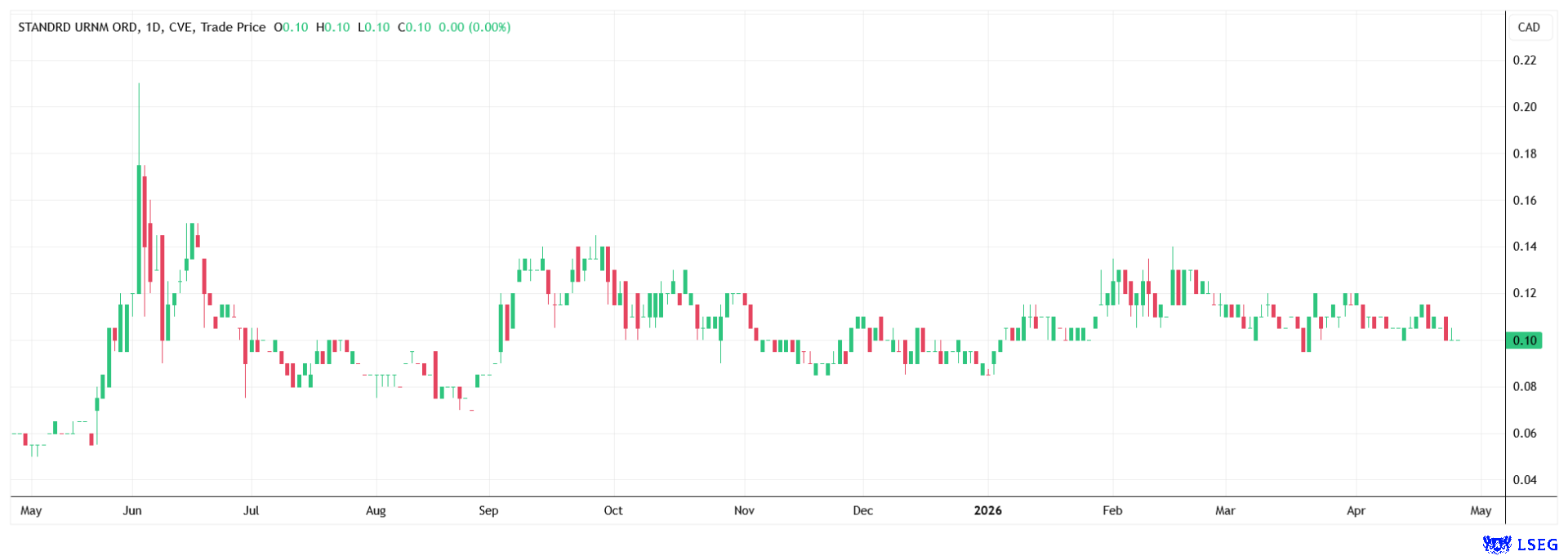
If this resistance falls, things could move very quickly. In this scenario, chartists see room for the price to reach the CAD 0.20 range. That would represent a doubling from current levels. The past has already shown that such jumps are not out of the question for Standard Uranium. As early as 2025, there was a phase in which the price multiplied rapidly before transitioning into a healthy consolidation lasting several months. The latest positive news from the Corvo and Rocas drill sites could provide exactly the momentum needed for this breakout. Investors are just waiting for the starting signal. The environment for uranium is more positive than it has been in over a decade, and Standard Uranium is well-positioned to benefit from this through its projects.

When looking at the big picture, several fascinating investment stories emerge. Siemens Energy and Nordex are the stable pillars of the energy transition that has been underway, now reaping the rewards after years of tough restructuring. They offer substance and growth in a booming market. Standard Uranium, on the other hand, is smaller and more speculative. It is a bet on the future importance of uranium.
Standard Uranium is proving to be a well-managed exploration company that executes with discipline. Drilling progress appears encouraging, and strategic local partnerships are in place. After an extended period of sideways consolidation, the stock resembles a coiled spring. If lab assays validate the initial radiometric readings and the resistance level at CAD 0.14 is breached, upside momentum could accelerate quickly. It remains a game of opportunities and risks. Investors looking to add energy stocks to their portfolio should take a closer look at this trio.

Conflict of interest
Pursuant to §85 of the German Securities Trading Act (WpHG), we point out that Apaton Finance GmbH as well as partners, authors or employees of Apaton Finance GmbH (hereinafter referred to as “Relevant Persons”) currently hold or hold shares or other financial instruments of the aforementioned companies and speculate on their price developments. In this respect, they intend to sell or acquire shares or other financial instruments of the companies (hereinafter each referred to as a “Transaction”). Transactions may thereby influence the respective price of the shares or other financial instruments of the Company.
In this respect, there is a concrete conflict of interest in the reporting on the companies.
In addition, Apaton Finance GmbH is active in the context of the preparation and publication of the reporting in paid contractual relationships.
For this reason, there is also a concrete conflict of interest.
The above information on existing conflicts of interest applies to all types and forms of publication used by Apaton Finance GmbH for publications on companies.
Risk notice
Apaton Finance GmbH offers editors, agencies and companies the opportunity to publish commentaries, interviews, summaries, news and the like on news.financial. These contents are exclusively for the information of the readers and do not represent any call to action or recommendations, neither explicitly nor implicitly they are to be understood as an assurance of possible price developments. The contents do not replace individual expert investment advice and do not constitute an offer to sell the discussed share(s) or other financial instruments, nor an invitation to buy or sell such.
The content is expressly not a financial analysis, but a journalistic or advertising text. Readers or users who make investment decisions or carry out transactions on the basis of the information provided here do so entirely at their own risk. No contractual relationship is established between Apaton Finance GmbH and its readers or the users of its offers, as our information only refers to the company and not to the investment decision of the reader or user.
The acquisition of financial instruments involves high risks, which can lead to the total loss of the invested capital. The information published by Apaton Finance GmbH and its authors is based on careful research. Nevertheless, no liability is assumed for financial losses or a content-related guarantee for the topicality, correctness, appropriateness and completeness of the content provided here. Please also note our Terms of use.
Stockhouse does not provide investment advice or recommendations. All investment decisions should be made based on your own research and consultation with a registered investment professional. The issuer is solely responsible for the accuracy of the information contained herein. For full disclaimer information, please click here.