

- InZinc Mining (TSXV:IZN) reported its strongest drill result to date at Indy, highlighted by 15.0 metres grading 7.0 per cent zinc, 3.2 per cent lead and 17.5 g/t silver in the new Apex discovery area
- Multiple shallow zinc-silver zones were intersected within 100 metres of surface, strengthening the potential for an open-pit resource along the 1,000-metre-long B-9 Trend
- The mineralized system remains open for expansion, with high-grade silver values and additional exploration targets suggesting significant growth potential
- InZinc Mining stock (TSXV:IZN) opened trading at $0.08
InZinc Mining (TSX:IZN) has announced what it calls its strongest mineralized drill intersection to date at its 100 per cent-owned Indy Sedex Project in central British Columbia, with new drilling uncovering multiple shallow zinc, lead and silver-rich zones that could significantly enhance the project’s open-pit development potential.
Results from the company’s spring 2026 diamond drilling campaign at the B-9 Apex Zone have revealed a series of stacked mineralized horizons located within 100 metres of surface, extending the growing footprint of the B-9 mineralized trend. The discoveries build on the 2025 Apex discovery and strengthen the case for a large, near-surface conventional sulphide resource.
This article is a journalistic opinion piece that has been written based on independent research. It is intended to inform investors and should not be taken as a recommendation or financial advice.
“Today’s drill results highlight not only our exploration success but two additional advantages on the horizon at Indy – ongoing discovery potential and an opportunity for potential open pit resources to lead the way,” InZinc’s CEO, Wayne Hubert said in a news release. “Additionally, Indy is a recent Sedex-style discovery in BC with 30 km of unexplored strata and roads connecting to the extensive logistics available in central and southern BC. These are distinct advantages, both for cost-effective exploration and for potential production of bulk metal concentrates.”
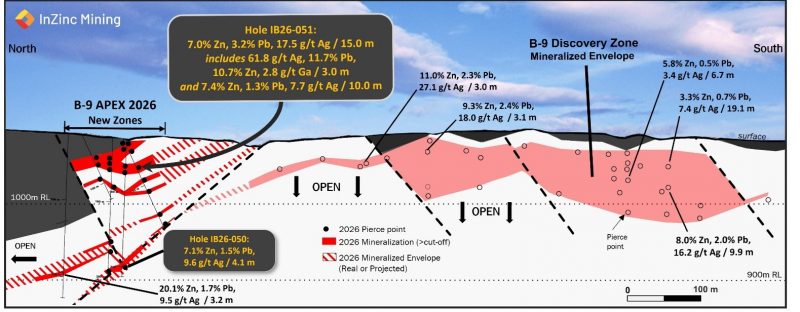
Best drill results to date
The standout result came from hole IB26-051, which intersected:
- 15.0 metres grading 7.0 per cent zinc, 3.2 per cent lead and 17.5 g/t silver from 67.1 metres downhole
The interval included:
- 3.0 metres grading 10.7 per cent zinc, 11.7 per cent lead and 61.8 g/t silver
- 10.0 metres grading 7.4 per cent zinc, 1.3 per cent lead and 7.7 g/t silver
According to InZinc, the intercept represents the strongest “grade-times-width” result encountered at Indy since exploration began.
Additional shallow mineralization was intersected in surrounding holes, including:
Hole IB26-049
- 5.7 metres grading 4.8 per cent zinc, 0.6 per cent lead and 3.5 g/t silver
- 9.8 metres grading 2.0 per cent zinc, 2.1 per cent lead and 11.2 g/t silver
Hole IB26-050
- 3.7 metres grading 1.7 per cent zinc, 0.6 per cent lead and 3.1 g/t silver
- 2.9 metres grading 4.0 per cent zinc, 1.7 per cent lead and 5.9 g/t silver
Hole IB26-052
- Multiple mineralized zones, including 5.0 metres grading 2.1 per cent zinc and 2.6 metres grading 3.1 per cent zinc
The company estimates true widths are approximately 80 per cent to 100 per cent of the reported downhole intervals.
Silver grades add new dimension
Beyond zinc and lead, drill results also highlighted growing silver potential at Apex.
One interval in hole IB26-049 returned:
- 3.3 metres grading 29.9 g/t silver
Meanwhile, hole IB26-051 produced:
- 3.0 metres grading 61.8 g/t silver
A single core sample from that hole assayed:
- 127.0 g/t silver over 0.65 metres
making it the highest silver assay recorded on the project to date.
The elevated silver values are interpreted as evidence of feeder-style mineralization, a geological setting often associated with stronger metal concentrations near mineralizing fluid pathways.
Coarse zinc mineralization encouraging
Geologists also reported extensive zones containing coarse crystalline sphalerite, the principal zinc-bearing mineral.
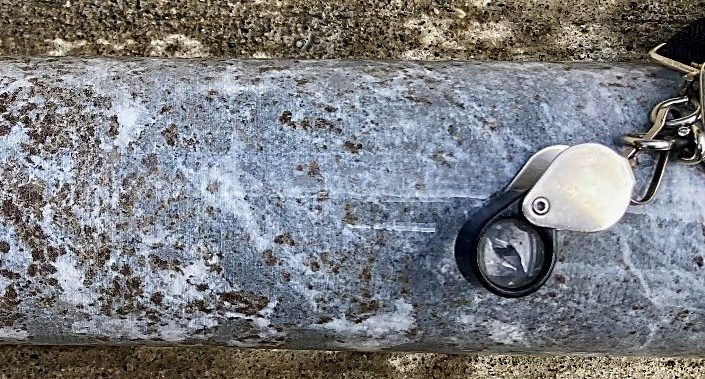
Several sections of hole IB26-051 contained sphalerite crystals reaching up to one centimetre in size. In mining operations, coarser-grained sulphide minerals can potentially improve metallurgical recoveries because they may be easier to separate during processing.
While metallurgical test work remains necessary, the company said the texture of the mineralization could ultimately support efficient zinc recovery characteristics.
Expanding open-pit opportunity
The discovery of multiple stacked mineralized zones close to surface is enhancing the potential for an open-pit mining scenario.
The new Apex discoveries lie along the broader B-9 Trend, a mineralized corridor that now extends more than 1,000 metres. InZinc believes the combination of shallow mineralization at Apex and the previously discovered B-9 Discovery Zone substantially improves the prospects for developing a sizeable near-surface resource.
Importantly, the trend remains open in multiple directions.
The area between Apex and B-9 Discovery has emerged as a priority exploration target, while geophysical and geochemical anomalies continue for an additional 1,200 metres to the northwest, offering significant room for future growth.
Deeper mineralization also confirmed
While much of the recent focus has been on shallow discoveries, drilling also encountered encouraging grades at depth.
Hole IB26-050 intersected:
- 8.8 metres grading 4.1 per cent zinc, 1.1 per cent lead and 6.8 g/t silver from 197.2 metres downhole
Including:
- 4.1 metres grading 7.1 per cent zinc, 1.5 per cent lead and 9.6 g/t silver
The deeper intersections suggest mineralization continues below the newly identified shallow zones and may support a larger mineralized system than currently defined.
Infrastructure provides competitive advantage
Located approximately 90 kilometres southeast of Prince George, the Indy Sedex Project benefits from infrastructure advantages uncommon among early-stage exploration projects.
The property is accessible by upgraded forestry roads and lies near major transportation and power networks, including:
- 85 kilometres from Canadian National Railway infrastructure
- Approximately 35 kilometres from hydroelectric transmission lines
- Direct access to ports at Prince Rupert and Vancouver
- About 500 kilometres from Teck’s zinc smelter complex in Trail, British Columbia
In addition, InZinc’s five-year exploration permit, renewed in 2024, still allows for up to 36 additional drill holes, providing substantial flexibility for continued expansion drilling.
Outlook
The latest drilling represents a significant milestone for InZinc as it continues to uncover higher-grade, near-surface zinc-silver mineralization at Indy. With its strongest intercept to date, growing evidence of metal-rich feeder systems, and a kilometre-scale trend that remains open for expansion, the project is increasingly positioning itself as a potential future source of critical zinc and silver in British Columbia.
Further drilling will be required to define the extent of the mineralized zones and determine whether the emerging discovery can evolve into a resource of meaningful scale. However, the latest results suggest Indy is becoming one of the more promising zinc exploration stories in Western Canada.
About InZinc Mining Ltd.
InZinc Mining is exposed to a diverse portfolio of active North American base metals and precious metals thanks to its Indy project.
Shares of InZinc Mining Ltd. (TSXV:IZN) opened trading at $0.08 and are trading 25 per cent since the beginning of the year.
Join the discussion: Find out what everybody’s saying about this stock on the InZinc Mining Ltd. Bullboard investor discussion forum and check out the rest of Stockhouse’s stock forums and message boards.