

Rheinmetall: The German Navy’s frigate order goes to TKMS
With the recent decline of Rheinmetall’s shares, we feel quite comfortable with our ongoing coverage. As a persistent warner about the obvious overvaluation, all it took was one more weak fundamental piece of news. That arrived at the end of June in the form of a cancelled F126-type frigate order worth EUR 12 billion. With this, the Düsseldorf-based group reached EUR 902 on June 25, a level 50% lower than in January. Rheinmetall would have acted as an important supplier in the large order; the German Navy has now awarded a much smaller alternative order for smaller and cheaper frigates to TKMS, which is majority-owned by thyssenkrupp.
With the sharp downward move and a 20% single-day sell-off, the market initially underestimated the gigantic order backlog and the structural special boom in land vehicles and ammunition. Analyst opinions after the recent Eurosatory trade fair were mixed. David Perry of JPMorgan downgraded the stock to “Neutral” and cut his price target from EUR 2,130 to EUR 1,500, but sticks to the argument that Germany will have to spend substantial sums over the coming five years to replace and modernize its army stocks. Warburg Research also backs the same price target and sees Rheinmetall’s operating fundamentals as by no means jeopardized by the German armed forces’ realignment toward smaller MEKO frigates. The consensus on the LSEG platform, with a certain time lag, still stands at EUR 1,753. We believe that, all things considered, a 30% rebound to EUR 1,250 to 1,300 is justified. Technically, the indicators were very heavily oversold, which is now leading to larger buybacks. For traders and long-term investors, Rheinmetall is now quite interesting again. However, a price target of over EUR 2,000, as at the start of the year, is unrealistic.
Renk: Analysts turn positive
A similar pattern is emerging in the shares of transmission specialist Renk. From over EUR 90 it fell all the way to EUR 40, and then it was over. The 2024 stock-market newcomer is fundamentally convincing with the highest order intake in the company’s history, which dispels fears of a lasting drop in demand. Analysts such as Holger Schmidt of DZ Bank emphasize the group’s enormous long-term potential in the area of drive systems for tanks and autonomous military vehicles. DZ Bank accordingly votes with a price target of EUR 64, and Jefferies can even make the case for EUR 70. What remains important about the Renk share is that its drive components are used in over 70% of military vehicles, making Renk a quasi-monopolistic supplier for tracked vehicles in the Western alliance. Since global defense programs remain in the public spotlight, the fundamental momentum here should by no means stop. On the LSEG platform, 16 of 17 analysts accordingly vote with a buy rating and a 12-month blended price target of EUR 67.88. In Augsburg, too, the catch-up rally has begun; yesterday it climbed back above the EUR 47 mark.
Hensoldt: Riding high with state-of-the-art sensor technology
The electronics and radar specialist Hensoldt completes the trio of major German defense stocks and is currently showing a particular technical counter-reaction. As a sensor supplier, Hensoldt would likewise have been involved in the F126 project, but offsets this risk through persistently strong demand for air-defense and reconnaissance systems. A key driver behind the turnaround in the Hensoldt share from EUR 64 to an astonishing EUR 77 in just 4 trading days is likely also the returned confidence of the company’s management: significant insider purchases by its own management, in the persons of Oliver Dörre and Inka Tews, sent a clear signal to the market that the price slump was not fundamentally justified. Analysts on the LSEG platform expect EUR 89.37 on average. From yesterday’s closing price of EUR 77.50, that no longer represents a particularly large upside. That the need for digital warfare and sensor technology remains unbrokenly high, independent of individual naval projects, can be assumed over the medium term. In favor of the Munich-based company is that, with the ballistic missile defense system “FREYJA,” it has the Ukrainian company Fire Point on board. This means modern systems can be subjected to an immediate, live test, significantly shortening long development cycles. Interesting!
Antimony Resources: And suddenly there is gold in the drill core
An intensifying competition for critical raw materials is changing the rules of the game on the global capital markets. While artificial intelligence, the defense industry, and modern energy technologies require ever larger quantities of strategic metals, exploration companies with high-quality deposits are increasingly coming into focus for long-term-oriented investors. Antimony Resources, a partner company of Globex Mining, aims to build a Western supply chain for antimony while steadily increasing the value of its projects through consistent exploration. The Canadian company focuses on promising deposits in New Brunswick and benefits from a market in which China continues to control the majority of global antimony production. What is putting pressure on the market is a sharp price increase over a few years, from around USD 15,000 to a record high of just under USD 60,000 per tonne in the summer of 2025; the price has since retreated but remains historically high.
At the center is the Bald Hill project, which, step by step, is developing into a strategically significant raw-materials project. Earlier geological models already point to around 2.7 million tonnes of mineralized rock with average antimony grades between 3 and 4%. Yet, the latest exploration results paint an even more compelling picture. In several areas, exceptionally high-grade stibnite mineralization was observed, with peak values of up to 36.0% antimony in drill holes and as high as 44.2% in surface samples. The real surprise of the current campaign, however, is an additional gold find that gives the project a completely new economic dimension. Drill-core analyses delivered gold grades of up to 1.88 g/t over a section of 4.95 m and show that Bald Hill might not be limited solely to an antimony project. Should this precious-metal mineralization be confirmed in the further course of drilling and expand spatially, it could considerably improve the future economics and open up additional revenue sources.
CEO James Atkinson in an interview with IIF host Lyndsay Malchuk on the strategic plans.
With the surprising gold find, the share rose 20% in value yesterday; the market capitalization is now back at around CAD 72 million. Over the past 90 days, many large investors withdrew from the tungsten and antimony space because a slight easing appeared in the international crisis hotspots. The speculative capital thus left the deck, but convinced long-term investors are now coming back on board, recognizing the property’s enormous potential as a long-term super opportunity. Correspondingly high were the turnovers, with almost 1 million shares over the course of the day. Anyone looking at the chart recognizes a clear change in direction!
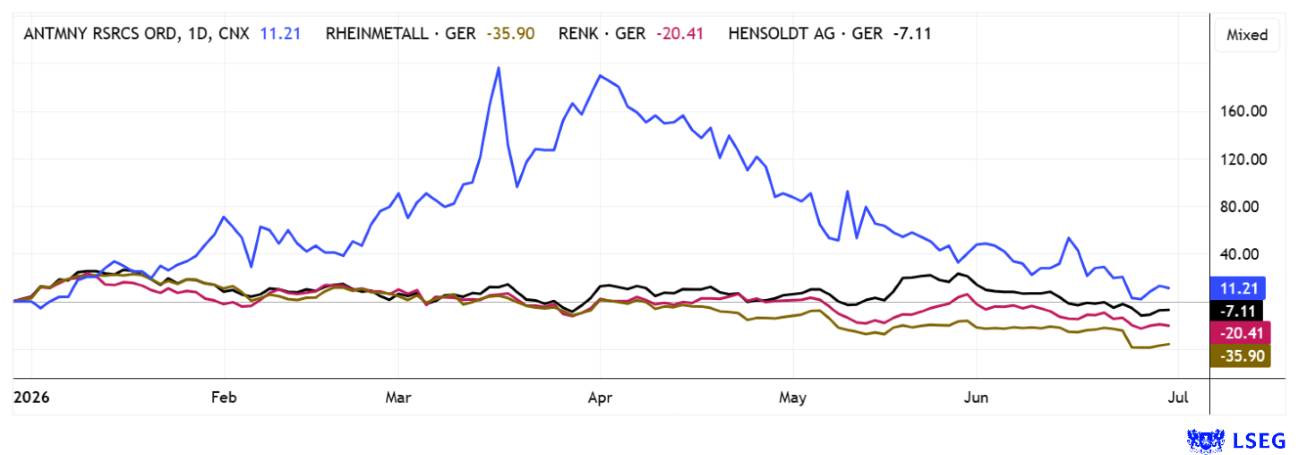
Capital markets are currently being driven by geopolitical developments, persistent inflation, and exceptionally strong growth forecasts for AI, high-tech, and data center infrastructure. As a result, 2026 could go down in history as the year of the “chip mega-boom.” The defense sector, by contrast, has underperformed after several years of exceptional gains. However, momentum is now returning as the second half of the year begins, with critical metals also showing renewed strength.
Conflict of interest
Pursuant to §85 of the German Securities Trading Act (WpHG), we point out that Apaton Finance GmbH as well as partners, authors or employees of Apaton Finance GmbH (hereinafter referred to as “Relevant Persons”) currently hold or hold shares or other financial instruments of the aforementioned companies and speculate on their price developments. In this respect, they intend to sell or acquire shares or other financial instruments of the companies (hereinafter each referred to as a “Transaction”). Transactions may thereby influence the respective price of the shares or other financial instruments of the Company.
In this respect, there is a concrete conflict of interest in the reporting on the companies.
In addition, Apaton Finance GmbH is active in the context of the preparation and publication of the reporting in paid contractual relationships.
For this reason, there is also a concrete conflict of interest.
The above information on existing conflicts of interest applies to all types and forms of publication used by Apaton Finance GmbH for publications on companies.
Risk notice
Apaton Finance GmbH offers editors, agencies and companies the opportunity to publish commentaries, interviews, summaries, news and the like on news.financial. These contents are exclusively for the information of the readers and do not represent any call to action or recommendations, neither explicitly nor implicitly they are to be understood as an assurance of possible price developments. The contents do not replace individual expert investment advice and do not constitute an offer to sell the discussed share(s) or other financial instruments, nor an invitation to buy or sell such.
The content is expressly not a financial analysis, but a journalistic or advertising text. Readers or users who make investment decisions or carry out transactions on the basis of the information provided here do so entirely at their own risk. No contractual relationship is established between Apaton Finance GmbH and its readers or the users of its offers, as our information only refers to the company and not to the investment decision of the reader or user.
The acquisition of financial instruments involves high risks, which can lead to the total loss of the invested capital. The information published by Apaton Finance GmbH and its authors is based on careful research. Nevertheless, no liability is assumed for financial losses or a content-related guarantee for the topicality, correctness, appropriateness and completeness of the content provided here. Please also note our Terms of use.
Stockhouse does not provide investment advice or recommendations. All investment decisions should be made based on your own research and consultation with a registered investment professional. The issuer is solely responsible for the accuracy of the information contained herein. For full disclaimer information, please click here.