
When most people think about commodities, they picture gold, oil, or copper. Rarely does salt make the list. Yet salt is one of the most indispensable minerals on Earth—quietly powering industries, keeping roads safe, and even shaping the global economy. For investors, this overlooked resource offers a compelling story of stability, necessity, and opportunity.
Why salt is more than a kitchen staple
Salt’s role in modern life goes far beyond seasoning food. It is the backbone of winter road safety, preventing ice from turning highways into hazards. It drives chemical processes that produce chlorine and caustic soda—key ingredients for plastics, detergents, and paper. It softens water, preserves food, and even supports oil and gas drilling. In short, salt is everywhere, and demand never goes away. It doesn’t depend on economic cycles or consumer trends; it’s tied to infrastructure and public safety.
This article is disseminated in partnership with Atlas Salt Inc. It is intended to inform investors and should not be taken as a recommendation or financial advice.
A market that’s bigger than you think
Globally, the salt market size was valued at US$26 billion in 2024 and is projected to grow to US$36 billion by 2032, according to Fortune Business Insights. More than 305 million metric tons are produced annually, with Asia-Pacific leading the charge. In North America, the U.S. alone consumes about 45 million tons each year—nearly half of that for de-icing roads during winter storms. Municipal contracts make this a predictable, recession-resistant business. Prices rise modestly over time, but when severe winters hit, they spike sharply, creating windfalls for producers.
North America’s hidden vulnerability
Despite being a major producer, North America still imports millions of tons of salt every year, mostly from Chile, Egypt, and North Africa. Those imports travel thousands of km by ship, taking two weeks or longer to arrive. This reliance on overseas supply introduces risk: shipping delays, potential tariff exposure, and volatile freight costs. In an era of supply chain uncertainty, that’s a problem—and it’s one that domestic producers are uniquely positioned to solve.
The advantage of local supply
Imagine replacing those imports with a reliable, homegrown source. Local supply means faster delivery, lower transportation costs, and alignment with the growing “Buy North American” sentiment. It also strengthens the security of supply for critical infrastructure. For municipalities and industrial buyers, that’s peace of mind. For investors, it’s a competitive edge.
Cost and sustainability: A winning combination
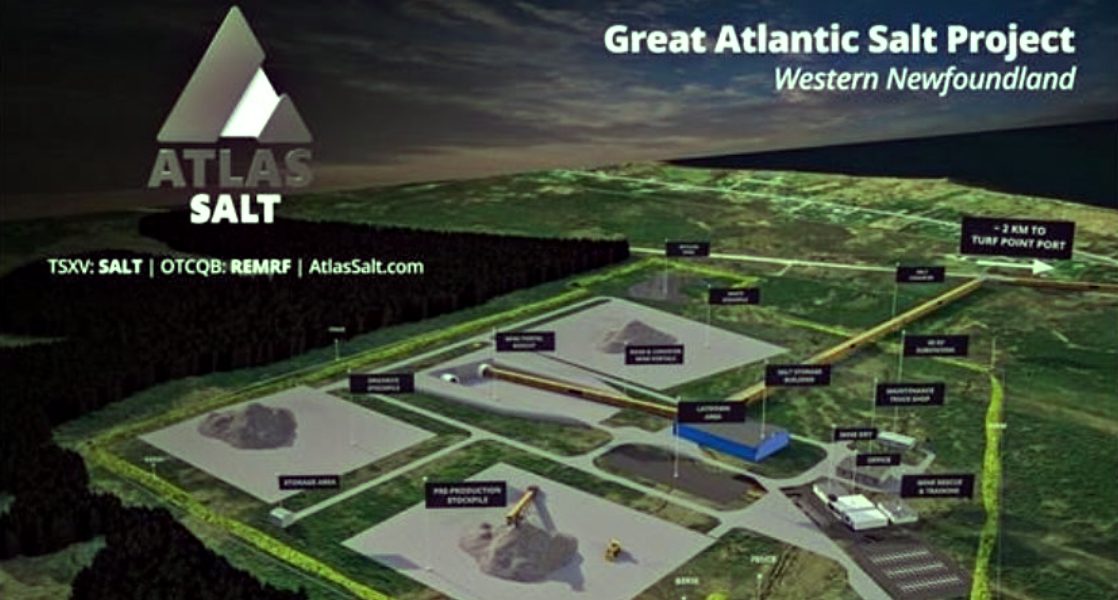
Atlas Salt’s (TSXV:SALT) Great Atlantic Salt Project in Newfoundland & Labrador checks all the boxes. The deposit lies just 200–250 metres below the surface—shallow compared to traditional salt mines—making extraction less expensive. It sits near the Trans-Canada Highway and a deep-water port, reducing capital and operating costs. And because it’s powered by clean hydroelectricity, the project boasts one of the lowest carbon footprints in the industry. No diesel trucks rumbling underground; instead, battery-electric haulage and conveyor systems move the product efficiently. Compared to salt shipped from overseas, the environmental advantage is clear: fewer emissions, shorter transit times, and a greener supply chain.
Atlas Salt: Building North America’s next salt powerhouse
With market cap of just C$63 million, Atlas Salt owns 100 per cent of the Great Atlantic Salt Deposit—North America’s largest undeveloped salt resource. The numbers tell the story: 95 million tonnes of probable reserves at 96 per cent purity, 383 million tonnes of indicated resources at 96 per cent purity, plus 868 million tonnes of inferred resources. Based on only on reserves, the updated feasibility study projects an average of 3.8 million tonnes of annual production for 24 years, generating C$188 million of after-tax cash flow each year. With a post-tax NPV8 of C$920 million and an IRR of 21 per cent, this is a project designed for scale and profitability. Based on the additional tonnes available in resource, production is likely to far exceed 24 years.
Ideally located just three km from a deep-water port, Atlas Salt is positioned to serve the massive Northeastern U.S. and Eastern Canadian markets—regions that consume millions of tonnes of de-icing salt every winter. This will be the first new underground salt mine in North America in nearly 30 years, built as a modern “Salt Factory” with sustainability at its core.
Jurisdictional strength
Newfoundland & Labrador isn’t just scenic—it’s a mining-friendly province that was ranked among thetop 10 mining jurisdictions globally by the Fraser Institute. Stable policies, streamlined permitting, and abundant clean energy make it an ideal setting for a project of this scale.
The bottom line
Salt may not sparkle like gold, but it’s a commodity that never goes out of style. It’s essential, stable, and tied to infrastructure rather than speculation. North America’s dependence on imports creates a strategic opening for domestic producers, and Atlas Salt is leading the charge. With its massive resource, cost advantages, and sustainability credentials, Atlas Salt offers investors a rare opportunity: exposure to a commodity that’s as timeless as it is vital.
Join the discussion: Find out what the Bullboards are saying about Atlas Salt and check out Stockhouse’s stock forums and message boards.
Stockhouse does not provide investment advice or recommendations. All investment decisions should be made based on your own research and consultation with a registered investment professional. The issuer is solely responsible for the accuracy of the information contained herein. For full disclaimer information, please click here.