


US President Donald Trump has made the nuclear debate with Iran a top priority. After years of living with what it views as a significant threat from the Iranian regime, Israel is now aligning its strategic interests more closely with Western partners. Discussions increasingly revolve around containing Iran’s influence and limiting its military capabilities. Whether this will be so easy is doubtful, as the Revolutionary Guards have developed into a powerful force over the last 10 years, and Russia is also likely to appear on the horizon as a friend of the Iranians. For financial markets, this constellation implies renewed uncertainty and elevated volatility. Historically, such phases have tended to benefit defense and armaments companies. For marathon runner Almonty Industries, the environment appears particularly favorable: geopolitical tensions, rising tungsten prices, and governments under pressure to secure strategic raw materials are reinforcing the investment case. The momentum in defense and critical metals markets continues.
This article is disseminated in partnership with Apaton Finance GmbH. It is intended to inform investors and should not be taken as a recommendation or financial advice.
Almonty Industries – All eyes are on tungsten
Lights out – spotlight on! The stock market star of the past 12 months enters the commodities stage, and the message is: The sky is the limit! Why is that? There is no need to dwell on the Canadians’ special positioning in the tungsten market; the story is well known. But how far will the ball fly before even stronger hands snatch it out of the market? This is a question that many stock market traders have been asking themselves for weeks, as Almonty’s (TSX:AII) (NASDAQ:ALM) share price has increased almost twentyfold since December 2024. The fact remains that the escalating conflict between Israel, the US, and Iran clearly shows how quickly geopolitical tensions can turn into serious supply chain risks. In such phases, critical metals become security policy levers, and tungsten plays a special role in this. No other metal combines such high heat resistance, hardness, and density, making it practically indispensable for ammunition, armor, missiles, drone technology, and high-performance electronics.
As diplomacy loses its effectiveness, inventories, producing countries, and export controls are becoming the focus of military planning. The tungsten market is extremely tight, with the price more than quintupling to USD 1,800 in 12 months as China continues to control the majority of global production and Western countries increasingly seek independent sources of supply. This is no longer a matter of classic economic cycles, but of sophisticated procurement issues. The key point: over the past five years, Almonty has evolved from a niche producer to a relevant supplier of non-Chinese tungsten. Operational progress at the Sangdong mine in South Korea marks the transition from vision to resilient reality. And for customers in the defense, aviation, and semiconductor industries, it is no longer the cheapest price that counts, but guaranteed delivery in the event of a crisis.
Almonty benefits in terms of valuation from long-term cost structures that are now meeting with skyrocketing prices. All historical calculations are being thrown out the window; whoever comes first gets the material, or else it goes to the next in line. In the foreseeable future, the next production-ready site in Montana will also strengthen the supply pipeline, and forward figures will continue to improve. **Yesterday, the research firm GBC recalculated its target price, raising it from CAD 9.00 to CAD 28.60. Pure mathematics? No, real resource scarcity will generate around CAD 1 billion in EBITDA in the transition period 2028/29. With an EV/EBITDA multiple of 5.9 to 6.8, Almonty’s market value of CAD 3.5 billion is well within the time frame! The trend is your friend!
CEO Lewis Black spoke at the recent 18th International Investment Forum (www.ii-forum.com) on February 25 about Almonty’s opportunities in challenging times. Click here for the video.

Hensoldt – Attempt to rise and downgrade
The German high-tech defense company Hensoldt, based in Munich, reached a peak price of EUR 117 in October. This was followed by a sharp consolidation to below EUR 70. Hensoldt generated revenue of around EUR 2.46 billion in fiscal year 2025, slightly missing the consensus estimate of around EUR 2.5 billion. The adjusted EBITDA margin of 18.4% was in line with forecasts, with order intake particularly strong, driven by sensor and defense technology. Apparently, the stock market had hoped for more and sent the share price back down from its January high of EUR 90 to EUR 75. With the tailwind of the Iran crisis, there were attempts yesterday to break through to EUR 81.50, but the British investment bank Barclays proved to be a show stopper during the course of the day and sent the share price back down again. The bank lowered its price target from EUR 97 to EUR 95 with a weak “Equal Weight” recommendation. Analyst Afonso Osorio sums up that although Hensoldt has good long-term prospects, it continues to suffer from short-term operational challenges. The expert consensus on the LSEG platform is EUR 88.74 with 5 out of 15 “Buy” recommendations – a 13% chance based on yesterday’s closing price of EUR 78.20. Not very exciting, as the 2026 P/E ratio of 4.2 also appears very ambitious!
Thales – Radar systems for the Gulf region
French high-tech group Thales is in the right place at the right time with its defense projects for Qatar. It is currently supporting the Emiri Air Force in expanding its air defense capabilities. At the DIMDEX defense exhibition in Doha, Qatar signed a contract for the delivery of the latest generation of GM200 and GM400 radar systems to improve airspace surveillance. The background to this is the threat posed by increasingly frequent drone flights in the airspace. Modern armed forces require powerful sensors that can detect targets early and integrate the data obtained into existing systems. The GM200MM/A system is a mobile multi-purpose radar for medium ranges and can also detect small targets at distances of up to 350 km. The GM400α is designed for long-range airspace surveillance and offers precise target tracking of slow, low-flying objects as well as highly maneuverable threats. Thales has been working with Qatar for 40 years and is active in various security-related areas in the country.
Another benchmark order for the rapidly growing group. Today, the annual figures for 2025 are being reported. They are expected to bring an increase in revenue of just under EUR 2 billion to around EUR 21.9 billion, with estimates for 2030 at just under EUR 29.8 billion – 50% more than in 2024. In terms of earnings, earnings per share are expected to rise from EUR 6.91 to EUR 9.35 in 2025, with EUR 15.72 expected for 2029. Experts on the LSEG platform are focusing on a 12-month average price target of around EUR 285. Yesterday, the price rose by a further 4% to EUR 262. Let’s see what today’s annual figures mean for the share price. With a 2026 P/E ratio of 2.5, Thales is not too expensive in the European defense sector.

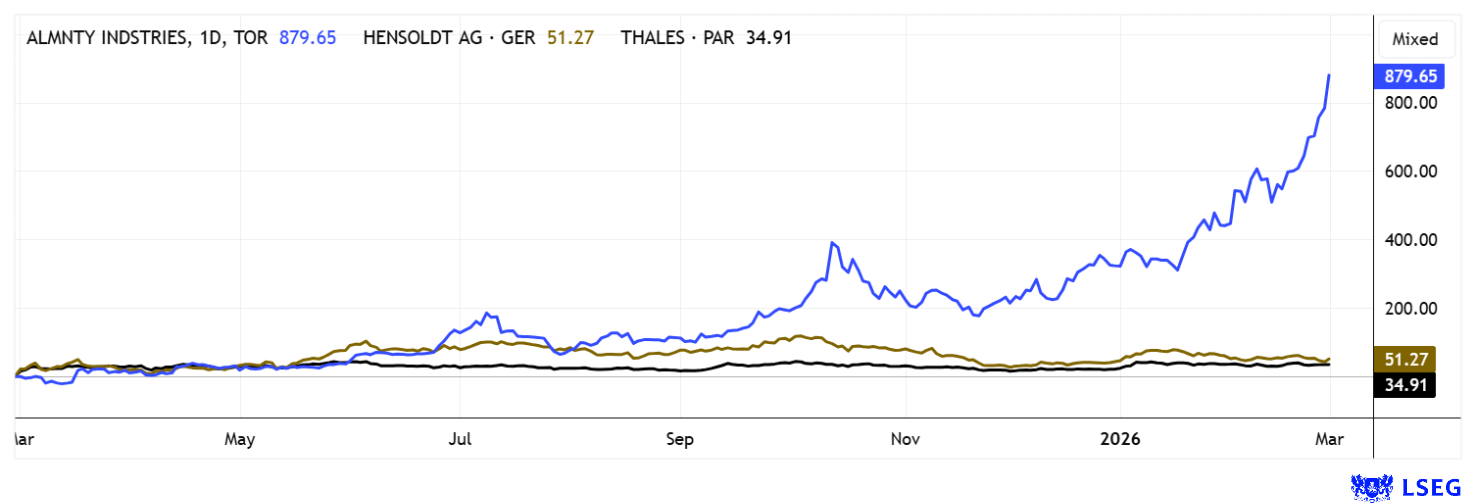
Once again, we are plagued by a new conflict in the Middle East. For investors, this is a replay of the Israel-Hamas war of the last 24 months. It means an upturn for defense and critical metals, but a downturn for economic prospects due to higher oil prices. Risks continue to rise for the overall market, but this is of little concern to commodity and defense investors!
Conflict of interest
Pursuant to §85 of the German Securities Trading Act (WpHG), we point out that Apaton Finance GmbH as well as partners, authors or employees of Apaton Finance GmbH (hereinafter referred to as “Relevant Persons”) currently hold or hold shares or other financial instruments of the aforementioned companies and speculate on their price developments. In this respect, they intend to sell or acquire shares or other financial instruments of the companies (hereinafter each referred to as a “Transaction”). Transactions may thereby influence the respective price of the shares or other financial instruments of the Company.
In this respect, there is a concrete conflict of interest in the reporting on the companies.
In addition, Apaton Finance GmbH is active in the context of the preparation and publication of the reporting in paid contractual relationships.
For this reason, there is also a concrete conflict of interest.
The above information on existing conflicts of interest applies to all types and forms of publication used by Apaton Finance GmbH for publications on companies.
Risk notice
Apaton Finance GmbH offers editors, agencies and companies the opportunity to publish commentaries, interviews, summaries, news and the like on news.financial. These contents are exclusively for the information of the readers and do not represent any call to action or recommendations, neither explicitly nor implicitly they are to be understood as an assurance of possible price developments. The contents do not replace individual expert investment advice and do not constitute an offer to sell the discussed share(s) or other financial instruments, nor an invitation to buy or sell such.
The content is expressly not a financial analysis, but a journalistic or advertising text. Readers or users who make investment decisions or carry out transactions on the basis of the information provided here do so entirely at their own risk. No contractual relationship is established between Apaton Finance GmbH and its readers or the users of its offers, as our information only refers to the company and not to the investment decision of the reader or user.
The acquisition of financial instruments involves high risks, which can lead to the total loss of the invested capital. The information published by Apaton Finance GmbH and its authors is based on careful research. Nevertheless, no liability is assumed for financial losses or a content-related guarantee for the topicality, correctness, appropriateness and completeness of the content provided here. Please also note our Terms of use.
Stockhouse does not provide investment advice or recommendations. All investment decisions should be made based on your own research and consultation with a registered investment professional. The issuer is solely responsible for the accuracy of the information contained herein.
For full disclaimer information, please click here.