

- Iran’s conflict and the threat of US$200 oil have intensified global supply‑chain shocks, making secure North American critical‑minerals sources—like Québec’s vanadium‑titanium‑iron projects—more valuable
- VanadiumCorp (TSXV:VRB) is advancing its Lac Doré and Iron‑T projects while developing its patented VEPT extraction technology, positioning itself as a domestic supplier of key metals for energy storage, steel, and defence applications
- Strategic Resources (TSXV:SR) complements this landscape by progressing its Port Saguenay pellet plant, arguing the Iran conflict proves the need to re‑shore high‑grade iron ore pellet capacity in stable jurisdictions like Canada
- VanadiumCorp stock (TSXV:VRB) opened trading at $0.11
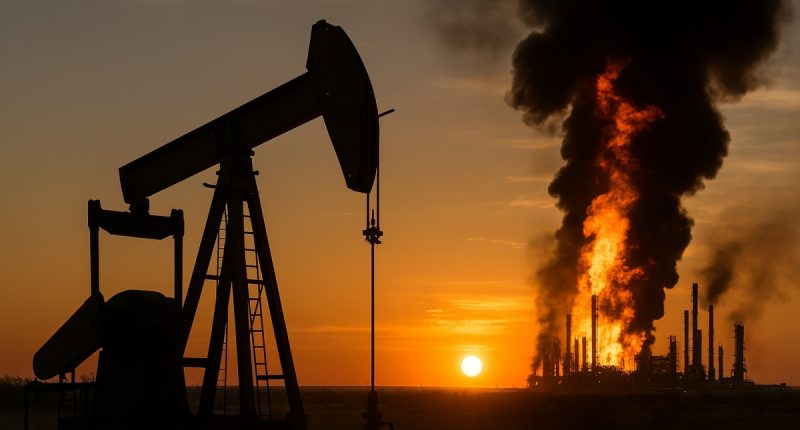
As markets grapple with an oil shock born from a widening war with Iran, investors are rediscovering a hard lesson from the 1970s: energy security and materials security are two sides of the same coin. Brent briefly surged above US$100 as hostilities intensified, and credible voices now warn that prices could lurch toward US$200 per barrel if the Strait of Hormuz remains effectively shut and energy infrastructure stays at risk.
This article is a journalistic opinion piece which has been written based on independent research. It is intended to inform investors and should not be taken as a recommendation or financial advice.
With ~20 per cent of global oil flows typically passing through Hormuz, the conflict’s market transmission is not just about spot crude—it’s about logistics, insurance, and risk premia rippling across every industrial supply chain that uses energy, ships goods, or depends on Middle Eastern corridors. That’s why metals, fertilizers, and broader commodity costs have repriced in tandem, not because mines suddenly vanished, but because delivery got riskier and costlier.
Against this backdrop, North American critical‑minerals projects—especially those related to the energy transition and defence—are gaining attention. One name at the nexus of these themes is VanadiumCorp Resource Inc. (TSXV:VRB), a Québec‑focused junior aiming to supply vanadium‑titanium‑iron (V‑Ti‑Fe) into domestic supply chains, while advancing a proprietary extraction process that could lower energy and environmental intensity.
The macro: Why US$200 oil and a blocked Hormuz elevate materials security
The war’s core risk is chokepoint exposure. Hormuz ordinarily carries ~20 million barrels per day, and the mere threat to that conduit has sent crude, LNG, marine insurance, and freight spiralling—knock‑on effects that amplify the costs of metals and refined inputs.
Analysts now frame multiple scenarios: from a swift de‑escalation and partial re‑opening of lanes to a protracted logistics shock that prolongs elevated prices, fan inflation, and compress growth. Even without a total shutdown, shipping constraints and risk surcharges can be enough to shift global cost curves for energy and metals—evidence already visible in premiums and exchange prices for non‑ferrous metals, and in the broader commodity complex.
For investors, the key is resilience: projects in stable jurisdictions, backed by supportive policy, and aligned with national strategies to onshore/nearshore critical inputs. Canada’s federal strategy has explicitly prioritized critical minerals, and the International Energy Agency continues to flag geopolitical concentration risk across battery and defence supply chains.
The company: VanadiumCorp’s Québec portfolio and why It matters now
VanadiumCorp controls two 100 per cent‑owned V‑Ti‑Fe properties in Québec—Lac Doré (flagship) and Iron‑T—each sitting squarely within the policy narrative for North American critical‑minerals security. Both vanadium and titanium are formally recognized as critical minerals in Canada and the United States, aligning the company with programs designed to de‑risk allied supply chains.
- Lac Doré (near Chibougamau, QC): The company completed an Ambient Noise Tomography (ANT) survey to refine geological understanding and guide deeper targeting; it is also working to update its resource model from a historical 2020 NI 43‑101 estimate (214.93 Mt grading 24.6 per cent magnetite and 1.3 per cent V₂O₅ in concentrate; ~1.49 billion lb contained V₂O₅). While historical, the figure underscores the perceived scale, and the goal is to advance classification as work progresses.
- Iron‑T (near Matagami, QC): VanadiumCorp is compiling historical datasets to build a new 3D geological model using AI‑assisted tools, referencing a historical 2011 inferred resource at the Genesis Zone (14.38 Mt at 0.42 per cent V₂O₅) that remains open. The company argues the project shares metallurgy and low‑impurity characteristics with Lac Doré, suggesting portfolio synergies in processing.
- VEPT—the process angle: In October 2025, VanadiumCorp received a Canadian patent allowance for its VanadiumCorp Electrochem Process Technology (VEPT), extending patent coverage to five countries (U.S., South Africa, Australia, India, Canada). VEPT aims to recover vanadium, iron, and titanium from titanomagnetite and other feedstocks using a hydrometallurgical route designed to reduce energy intensity versus conventional pyrometallurgy; third‑party testing is underway via an Australian partner and Electrochem Technologies in Québec.
Why this matters in a war‑driven oil shock: high oil and gas prices ripple through mine fleets, power tariffs, reagents, and logistics. A flowsheet that can lower energy use and broaden feedstock optionality is especially valuable when energy costs are volatile and supply routes are fragile.
The security case for vanadium
Vanadium is dual‑use: it strengthens steel (notably for construction and pipelines) and is a core active material in vanadium redox flow batteries (VRFBs), a grid‑scale storage technology that complements intermittent renewables. In tight energy markets, grid operators seek resilience via storage, and defence planners prize materials that reinforce infrastructure and deliver long‑duration energy buffering. Canada and the U.S. have both elevated vanadium’s status within critical‑mineral frameworks—bolstering the case for domestic development.
Moreover, when maritime risk spikes, localization can be as important as grade. Québec’s hydro grid, brownfield industrial base, and proximity to North American battery and steel markets make regional V supply a compelling story. That is especially true when the “logistics premium” becomes the marginal cost driver rather than geology alone.
VanadiumCorp vs. the field: What’s distinct?
VanadiumCorp is not alone in chasing North American V‑Ti‑Fe opportunities, but it has a few distinguishing features:
- Two Québec assets with complementary geology: Portfolio scale offers optionality for sequencing, financing, and processing synergies if metallurgy lines up as indicated.
- Proprietary processing (VEPT): Patent coverage across five jurisdictions and ongoing validation provides a potential technology moat; if commercialized, it could lower energy and environmental footprints relative to traditional routes.
- Policy alignment: The projects’ metals (V, Ti) sit within Canadian/U.S. critical‑minerals priorities, which can matter for permitting pathways, grants, and offtake.
At the same time, investors should recognize the execution hurdles common to juniors: advancing historical resources to current NI 43‑101 standards, scaling a novel flowsheet, financing studies and infrastructure, and navigating permitting and market cycles. The IEA has repeatedly cautioned that even when demand is strong, mineral supply expands slowly, underscoring long project lead times and concentration risk.
Sidebar: Strategic Resources—A thematically linked peer
Strategic Resources (TSXV:SR), a Canadian developer also positioned around vanadium, high‑purity iron, and titanium. The company recently advanced its permit‑amendment process for a 4‑million‑tonne‑per‑year iron ore pellet plant at Port Saguenay (Québec), with regulators issuing technical questions the company is now addressing—described as a routine step. Commissioning of a multi‑user electric pipe conveyor at the port is slated for spring, a logistics enabler for future feed and exports.
In a notable market‑timing twist, SR explicitly linked the Iran conflict to the need for reshoring pellet capacity in North America, highlighting that a large share of global seaborne pellets originates from the broader Gulf region—a supply chain now disrupted by war and Hormuz risk. Their stance: more reliable pellet capacity in stable jurisdictions is needed to serve DRI‑based, low‑carbon steelmaking in North America and Europe.
How it complements VanadiumCorp:
- Same strategic metals (V‑Ti‑Fe) but different development angle: SR’s near‑term emphasis is on pelletizing capacity and logistics at a federal port; VanadiumCorp is focused on upgrading geology and de‑risking a proprietary processing route for V‑bearing magnetite.
- Shared macro tailwinds: Both benefit from policy support and security‑of‑supply narratives intensified by Middle East disruptions and higher energy prices.
What to watch next
- War path and energy prices
Track the duration of the Iran conflict, insurance restrictions, and any escorted transits through Hormuz. A longer disruption implies sustained logistics premia and elevated input costs—conditions that favour local, policy‑aligned projects in Canada. - Resource de‑risking at Lac Doré / Iron‑T
Evidence of updated, current NI 43‑101 resources and deeper structural understanding from geophysical work would be an important step beyond historical baselines. - VEPT validation
Look for pilot data, third‑party test results, and cost/energy benchmarks versus conventional flowsheets. If VEPT’s energy and recovery claims hold, it strengthens VanadiumCorp’s case in a world where energy becomes the marginal driver of processing economics. - Policy and offtakes
Continued evolution of the Canada‑U.S. critical‑minerals framework, and any procurement by utilities, defence, or storage integrators, could catalyze financing and timelines for domestic V supply.
Investor’s corner
When oil spikes and shipping lanes wobble, the premium on proximity goes up. VanadiumCorp offers investor exposure to vanadium‑titanium‑iron in a stable, hydro‑powered jurisdiction, with a potential process technology edge via VEPT that—if proven at scale—could improve economics in an era where energy is both a commodity and a constraint.
And with peers like Strategic Resourcesmoving to onshore pellet capacity at Port Saguenay, the Canadian critical‑minerals ecosystem is positioning to absorb shocks from geopolitical flashpoints—exactly the kind of resilience investors tend to prize when headlines talk about US$200 oil.
VanadiumCorp Resource Inc. is a Canadian critical minerals exploration company out to secure a sustainable supply of vanadium, titanium, and iron through its 100 per cent ownership of two located properties in Québec: its flagship Lac Doré Project and the Iron-T Project.
VanadiumCorp stock (TSXV:VRB) opened trading at $0.11 and has kept steady since this time last yesr.
Join the discussion: Find out what the Bullboards are saying about Vanadiumcorp Resource and check out Stockhouse’s stock forums and message boards.
Stockhouse does not provide investment advice or recommendations. All investment decisions should be made based on your own research and consultation with a registered investment professional. The issuer is solely responsible for the accuracy of the information contained herein. For full disclaimer information, please click here.