

Driven by hype and FOMO, the rapid expansion of artificial intelligence (AI) across the industry spectrum—from consumer electronics to heavy industry—has ushered in a wave of companies retrofitting standard products with algorithmic features whose practical value is, at best, questionable, often resulting in gadgets over-engineered to solve non-existent problems.
This article is disseminated in partnership with AI companies Secur3D Holdings Inc. and Argo Corp. It is intended to inform investors and should not be taken as a recommendation or financial advice.
Notable examples here include AI wearables, such as the Humane AI Pin and Rabbit R1, whose companies promised screen-free smartphone replacements, but ended up offering little more than slow, error-prone voice interfaces, within devices prone to overheating, that failed at tasks your iPhone and Android already perform effortlessly.
There’s also an excess of AI-enabled household goods on the market, from smart toothbrushes, to mattresses, to grills equipped with sensors tracking metrics such as brushing speed and generative AI dishing out conversational cooking advice, each of which introduces subscription fees and arguable unnecessary complexity to simple, everyday routines.
AI chatbots deserve a mention, as well, having infiltrated your favorite websites and apps, forcing users to compose lengthy prompts for assistance for simple asks, the majority of them previously accomplished by a quick scan of the user interface plus a couple of clicks.
All this is to say that, as AI’s initial novelty fades, so will its tendency for gimmickry, highlighting an important lesson for investors interested in the space: to look past the AI buzz, restricting their investable universes to companies delivering tangible value to their clients.
Secur3D
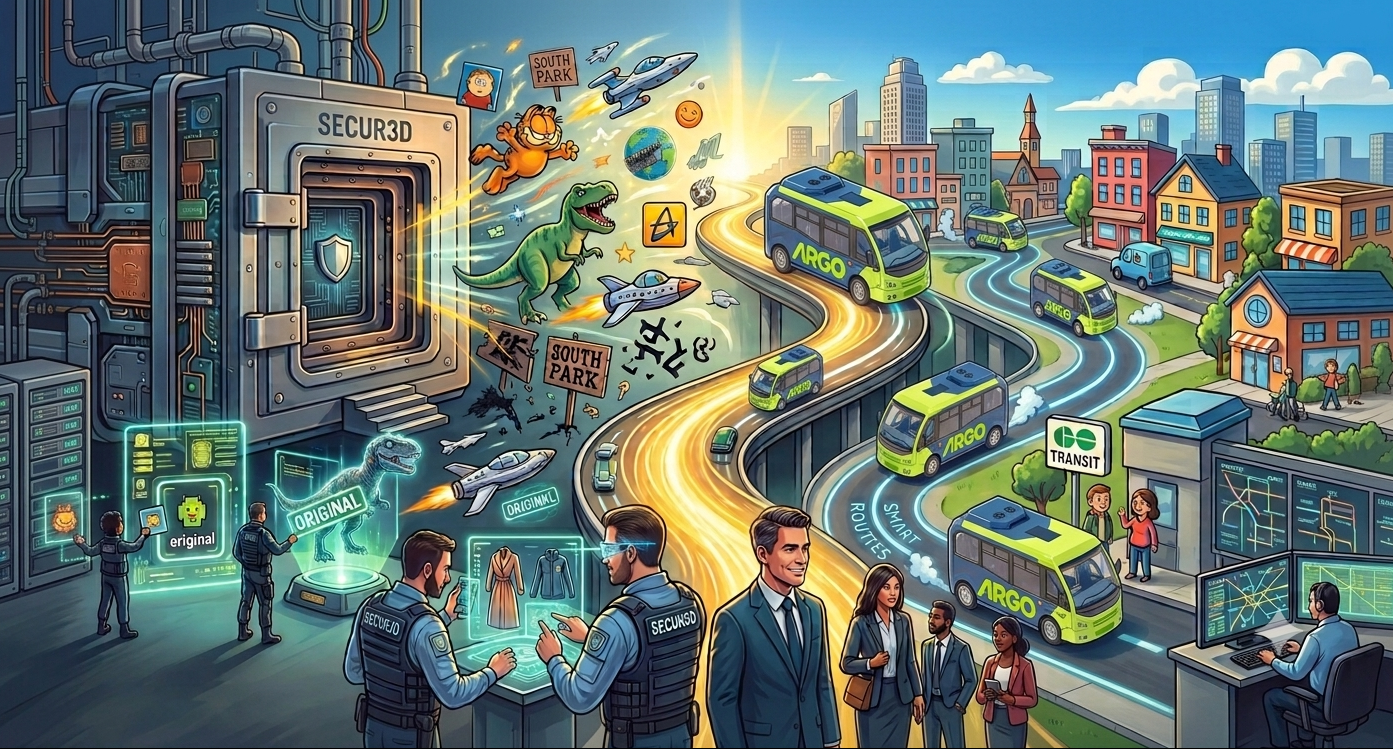
An AI company centered on utility worth some thought is Secur3D, market cap C$12.3 million, a Vancouver-based brand security specialist helping clients protect their intellectual property (IP) through a proprietary technology suite that detects unauthorized IP use, monitors infringement risk and supports enforcement intelligence, all while bolstering brand integrity and consumer trust.
Secur3D, designed to operate before publication, has proven especially useful in the fashion, gaming, entertainment and digital commerce spaces, monitoring more than 25,000 assets and 12 marketplaces, onboarding 14 customers to date, many of which keep a high profile, including Herschel, South Park and Star Trek: The Next Generation.
Here’s a brief breakdown of Secur3D’s technology portfolio:
- AssetSafe, now active in the marketplace, fingerprints and screens assets before they go live for easy identification.
- Sentry, in development, provides continuous enforcement intelligence, detecting unauthorized use, clones and lookalikes, as well as high-risk activity more broadly, which it builds into evidence packages for authorities or to streamline decision making.
- Creator Portal, in the planning stage, will act as a self-serve protection service for creators, allowing them to register assets and monitor their use across online marketplaces.
With recurring subscription revenue already rolling in, as well as fees per asset scanned, Secur3D is stepping into an increasingly AI-generated online environment, where billions of assets, both original and fraudulent, are produced daily and in need of efficient moderation, propelling a global digital security market expected to almost double from US$20.7 billion in 2026 to US$38.3 billion by 2030.
The company intends to establish itself as a trust layer within this unfettered output, with its impressive customer rolodex to date, which also includes Garfield, Jurassic World and How To Train Your Dragon, speaking highly of the results it’s capable of achieving for treasured IP.
Otis Perrick, Director and Chief Executive Officer, who brings more than 20 years of experience in 3D content, brand licensing and digital entertainment, including senior roles with CanAm Sport and Electronic Arts / EA SPORTS, joined Stockhouse’s Ricki Lee to introduce Secur3D to the market. Watch the interview here.
Secur3D stock (CSE:SRD) last traded at C$0.20, giving back 60 per cent since inception on July 17, 2026, with only 61.5 million shares outstanding granting leadership the kind of flexibility to tap into capital markets that most micro-caps can only dream of.
Argo
Investors hunting at the intersection of AI and value-creation should also add Argo, market cap C$89.39 million, to their watchlists, thanks to the data-driven improvements the company is bringing to transit systems across the Canadian province of Ontario.
Argo is pioneering the world’s first vertically and publicly integrated city transit system, which uses dynamic, AI-powered routing and in-house electric vehicles to fill in the gaps left by legacy infrastructure, scaling it to better meet travelers’ mobility needs. Here’s how the system works:
- Users sign in to the company’s app and request a ride, priced at standard public transit fares, and are rapidly connected to a network that will determine the vehicle best positioned for the pick up.
- Once onboard, Argo’s Smart Routes technology will take care of getting passengers where they need to go, from door to door, adjusting to traffic in real time, sidestepping infrastructure costs associated with traditional transit system expansion.
- Argo X1 accessible EVs keep the whole system moving in an environmentally-friendly fashion.
Argo’s leadership team has been hard at work demonstrating the value it brings to urban mobility, notching an initial win by doubling transit ridership in Bradford West Gwillimbury in 2023 after only one year of service.
Not wanting its citizens to be left behind, Brampton soon added its name to the mix, instituting a Smart Routing pilot plan in 2025, complementing one of Ontario’s largest and busiest transit systems with on-demand service, including connections to Brampton Transit and Go Transit stations.
Most recently, the town of Caledon stepped onboard, enlisting Argo’s next-gen transit solutions through the signing of a 15-month, C$4.5 million service agreement expected to kick off this fall.
What follows from this initial traction is a glimpse into Argo’s emerging scale, as evidenced by Q1 2026 revenue hitting C$2.9 million, up from C$2.2 million in fiscal 2025 and C$1.56 million in 2024. Concurrently, Argo managed to post net income from continuing operations of C$1 million in Q1 2026, building upon operating cash flow of C$3 million in 2025, improving from a cash outflow of C$3.1 million in 2024, pairing top-line growth with lower-line momentum worth keeping tabs on as leadership vies to usher ongoing discussions with several municipalities towards definitive agreements.
Praveen Arichandran, Co-Founder and CEO, spoke with Ricki Lee about a new C$10 million institutional investment and what it means for the company’s expansion plans. Watch the interview here.
Argo stock (TSXV:ARGH) last traded at C$0.33, giving back 50.75 per cent year-over-year, suggesting a pronounced disconnect between the company’s transit innovations and its intrinsic value.
Thanks for reading! I’ll see you next Monday for a new edition of Weekly Market Movers, where I delve into companies that joined Stockhouse for an interview over the past week. Here’s the most recent article, in case you missed it.
Join the discussion: Find out what investors are saying about these AI companies on the Secur3D Holdings Inc. and Argo Corp. Bullboards and make sure to explore the rest of Stockhouse’s stock forums and message boards.