
- Successful micro-cap investing begins with sizing up an unmet need’s market potential, followed by rigorous analysis of a company’s financial history, growth milestones and leadership track record.
- Yocale.ai (CSE:YAI) makes for a compelling case study, addressing scaling pain points for small businesses with an AI-driven operating system, whose proven ability to unlock operating leverage is balanced against early-stage execution risk following a public listing in May.
- The same goes for Atlas Salt (TSXV:SALT), an exploration and development company leveraging North America’s de-icing salt supply deficit with its Great Atlantic project in Newfoundland, which offers strong economics, offset by pending project financing, ahead of its targeted 2030 production date.
Investing starts with a problem and the stocks listed to solve it. From there, it’s up to you to fire up your due diligence process to determine which of them are doing a better job and therefore most likely to earn you the best risk-adjusted return.
The first step in this process is sizing up a given problem, figuring out whether or not it’s worth solving at all. Key considerations include the number of people affected, how severely the problem impacts quality of life, and if there’s room for a company to differentiate itself through quality and innovation, without having to fend off too much competition or shoulder egregious development costs.
This article is disseminated in partnership with micro-cap stocks Yocale.ai Inc. and Atlas Salt Inc. It is intended to inform investors and should not be taken as a recommendation or financial advice.
The second step requires you to put your detective/forensic accountant hat on and cast a critical eye on your target company, testing to see how many boxes it checks on your list of non-negotiable fundamentals. A reasonable ideal to strive for is multiple years of revenue and net income growth, orchestrated by a leadership team replicating past successes, with any company headed in that direction deserving more points than one with no intimations as to its financial path forward.
If a company’s combination of assets and leadership stands a fighting chance of solving an unmet need and earning its way into a thriving market, you may have found your next investment.
To help this analytical framework bear fruit, however, you will need to run a steady stream of promising stocks through it, which will serve to both top up your portfolio and improve your skills when it comes to identifying untapped value.
Yocale.ai
Picture the tens of thousands of small businesses that’re lucky enough to gain a little traction, such that making ends meet, thanks to word of mouth, turns into a growing client base and the kind of reliable profitability that will make it easier to plan for the future.
At some point early on in this transition, whatever ad-hoc systems they have in place to track orders and payments, reach out to clients and market their services will require a step-up in sophistication to make sure they can continue delivering on the quality their scaling clientele expects.
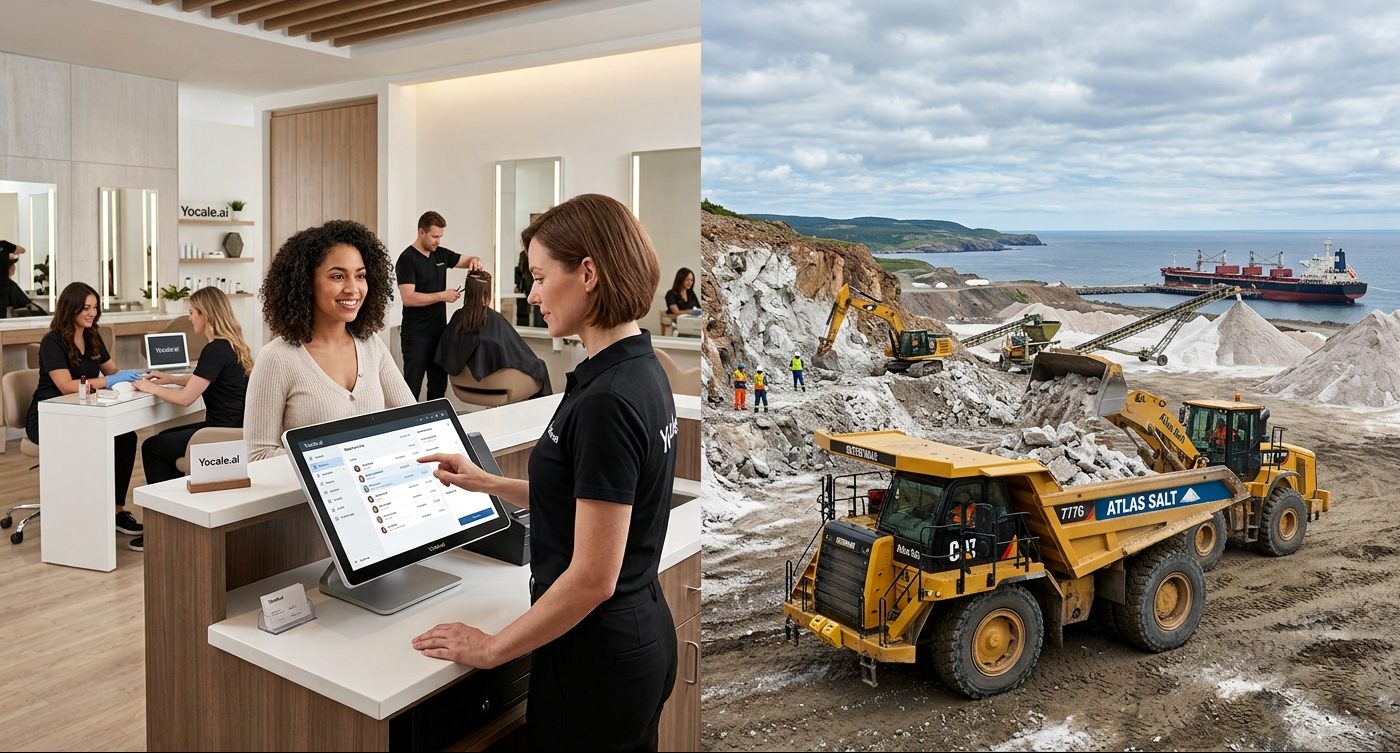
This is where Vancouver-based Yocale.ai, market cap C$54.38 million, thinks it can enhance your operations with an AI-powered operating system overseeing acquisitions, bookings, payments and client engagement, with the added benefit of machine learning to grow more efficient by the business day.
Yocale.ai’s first iteration of its platform, designed for the beauty and wellness industry, promises to help small businesses across the growth spectrum, from independent salons to enterprise wellness brands, create the kind of operating leverage normally reserved for industry leaders, where real-time visibility allows managers to optimize pricing, personalize client experiences and anticipate demand at scale.
The company’s flagship product is based on the established Yocale platform, which has modernized thousands of businesses across more than 22 countries, including medical, automotive, general retail and professional services, boasting a proven track record of significantly increasing bookings and client retention, while cutting admin work hours by the dozens, leaving room for additional publicly listed iterations should Yocale.ai achieve meaningful market share. To that end, the company is well-funded to pursue further scale, having closed a C$1.73 million capital raise in July.
That said, investors should offset their excitement with the fact that Yocale.ai only went public in May, meaning that there are no available financial results to build your conviction on. For prudence’s sake, give leadership a few quarters to show you what they’re made of.
Yocale.ai stock (CSE:YAI) last traded at C$0.83 and has added 232 per cent since inception.
Aydin Asli, Chief Executive Officer (CEO) of Yocale.ai, sat down with Stockhouse’s Ricki Lee to introduce the company to the world. Watch the interview here.
Atlas Salt
Now, for something completely different, let’s think about salt for a moment and the essential roles it plays in the world at large, from flavor enhancer and preserver, to cleaner and strain remover, to chemical feedstock for plastics, glass, chlorine and baking soda, granting it a more than US$40 billion global market on pace to surpass US$60 billion by 2030.
It may be difficult to think of a commodity so ubiquitous undergoing a shortage, but one is currently taking place in North America, covering both Canada and the United States,
creating public safety risks that’re incentivizing new ventures to satisfy demand.
Atlas Salt, market cap C$205.11 million, is throwing its name into the ring, advancing The Great Atlantic Salt project in Newfoundland, North America’s first new salt mine in nearly 30 years, to jumpstart an aging market (see slide 33 of the Q3 2026 investor deck).
Great Atlantic is targeting the more than US$2 billion North American de-icing salt market, where rock salt prices have steadily increased over the past two decades (see slide 10), by means of a high-grade deposit hosting 95 million tons grading 95.9 per cent NaCl2, de-risked by a feasibility study delineating an attractive value proposition:
- After-tax net present value (8 per cent discount) of C$920 million.
- After-tax payback of only 4.2 years, with pre-production CAPEX estimated at C$589 million.
- After-tax average annual free cash flow of ~C$188 million over an estimated 24-year mine life, accounting for reserves alone, with an inferred resource of 868 million tons grading 95.2 per cent NaCl likely extending operations past the half-century mark.
- A strong environmental bent, including plans for fully-electric operations that require no chemicals and will generate no tailings.
The mine, on pace for initial production by 2030, is focused on import-reliant markets such as the US, which turned to Canada for 29 per cent of the 67.5 million tons of salt it imported from 2020-2023 (see slide 11). An offtake agreement with Scotwood Industries, the largest distributor of packaged retail de-icing salt in the US, is already in place, targeting volumes of 1.25 to 1.5 million tons per year.
Nonetheless, like Yocale.ai and its short history as a public company, Atlas Salt also presents investors with a major asterisk to consider before putting dry powder to work, and that’s project financing.
While a C$150 million letter of intent with Export Development Canada and a C$132 million mining equipment memorandum of understanding with Sandvik are no doubt aiding in ongoing discussions with other potential backers, Great Atlantic has yet to be fully funded. This milestone, if met, will likely represent the company’s next major share price driver, marking its transition from speculative investment to supply chain pillar.
Nolan Peterson, Director and CEO of Atlas Salt, is a strategic choice to guide the company, given his more than 20 years in mining operations and development. He oversees a team of mine builders specializing in finance, engineering, exploration, construction and production, highly aligned with shareholders at more than 30 per cent insider ownership.
Atlas Salt stock (TSXV:SALT) last traded at C$1.59 and has added 238.30 per cent year-over-year.
Peterson spoke with Ricki Lee about a preliminary deal with the Canadian National Railway covering logistics for Great Atlantic, shedding light on what it could mean for the project’s path along the mining lifecycle. Watch the interview here.
Thanks for reading! I’ll see you next Monday for a new edition of Weekly Market Movers, where I delve into companies that joined Stockhouse for an interview over the past week. Here’s the most recent article, in case you missed it.
Join the discussion: Find out what investors are saying about these micro-cap stocks on the Yocale.ai Inc. and Atlas Salt Inc. Bullboards and make sure to explore the rest of Stockhouse’s stock forums and message boards.