Viridian Metals (CSE:VRDN) has zeroed in on Newfoundland and Labrador, chasing scale in one of the world’s most prospective copper belts.
With basin-wide targets outlined and drills now turning at the Kraken Main Zone, the company is positioning itself to unlock structural controls that could define the region’s next copper story.
Host, Ricki Lee, was joined by Tyrell Sutherland, CEO of Viridian Metals, for an episode of Capital Compass.
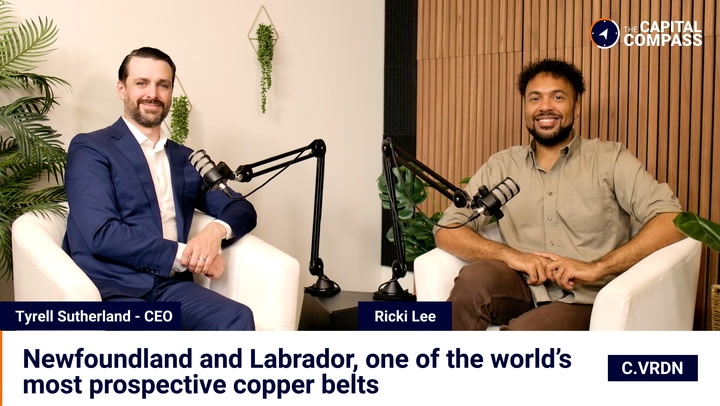
Ricki: Let’s start with the Sedna project. You recently laid out basin scale copper targets in the Seal Basin in Labrador. What makes these structural controls so compelling and how do they frame the scale potential for investors?
Tyrell: So, the Seal Basin is an unrecognized copper basin. The first thing we have to do is come in and look that there are structural controls of the scale necessary to build these big deposits.
You look at other sedimentary basins globally, like the Kupferschiefer or the Central African Copper Belt, you need the scale there before you can start building big, large deposits. What we identified at Seal really drives that thesis forward.
Some of these structures were over a hundred kilometers in length, which when they start intersecting the copper traps, which we’ve also identified, two of which extend for over 20 kilometers in length, it starts to show the scale of the system.
And that scale is what’s required to build really globally significant copper deposits.
Ricki: So, let’s zoom in a little bit then. Drilling at the Kraken main zone that’s commenced recently. So, walk us through what the program looks like and update us on what you found on the ground.
Tyrell: So, Kraken is our second project in Labrador. The mineralization there is in the same suite of intrusions that host the Voisey’s Bay deposit.
Our teams are out there on the ground now. We’re planning to do up to 35 holes this year. As of today, we’re at about 18 holes drilled.
Our first five holes actually ended in mineralization and were mineralized from the top of the hole to the bottom. This project is really unique in Canada in that mineralization is exceptionally shallow.
Most of the holes that we’re intersecting mineralization in are mineralized from surface. So, we’ve actually had to develop new drill technology in-house to really test this to depth, because our average mineralized zones end at about 25 to 30 meters deep.
So, we’ve developed a type of drill technology that can test these surface deposits effectively and move quickly where our cost per drill target is actually significantly less than industry average.
So, it’s fantastic. We’re getting holes that are mineralized from surface to 25 meters and not needing a helicopter to move it. We’re going from site to site just with manpower out on the ground.
Ricki: So, let’s look at both the Sedna and the Kraken projects together now. How do they fit together in building a long-term growth story for the company?
Tyrell: So, when we were looking at projects throughout Canada, we really zoomed in on Labrador as just an effective place to explore. The regulatory regime there makes a lot of sense.
And it’s the jurisdiction in Canada that is most favorable to mining people there are really accepting of mining and happy to have us there. It was the first place in Canada where I came out of the bush, and I was actually thrown a barbecue by one of the local families.
But beyond that, from an exploration standpoint, it has really been under explored. At our Seal Basin project, we have a land position that covers over 2,600 square kilometers. That’s roughly the size of the entire country of Luxembourg.
And this is a road accessible project. There’s over 300 existing copper occurrences in the basin and the prime areas for large copper deposits have never been explored here before.
And the road access that allows us to get into that basin is actually the same road access that allows us to get to the Kraken project. So we’re able to share infrastructure and camps and a lot of activities just because of the proximity of these two projects that have never really been effectively explored.
Ricki: So, let’s take a look now at the next 12 months, for example, what milestones should investors be watching as you advance drilling, generate results and move these copper projects up the value curve?
Tyrell: So, the first things that we should be starting to receive in the next three to four weeks are the initial drill results from Kraken. The first set of drill holes was actually just sent off to the lab today.
So, we should start getting results soon and then we’ll continue to get results well into November, possibly as late as December. This is the first time the copper potential at Kraken has really been the highlight of the exploration here.
And people often forget it’s the same suite of intrusions that host Voisey’s Bay, but Voisey’s Bay is also a 1.5% percent copper resource. So, we’re intersecting zones that are over 4% copper in some cases.
And so really outlining what that copper resource looks like at the main zone will be pretty key to our story going forward. On the Sedna fronts, we have extended our BHP Explorer agreement until December this year.
So, we will be looking at furthering that partnership over the next three months and should be having news out regarding that by the end of the year or early next year.
Ricki: You guys have got a lot going on it seems. I wish you all the best. Thank you so much, Tyrell Sutherland for joining us today and letting us know all about the inside track at Viridian Metals.
You can learn more at viridianmetals.com.
Join the discussion: Find out what everybody’s saying on this stock on the Viridian Metals investor discussion forum, and check out the rest of Stockhouse’s stock forums and message boards.
The material provided in this article is for information only and should not be treated as investment advice. For full disclaimer information, please click here.