
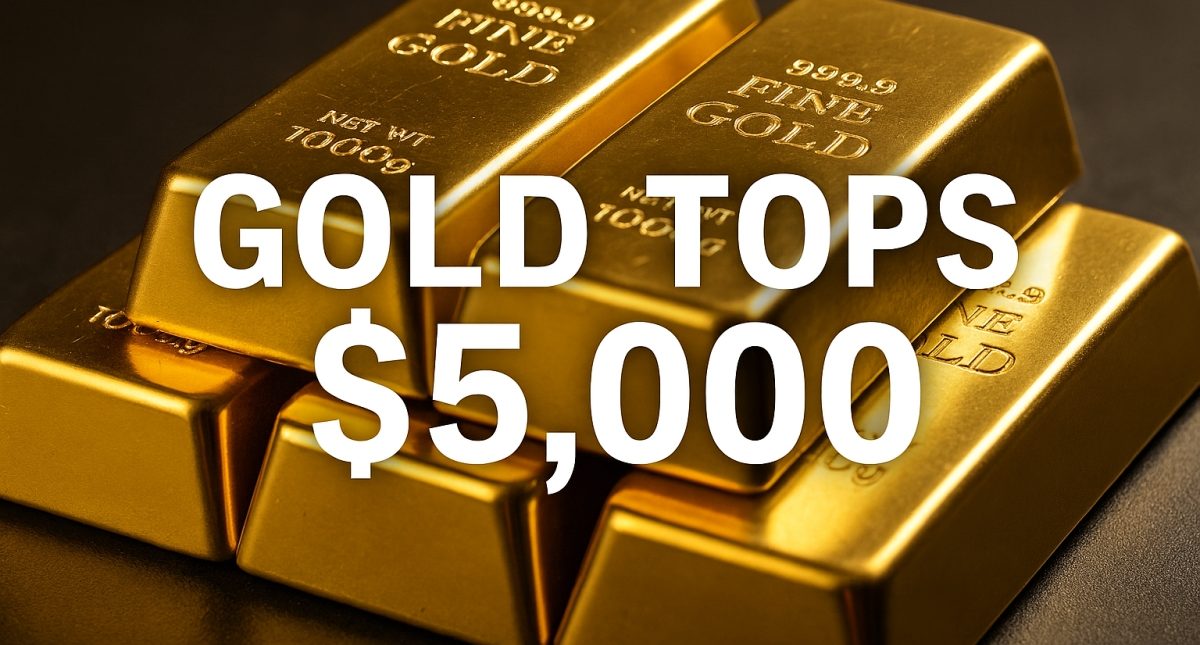

- Gold broke above US$5,000 per ounce for the first time, extending a historic rally driven by escalating geopolitical and economic uncertainty
- Tensions between the U.S. and NATO over Greenland, along with broader global instability, have accelerated safe‑haven demand
- Expectations of Federal Reserve rate cuts and continued central‑bank gold buying have further boosted investor appetite
- Analysts say the surge reflects the growing “debasement trade,” as investors seek protection from rising global debt and fears of long‑term inflation
Gold prices smashed through the US$5,000-per‑ounce (C$6,800) barrier for the first time in history, extending a record‑setting rally fueled by geopolitical strains, concerns over rising global debt, and expectations of further monetary easing around the world.
Spot prices climbed as high as US$5,078.70, marking one of the most significant milestones in the precious metal’s trading history.
The latest leg of gold’s surge follows a dramatic 2025 rally and reflects an intensifying flight to safety amid mounting uncertainty. Bullion is now up more than 17 per cent year‑to‑date, after posting a powerful multi‑month advance driven by macroeconomic anxiety, central‑bank demand, and deteriorating confidence in financial institutions.
This article is a journalistic opinion piece that has been written based on independent research. It is intended to inform investors and should not be taken as a recommendation or financial advice.
Greenland dispute amplifies safe‑haven demand
One of the defining geopolitical pressures elevating gold has been the escalating standoff between the United States and its NATO allies over Greenland. Renewed U.S. tariff threats tied to strategic control of the Arctic territory have sent shockwaves through global markets, intensifying fears of a broader trade rupture. Recent reporting highlights that gold’s historic run has been tightly correlated with these tensions, as investors flee into assets traditionally insulated from political risk.
Analysts note that trade‑related uncertainty has become a recurring trigger for upward moves in bullion, pushing safe‑haven positioning to levels not seen in years. The weakening U.S. dollar — which recently posted one of its sharpest declines in a month — has further boosted demand by making gold more affordable in global markets.
Monetary policy expectations add fuel to the rally
Expectations that the U.S. Federal Reserve will cut interest rates again this year are also strengthening the case for gold. Lower rates decrease the opportunity cost of holding non‑yielding assets, making gold more attractive to both institutional and retail investors.
Central banks worldwide have meanwhile continued to expand their gold reserves — a trend that major financial institutions say has become a structural driver of price support. Official‑sector buying has remained strong since 2022, with forecasts suggesting that global central banks could continue absorbing hundreds of tonnes of bullion throughout 2026.
A symbol of the “debasement trade”
Analysts across Wall Street have increasingly described gold’s meteoric rise as the embodiment of the so‑called “debasement trade” — a shift toward assets perceived as shields against the erosion of purchasing power. High fiscal deficits, ballooning sovereign debt, and growing concerns over long‑term inflation dynamics have contributed to a perception that major governments may eventually rely on financial repression or inflationary tactics to manage their debt burdens.
Forecasts reflect this sentiment: several major banks expect gold to average near or above US$5,000 per ounce through much of 2026, with some projecting potential spikes toward US$5,400 amid financial or political stress.
Market outlook: Volatility ahead, but bullion’s shine endures
While gold’s rapid ascent has fueled speculation about an overheated market, technical indicators continue to reflect strong bullish momentum. Market watchers say the metal’s breach of the psychologically significant US$5,000 threshold underscores the magnitude of current macroeconomic pressures — from geopolitical realignment to persistent fiscal anxieties.
With safe‑haven demand entrenched and policy ambiguity lingering, analysts caution that volatility is likely ahead. However, they also note that gold’s role as a portfolio stabilizer appears stronger than ever, supported by powerful structural forces and a global investment community preparing for a new era of economic uncertainty.
Join the discussion: Find out what the Bullboards are saying about gold mining stocks and check out Stockhouse’s stock forums and message boards.
Stockhouse does not provide investment advice or recommendations. All investment decisions should be made based on your own research and consultation with a registered investment professional. The issuer is solely responsible for the accuracy of the information contained herein. For full disclaimer information, please click here.