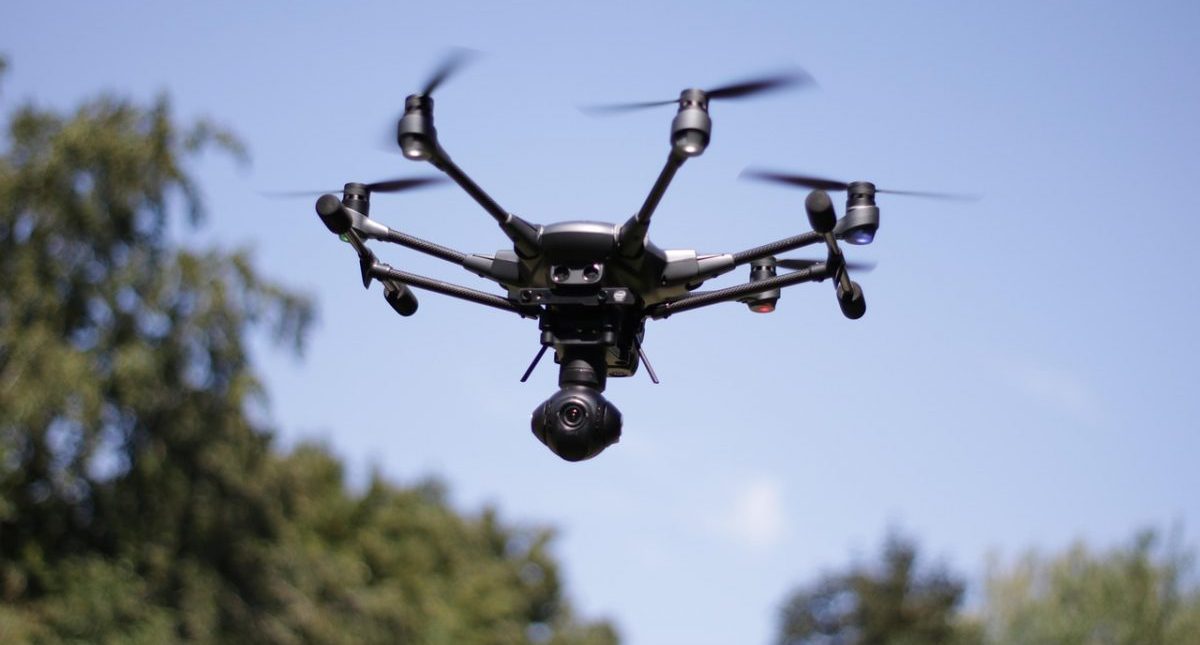


The geopolitical tensions of recent years have brought a fundamental truth to light. Security is not just a matter of tanks and soldiers, but increasingly a race for technological superiority. While established, large companies like Rheinmetall are securing record orders and DroneShield is trying to secure the skies above our heads, a third player is quietly moving into the center of power: NEO Battery Materials. Today, it is no longer just about who builds the best drone, but also about who keeps it in the air the longest and most efficiently. In a world where conflicts like those in Iran or Ukraine are decided by autonomous systems, traditional armaments and state-of-the-art battery technology are merging into a single entity. We take a look behind the scenes of an industry that offers completely new opportunities for investors right now.
This article is disseminated in partnership with Apaton Finance GmbH. It is intended to inform investors and should not be taken as a recommendation or financial advice.
Rheinmetall: The Backbone of European Defense
The current situation on global markets leaves no doubt that the era of peace is finally over. In this environment, Rheinmetall has emerged as one of the most significant players on the European continent. The Düsseldorf-based group no longer operates merely as a simple machinery manufacturer, but as an indispensable supplier of defense equipment to NATO. The figures the company is presenting for 2026 are impressive. But sometimes, “good” just isn’t good enough on the stock market. With a targeted annual revenue of up to EUR 14.5 billion, Rheinmetall is making a bold statement about its growth ambitions. This development is driven by a massive order backlog, which has now surpassed the EUR 63.8 billion mark. Management has clearly defined its focus and is consistently divesting itself of legacy burdens from the automotive supply business to fully concentrate its capacities on the defense sector.
Particularly impressive is the operating margin the company is targeting. At around 19%, Rheinmetall demonstrates that efficiency and impact need not be a contradiction. Whether it is the Puma infantry fighting vehicle or the proven Leopard, demand for heavy equipment is higher than it has been since the end of the Cold War. And even if Rheinmetall does not build the tanks entirely on its own, it supplies components for them. The stock market recognizes this strength, even though the share price has recently consolidated around the EUR 1,600 level. This sideways consolidation could be interpreted as a breather before the next big leap. After all, Rheinmetall provides the foundation upon which modern defense strategies are built. But in modern warfare, where tanks are often threatened by small, low-cost flying objects, it takes more than just thick steel. This is where the logical chain begins, leading directly to the next crucial building block of modern security.
DroneShield: The Digital Shield Against Threats from Above
What good is the most impressive tank fleet if it can be neutralized by swarms of cheap drones? This question poses new challenges for military strategists worldwide. DroneShield has established itself as the global market leader in precisely this niche. The company offers the digital solution to a threat that was considered science fiction just a few years ago. In conflicts such as those currently unfolding in the Middle East or Eastern Europe, drones have become a decisive factor. They serve as eyes, ears, and weapons all at once. DroneShield provides the technology to detect these threats early and neutralize them electronically without firing a single shot. This form of electronic warfare is as important today as traditional artillery.
The company is also benefiting significantly from the fact that armies and security agencies worldwide are significantly increasing their budgets for drone defense. This is not just about the battlefield. Airports and critical infrastructure, in particular, must be specially protected against attacks. DroneShield offers the solution for this. AI-based systems enable the identification and classification of aerial threats in real time. This is a valuable complement to Rheinmetall’s tank solutions and heavy artillery. Yet every drone, whether used for defense or surveillance, has an Achilles’ heel: its power supply. This brings us full circle to a company that is laying the chemical foundation for the next generation of mobility and defense.
NEO Battery Materials: Delivering Technological Sovereignty
When we talk about modern warfare, as seen in the current Iran conflict or, for more than four years now, across the vast expanses of Ukraine, we are always talking about batteries. This is where NEO Battery Materials (TSXV:NBM) enters the picture. The Canadian-South Korean company is far more than just a materials developer. It is the key to the next level of autonomous systems. Recently, the team led by CEO Spencer Huh announced that a 3.2-hectare site had been acquired for a commercial battery cell factory. This is a crucial milestone, as this facility is set to manufacture high-performance pouch cells specifically tailored to the needs of drone manufacturers and the military. The strategic highlight here is the deliberate move away from Chinese supply chains. At a time when the US National Defense Authorization Act (NDAA) of 2026 prohibits the use of Chinese batteries in defense applications, NEO is positioning itself as the Western alternative.
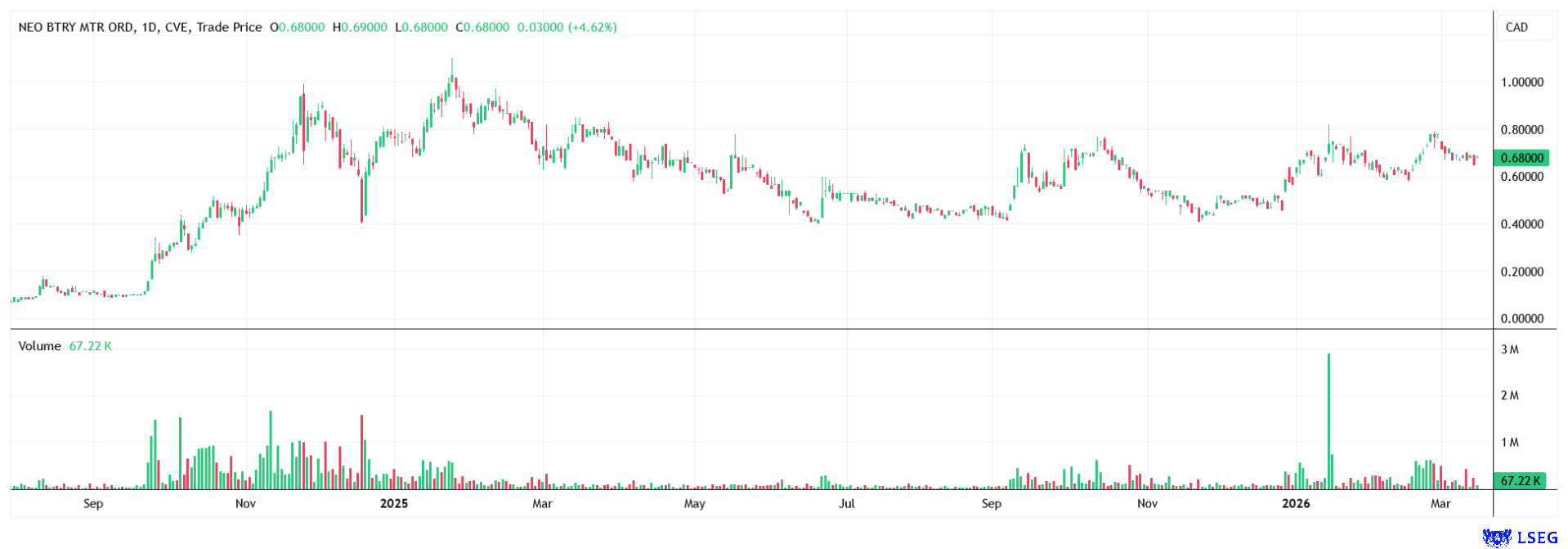
At the heart of this innovation is the company’s proprietary silicon anode technology called NBMSiDE. Conventional graphite anodes have long since reached their limits. NEO’s silicon solutions, on the other hand, offer up to seven times higher capacity. For a soldier in the field or a drone operator, this means significantly longer flight times and shorter charging cycles. The P200 product line is specifically designed for loitering munitions – the “kamikaze drones” that are so effective in modern conflict. The P300N anodes, in turn, are used in reconnaissance drones, where every additional minute in the air counts. NEO’s goal is clearly defined: to achieve an annual capacity of 500 megawatt-hours. This would be enough to equip approximately 315,000 units of loitering munitions or 66,000 ISR drones per year.
The collaboration with the South Korean Ministry of Defense is intended to be just the beginning. This validation by one of the world’s most advanced armies serves as a seal of approval for NATO partners and the United States. NEO Battery Materials thus skillfully connects the world of high technology with defense policy. With a projected market volume for drone batteries of USD 29 billion by 2032, the company is in an excellent starting position. It is precisely this blend of science and market positioning that makes NEO so interesting right now, because while others are still debating dependence on Asia, NEO is already creating a fait accompli in South Korea. What is important here is that everything must be practical and applicable in the real world. Scalability is equally important. This is a very exciting story and stock for the future – not just for drone enthusiasts.
Conclusion: Synergies for a Safer Future
In summary, we are dealing here with three companies whose technologies complement each other across the modern defense ecosystem. Rheinmetall remains the undisputed top dog in the arms and defense sector, providing stability with its billion-euro contracts and focus on its core business. DroneShield occupies the increasingly important field of electronic defense and protects what Rheinmetall builds. Finally, NEO Battery Materials supplies the necessary technological fuel for the digital army of tomorrow.
NEO Battery Materials is also proving to be a shrewd player, as the company is establishing its own cell production and strictly adheres to Western security standards. Anyone who closely follows the developments in modern conflicts will recognize that these three stocks together form a powerful portfolio for a world in which security once again has its value – and its price.
Conflict of interest
Pursuant to §85 of the German Securities Trading Act (WpHG), we point out that Apaton Finance GmbH as well as partners, authors or employees of Apaton Finance GmbH (hereinafter referred to as “Relevant Persons”) currently hold or hold shares or other financial instruments of the aforementioned companies and speculate on their price developments. In this respect, they intend to sell or acquire shares or other financial instruments of the companies (hereinafter each referred to as a “Transaction”). Transactions may thereby influence the respective price of the shares or other financial instruments of the Company.
In this respect, there is a concrete conflict of interest in the reporting on the companies.
In addition, Apaton Finance GmbH is active in the context of the preparation and publication of the reporting in paid contractual relationships.
For this reason, there is also a concrete conflict of interest.
The above information on existing conflicts of interest applies to all types and forms of publication used by Apaton Finance GmbH for publications on companies.
Risk notice
Apaton Finance GmbH offers editors, agencies and companies the opportunity to publish commentaries, interviews, summaries, news and the like on news.financial. These contents are exclusively for the information of the readers and do not represent any call to action or recommendations, neither explicitly nor implicitly they are to be understood as an assurance of possible price developments. The contents do not replace individual expert investment advice and do not constitute an offer to sell the discussed share(s) or other financial instruments, nor an invitation to buy or sell such.
The content is expressly not a financial analysis, but a journalistic or advertising text. Readers or users who make investment decisions or carry out transactions on the basis of the information provided here do so entirely at their own risk. No contractual relationship is established between Apaton Finance GmbH and its readers or the users of its offers, as our information only refers to the company and not to the investment decision of the reader or user.
The acquisition of financial instruments involves high risks, which can lead to the total loss of the invested capital. The information published by Apaton Finance GmbH and its authors is based on careful research. Nevertheless, no liability is assumed for financial losses or a content-related guarantee for the topicality, correctness, appropriateness and completeness of the content provided here. Please also note our Terms of use.
Stockhouse does not provide investment advice or recommendations. All investment decisions should be made based on your own research and consultation with a registered investment professional. The issuer is solely responsible for the accuracy of the information contained herein. For full disclaimer information, please click here.