

- Saga Metals (TSXV:SAGA) agreed to acquire Catalyst Rare Metals, gaining 100 per cent ownership of the royalty‑free Wolverine rare earth project in central Labrador through a share‑and‑cash transaction with milestone-based payments
- Recent drilling at Wolverine confirmed broad, near-surface REE mineralization, with thick intercepts, peak grades above 2 per cent TREO, and a relatively high heavy rare earth component across a large, under‑explored caldera system
- Saga plans to advance the project toward an NI 43‑101 resource, with diamond drilling, metallurgical testing, and technical studies targeted in a 2026 exploration program
- Saga Metals stock (TSXV:SAGA) opened trading at $0.58
Canadian critical metals explorer, Saga Metals (TSXV:SAGA) signed a definitive share purchase agreement to acquire Catalyst Rare Metals Ltd., adding the Wolverine rare earth element (REE) project in central Labrador to its portfolio.
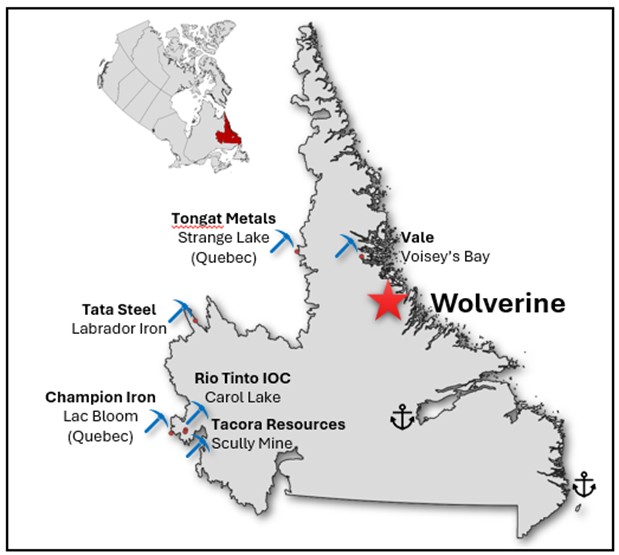
Under the agreement dated April 13, 2026, Saga will acquire all issued and outstanding shares of Catalyst, which holds a 100 per cent interest in the Wolverine REE project. The project is royalty-free and located approximately 12 kilometres inland from the Labrador coast, west of the community of Hopedale.
Project background and recent work
The Wolverine REE project comprises five contiguous mineral licenses covering approximately 230.5 square kilometres within the Flowers River Igneous Suite, the largest peralkaline intrusive‑volcanic complex in Labrador. The property lies within the broader Labrador–Greenland peralkaline province, which hosts several globally recognized rare earth deposits.
Exploration at Wolverine has focused on near-surface, stratabound rare earth mineralization hosted in peralkaline ash‑flow tuffs associated with a partially eroded Proterozoic caldera system. Rare earth mineralization is reported to occur primarily as bastnäsite, allanite, and monazite, with yttrium-bearing accessory minerals contributing to the heavy rare earth component. Accessory niobium and zirconium enrichment has also been documented.
Initial confirmation drilling was completed in 2023 and 2024 using shallow backpack drilling. Although limited to depths of less than six metres, several holes returned elevated total rare earth oxide (TREO) grades, including intercepts exceeding 1 per cent TREO near surface.
2025 RC drilling results
More extensive testing was carried out in 2025 through a reverse circulation drilling program comprising 25 drill holes and 537 samples. According to Saga, the drilling confirmed broad, laterally continuous rare earth mineralization across an area measuring approximately 1.7 kilometres by 1.2 kilometres.
Reported drill intercepts include:
- WOLRC25‑003: 48.8 metres grading 0.77 per cent TREO from 1.5 metres depth, including 18.3 metres at 1.06 per cent TREO
- WOLRC25‑006: 38.1 metres grading 0.71 per cent TREO from surface, including 4.6 metres at 1.53 per cent TREO
- WOLRC25‑002: 51.8 metres grading 0.52 per cent TREO from surface, including 33.5 metres at 0.67 per cent TREO
Peak sample grades from the program reached 2.03 per cent TREO. The company reported an average heavy rare earth oxide (HREO) contribution of approximately 24–28 per cent, which is considered notable for peralkaline REE systems. Mineralization remains open both laterally and at depth, with less than 10 per cent of the prospective host unit tested to date.
Geological setting and regional context
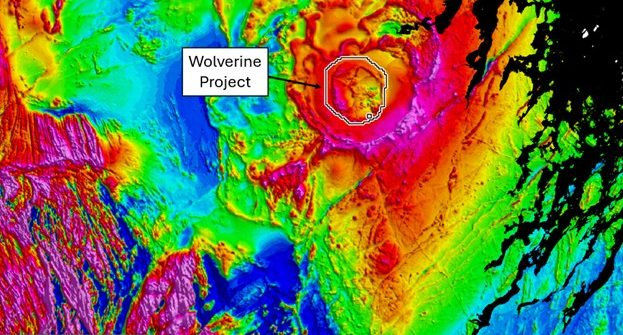
Wolverine is situated within a nested caldera system estimated to be approximately 1.3 billion years old and part of the Flowers River Igneous Suite. An airborne magnetic survey completed in 2018 outlines the caldera complex as a prominent circular magnetic anomaly, distinct from surrounding lithologies of the Nain Plutonic Suite.
The broader peralkaline province hosts other large rare earth systems, including Tanbreez in South Greenland and Strange Lake on the Québec‑Labrador border. Saga noted that the Wolverine project differs from these deposits in that mineralization is hosted in near-surface volcanic units rather than intrusive complexes. The company has not independently verified public resource figures reported for neighbouring deposits.
Infrastructure and access
The project is accessible by fixed‑wing aircraft to the Hopedale gravel airstrip, followed by helicopter access to site. Regional infrastructure includes scheduled air service, ferry routes, and road access near the communities of Natuashish and Hopedale. The project’s proximity to tidewater—approximately 12 kilometres—may provide logistical advantages for future exploration or development. Local communities in the region have established agreements with the nearby Voisey’s Bay nickel mine.
Leadership commentary
“The agreement to acquire of the Wolverine REE Project is a major milestone for Saga Metals and completes our diversified portfolio of critical minerals projects, strategically positioned to support North American supply security and national defence priorities,” Saga’s CEO and director, Mike Stier, said in a news release. “With titanium, uranium, vanadium, lithium, and now a high-potential heavy rare earth asset all 100 per cent owned in Tier-1 jurisdictions, Saga is well placed to deliver the strategic metals essential for the clean-energy transition and defence applications. Wolverine’s scale, HREE enrichment, and clear path to resource delineation position it as a well-timed addition with significant potential to enhance shareholder value.”
Planned 2026 work program
Saga indicated that it intends to advance Wolverine toward a National Instrument 43‑101 compliant mineral resource estimate, subject to additional diamond drilling and metallurgical testing. A proposed 2026 work program includes diamond core drilling to confirm vertical continuity, collection of material for metallurgical analysis, step‑out drilling, structural interpretation, and technical studies to support future resource definition.
Transaction terms
Under the terms of the acquisition, Saga will issue 4.25 million common shares to the Catalyst shareholders at closing and pay $1 million in cash within 120 days. The agreement also includes a series of milestone-based payments tied to resource definition, economic studies, and feasibility milestones. These payments include additional Saga shares and cash, contingent on the project achieving specified thresholds for contained TREO, heavy rare earth proportions, and economic metrics such as net present value and internal rate of return.
Completion of milestone payments will be based on the publication of independent technical reports prepared in accordance with NI 43‑101 standards.
About Saga Metals
Saga Metals is a North American mining company focused on critical minerals exploration and development. Besides its flagship Radar project, the company’s portfolio includes:
- The 25,600-hectare Double Mer uranium project in Labrador, where a 14-km section sampled up to 0.428 per cent U3O8.
- The 65,849-hectare Legacy lithium property in Québec’s Eeyou Istchee James Bay region, developed with Rio Tinto, which shares geological continuity with other major projects in the area operated by Winsome Resources, Azimut Exploration and Loyal Metals.
Saga Metals stock (TSXV:SAGA) opened trading at $0.58 and has risen more than 175 per cent since this time last year.
Join the discussion: Find out what investors are saying about this titanium stock on the Saga Metals Corp. Bullboard and make sure to explore the rest of Stockhouse’s stock forums and message boards.
Stockhouse does not provide investment advice or recommendations. All investment decisions should be made based on your own research and consultation with a registered investment professional. The issuer is solely responsible for the accuracy of the information contained herein. For full disclaimer information, please click here.