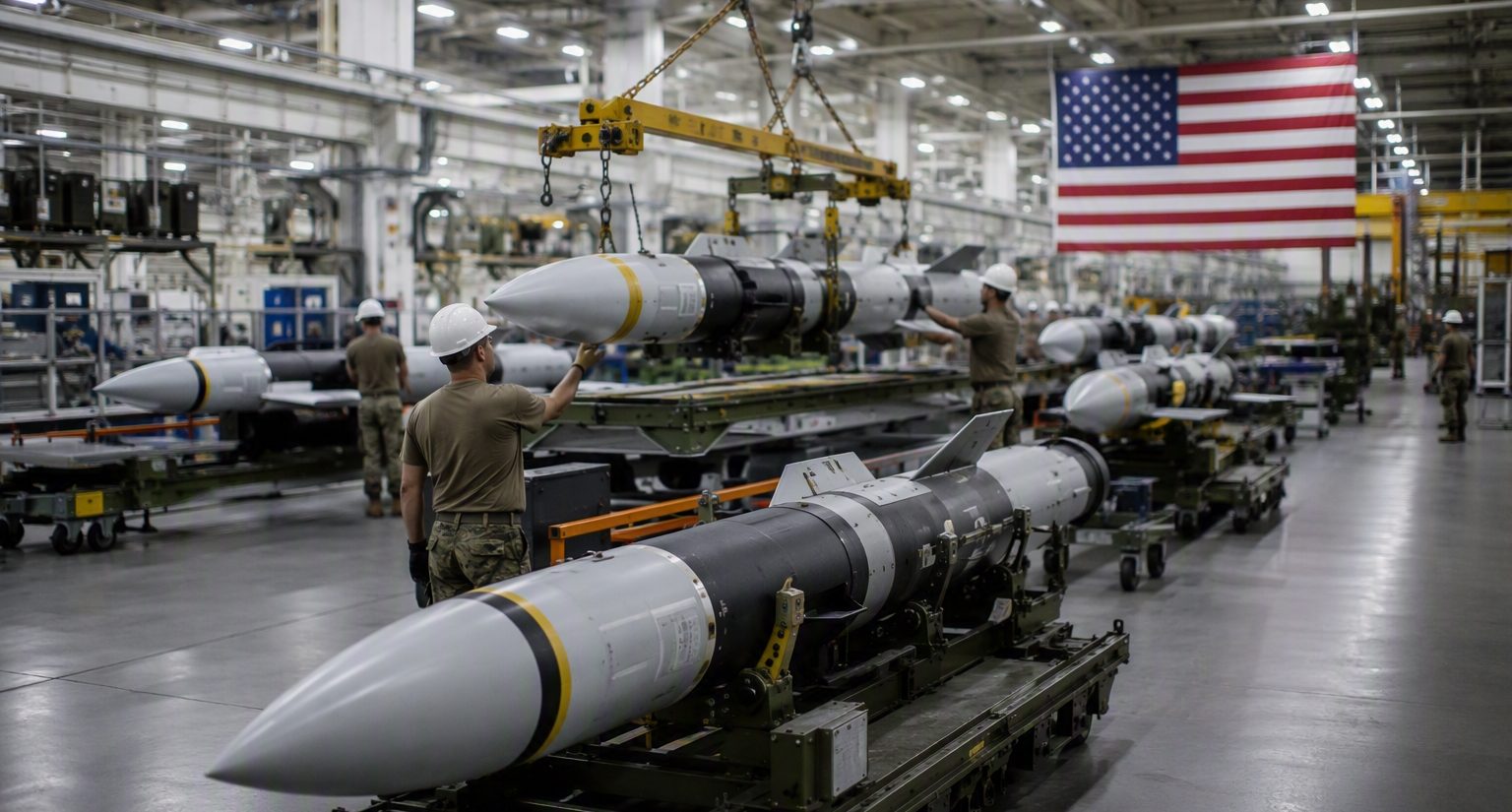

- The Pentagon has urged defence contractors to accelerate weapons production as heavy use of Patriot and THAAD interceptors during the Iran conflict has strained U.S. stockpiles
- Lockheed Martin (NYSE:LMT) appears positioned to benefit most directly through increased demand for Patriot and THAAD missile systems and replenishment contracts
- BAE Systems (LSE:BA) and Honeywell (NASDAQ:HON) could see indirect gains as higher defence spending boosts demand for military electronics, combat systems, sensors, and other critical components
- MDA Space (TSX:MDA) may benefit from growing investment in satellite-based missile tracking, surveillance, and space-defence infrastructure supporting modern missile defence networks
The Pentagon’s decision to press U.S. defence contractors to accelerate weapons production marks one of the strongest signals yet that Washington is preparing for a prolonged period of elevated defence demand. The move comes amid reports that the war with Iran has significantly drawn down inventories of critical munitions, particularly Patriot and THAAD missile interceptors, prompting concerns about the readiness of U.S. stockpiles.
According to reports, Deputy Defense Secretary Steve Feinberg has instructed industry leaders to submit plans within 21 days showing how they can increase production capacity and shorten delivery timelines. The Pentagon’s message is clear: the traditional multi-year pace of weapons procurement is no longer sufficient for current geopolitical realities.
For investors, the development is less about the immediate conflict and more about what it could mean for defence budgets, order backlogs, and manufacturing capacity over the next several years.
This article is a journalistic opinion piece that has been written based on independent research. It is intended to inform investors and should not be taken as a recommendation or financial advice.
A defence industry reacceleration
The key issue is not simply replacing weapons used in the Iran conflict. The Pentagon is simultaneously supporting allies, maintaining reserves, and preparing for potential future contingencies involving major powers such as China and Russia. Reports indicate that Patriot and THAAD inventories have fallen substantially from pre-war levels, increasing urgency around replenishment efforts.
The Department of Defense has already begun awarding larger contracts tied to missile defence production. Earlier this month, the Pentagon announced agreements intended to triple Patriot interceptor production and quadruple THAAD-related production capacity.
The erosion and weakening of U.S forces creates a potentially favourable environment for several publicly traded defence and aerospace companies.
Lockheed Martin
Among major defence contractors, Lockheed Martin (NYSE:LMT) appears to be one of the most direct beneficiaries.
Lockheed is the prime contractor for the THAAD missile defence system and is also heavily involved in Patriot PAC-3 interceptor production. The company recently secured a contract that could be worth up to $58.6 billion for Patriot interceptors, while additional Pentagon agreements are expected to support long-term missile production expansion.
From an investor perspective, several factors stand out:
- Larger missile replenishment orders
- Increased utilization of manufacturing facilities
- Potential acceleration of existing contracts
- Greater visibility into future revenue streams
While Lockheed already maintains a substantial backlog, investors may view the Pentagon’s latest actions as increasing the likelihood of sustained missile-defence spending well beyond the current conflict. The company’s missile and fire control division could be a particularly important growth driver if interceptor demand remains elevated.
Investor takeaway: Lockheed appears to have the most direct exposure to the replenishment cycle underway. Lockheed Martin stock (NYSE:LMT) is up more than 20 per cent since the year began.
BAE Systems
BAE Systems (LSE:BA) may not be the headline name in Patriot and THAAD programs, but the company occupies an important role across the broader defence supply chain.
BAE manufactures a variety of combat systems, electronic warfare technologies, precision-guidance components, and military support systems used across NATO and U.S. defence networks. Historically, periods of rising geopolitical tensions have resulted in increased spending not only on missiles but also on sensors, command-and-control systems, electronic warfare capabilities, and military modernization programs where BAE is active.
The Pentagon’s push to expand capacity throughout the defence industrial base suggests that demand growth could extend beyond prime contractors to major subsystem suppliers and defence electronics providers.
For BAE investors, the potential opportunity is less about any single interceptor program and more about:
- Expanded NATO defence spending
- Higher procurement budgets
- Supply-chain participation in missile-defence programs
- Long-term military modernization initiatives
Investor takeaway: BAE is likely an indirect beneficiary, with gains tied more broadly to a stronger defence spending cycle. NAE stock (LSE:BA) is up more than 27 per cent since the year began.
Honeywell
Honeywell (NASDAQ:HON) is often viewed as an industrial and aerospace company rather than a pure-play defence contractor, but it remains deeply embedded in military programs through avionics, guidance systems, navigation technologies, engines, sensors, and defence electronics.
If Pentagon procurement volumes increase across missiles, aircraft, and integrated defence systems, Honeywell could benefit through higher demand for components and systems deployed throughout those platforms.
The investment case here differs from Lockheed:
- Honeywell is unlikely to experience the same dramatic contract announcements
- However, increased production throughout the defence ecosystem can generate incremental demand across multiple business segments
- Defence growth could complement the company’s commercial aerospace recovery and industrial automation businesses
Investor takeaway: Honeywell offers more diversified exposure, potentially allowing investors to participate in defence growth without taking on the full concentration risk of a pure defence stock. Honeywell stock (NASDAQ:HON)is up 20 per cent since the year began
MDA Space
MDA Space (TSX:MDA) may be the most interesting secondary beneficiary for Canadian investors.
Unlike Lockheed or BAE, MDA is primarily associated with space infrastructure, satellite systems, robotics, and space-based intelligence capabilities. However, modern missile defence increasingly depends on space assets for missile warning, tracking, communications, and surveillance.
As North America continues expanding missile-defence capabilities, there is growing emphasis on:
- Satellite-based missile tracking
- Space situational awareness
- Secure military communications
- Integrated defence networks
MDA’s expertise in space-based sensing and defence-related satellite technologies places the company in a stable position if North American governments accelerate investment in next-generation missile warning architecture. While the company’s benefit would likely be less immediate than that of traditional weapons manufacturers, the long-term trend toward integrated space and missile defence could be significant.
MDA Space was even selected by BAE Systems back in June for the U.S. Space Systems Command MECO Epoch 2 constellation.
Investor takeaway: MDA is a higher-growth, less obvious defence play that could benefit from increased spending on the missile-defence space layer rather than on missile production itself. MDA Space stock (TSX:MDA) is up more than 80 per cent since the year began.
The sit-rep
The most important takeaway is that the Pentagon’s request does not appear to be a short-term response alone. Defence officials are increasingly focused on expanding industrial capacity after discovering how quickly modern conflicts can consume advanced munitions inventories.
For investors, that suggests the opportunity may extend far beyond replacing missiles used in the current war in Iran. If Washington commits to larger stockpiles, higher production rates, and expanded missile-defence networks, defence companies could enjoy years of elevated demand.
Among the names discussed:
- Lockheed Martin appears to be the clearest direct winner
- BAE Systems could benefit through wider defence modernization spending
- Honeywell offers diversified exposure through defence electronics and aerospace systems
- MDA Space represents a longer-term play on the increasing importance of space-based missile defence and military surveillance
While investors should remain mindful of valuation, budget risks, and the possibility of future geopolitical de-escalation, the Pentagon’s latest actions reinforce a theme that has been building for several years: defence production capacity is becoming a serious asset, and companies positioned to expand it may see meaningful long-term benefits.
Join the discussion: Find out what the Bullboards are saying about aerospace and defence stocks, then check out Stockhouse’s stock forums and message boards.