

Key Highlights
- QNX, a BlackBerry division, plans to showcase new demonstrations at CES 2027.
- Demos are set to cover robotics, Physical AI and software-defined vehicle development tools.
- QNX said the exhibits will focus on safety-certified, real-time software for mission-critical systems.
QNX, a division of BlackBerry Limited (NYSE: BB) (TSX: BB), said it plans to showcase new demonstrations spanning Physical AI, robotics and software-defined vehicles at CES, scheduled for January 6-9, 2027.
The company said the demonstrations are intended to highlight the role of safety-certified, real-time software as artificial intelligence is used in more complex systems, including vehicles and robotics. QNX said it will host the demos in a private meeting suite (W315) in the West Hall.
This article is a journalistic opinion piece which has been written based on independent research. It is intended to inform investors and should not be taken as a recommendation or financial advice.
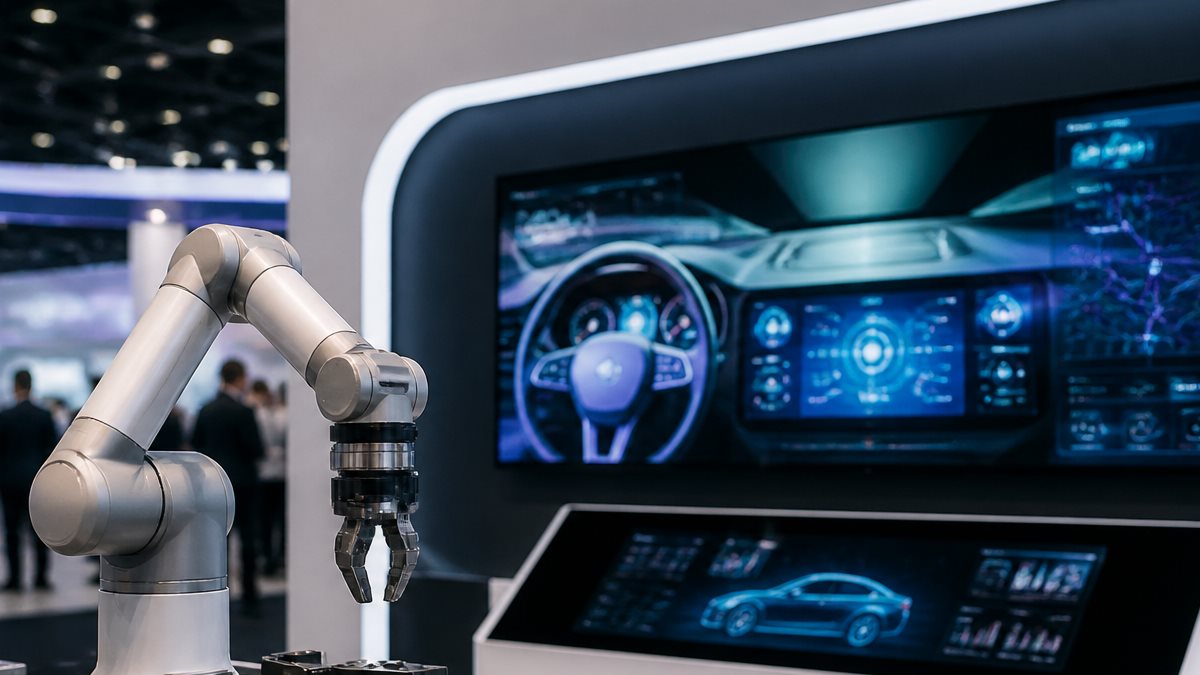
Among the planned demonstrations, QNX said it will show two robotics setups under the theme “Physical AI on QNX.” One uses open-source robot arms running on Raspberry Pi hardware to demonstrate “QNX Everywhere” as an entry point for building Physical AI applications on QNX. The other uses a Flexiv industrial robot arm and is designed to show AI perception and sensor fusion used to replicate human movements and respond to obstacles, with QNX providing the underlying software foundation.
QNX also outlined a “Physical AI Studio” demonstration that it said will run on an Intel NUC with an NVIDIA graphics processing unit. The company said the setup combines AI perception, generative AI, ROS 2 tools and robotics simulators on QNX OS 8, with the goal of connecting open-source development with a platform intended for production environments.
For automotive software, QNX said it will demonstrate “cloud-first digital cockpit development” using QNX Cabin, which it described as a way for development teams to simulate, integrate and test digital cockpit software in the cloud before pre-production hardware is available. QNX said the demo will use live signals and camera streams to create a cloud-based cockpit twin.
Another planned exhibit is a “mixed-criticality cockpit” demonstration on Qualcomm hardware. QNX said it will show safety-critical displays operating alongside Android infotainment, illustrating how QNX OS and the QNX Hypervisor can support multi-operating-system automotive systems on a single system-on-chip.
QNX also said it will present an interactive decision simulator for Alloy Kore, which it described as a foundational automotive operating system developed with Vector. The simulator is designed to show how architectural choices can increase software integration complexity, and to compare a traditional approach with Alloy Kore’s common interface.
“At CES 2027, we look forward to showing how QNX provides that foundation and can help developers turn ambitious ideas into intelligent systems built for the real world,” Carsten Hurasky, SVP and CMO at QNX, said.
QNX said attendees can visit its suite in the West Hall Meeting Suite or schedule a meeting with a spokesperson.
Read the original press release on Stockhouse.com.
s-17v5_h-18v5_i-19v5