
Germany as a Business Location: VW and BMW Under Pressure
Now we have it in black and white! Germany as an industrial location, saddled with the highest energy costs and an ailing economy, is sliding through a historic structural crisis in which the two flagship automotive groups VW and BMW are feeling the pressure acutely. Europe’s largest automaker, Volkswagen, recently shocked the markets with plans to cut up to 100,000 of its roughly 657,000 jobs worldwide and put 4 German plants up for review. CEO Oliver Blume justified this drastic step with a compelling, far-reaching transformation in the face of collapsing margins and excess capacity. At the same time, management cut the future investment budget by around 15% to a solid EUR 130 billion – which is still a hefty sum!
At premium rival BMW, too, the curve is pointing steeply downward, after the Munich company had to drastically cut its full-year guidance for the operating margin in its auto business to just 1 to 3%. As a result of weak business in China and geopolitical upheavals, BMW’s board now expects a sharp decline in pre-tax profit of more than 15%. The stock market reacted mercilessly to this bad news from the heart of the German economy. The price of the VW preferred share temporarily slumped to around EUR 70, a multi-year low and at the same time a 33% loss since the start of the year. BMW is currently faring no better amid the sector’s misery, with its year-to-date loss at 35%.
What do the analysts say? On the LSEG platform, hope still exists. 13 of 26 experts are holding thumbs for VW and agree on a 12-month price target of EUR 110 – more than 50% above Friday’s price. The fundamentals are also astonishing, with a 2026 P/E ratio of 4.2 and a 7% dividend yield. Here, however, we would anticipate a cut, since high payouts offer little useful symbolism for social balance. At BMW, the consensus price target has been lowered over the past 3 months from EUR 95 to EUR 78, with a P/E currently at 9 and a 4.7% dividend yield. Here, too, only 10 of 30 experts are positive. The Institute for Automotive Economics stresses that the old success model of premium combustion engines, high German vertical integration and boundless export strength is no longer viable. Whether it is already time to buy is probably a matter of taste. Berlin is countering the historic sales crisis with a new EV subsidy that also benefits foreign providers; it would be better to finally improve the general conditions in Germany.**
BYD: The Structural Market Conquest Gains Momentum
It can be done better! The Chinese automotive giant BYD impressively demonstrates how consistent vertical integration becomes the ultimate competitive advantage in the global electric vehicle market. By producing critical core components in-house, especially the innovative Blade Batteries, the company largely insulates itself from volatile global supply chain problems. This enormous manufacturing depth enables unprecedented cost leadership, putting traditional European manufacturers under immense margin pressure. For a few weeks now, production has also been running in Hungary, thereby giving the EU customs authority the cold shoulder. From the outset, BYD has operated on the basis of a purely electric, highly efficient scale architecture.
This technological lead is flanked by an aggressive global expansion strategy that specifically targets market gaps in the European and Asian regions. In the EU, its market share already stands at nearly 2%. At the same time, the company benefits in its home market from deep roots in a digitalized ecosystem that perfectly appeals to young buyer segments. The continued state backing in the Chinese domestic market also secures BYD a stable foundation for capital-intensive research and development projects. This enables the group to shorten innovation cycles in software and battery technology at a pace that exposes the competition. Nevertheless, the BYD share price has its problems. At the end of June, a two-year low of EUR 8.06 was reached. From this level, the share jumped 20% on a renewed annual outlook! Perhaps the bottom has been seen here!
North Arrow Minerals: Best Prospects in Botswana
For 2026, the International Monetary Fund (IMF) forecasts subdued real GDP growth of around 1.0% for South Africa, as the country continues to struggle with structural problems and high inflation. In contrast, neighbouring Botswana is recording a marked economic recovery and, according to IMF forecasts, is expanding by a strong 4.7% in GDP over the same period, driven above all by an upswing in commodities trading and the utilities sector. While the global automotive market is undergoing profound changes, southern Africa remains a stable sales region for international manufacturers. Companies such as BYD, Volkswagen and BMW have recently expanded their market positions and are benefiting from increasing industrialization and growing investments across the automotive value chain.
As the region’s economic importance grows, its abundant raw material deposits are increasingly in focus, since gold, copper, and other metals form the basis of numerous future industries. Over the past decades, Botswana has developed into one of the most reliable and business-friendly mining locations in Africa and enjoys an excellent reputation among international commodity groups. Political stability, legal certainty and transparent permitting procedures create an environment there that offers attractive conditions, particularly for long-term-oriented exploration companies. North Arrow Minerals has recognized this locational advantage and aligned its corporate strategy with the exploration of the Kraaipan area.
With a large land package of around 724 km², the company is located in a hitherto little-explored district along the northern extension of the Kraaipan Greenstone Belt, whose southern section has hosted a significant gold mine for decades. It is interesting to note that more than 80% of the project area lies hidden beneath the sands of the Kalahari and has therefore only been explored superficially. Now high-resolution geophysics, drone magnetics and cost-efficient reverse-circulation drilling are on the agenda to track down still-hidden gold systems. The most recent drilling campaigns provide the first convincing indications of this, after gold mineralization was confirmed over a roughly 700-meter-long trend. Particularly noteworthy are intervals of 9 m at an average of 1.23 g/t as well as 7 m at 1.99 g/t. The exploration team is already working on additional target areas and has completed additional drilling and extensive rock and soil sampling programs, the results of which are expected in the coming months. With a market valuation of merely around CAD 10 million, a fully funded exploration program and the option to gradually increase the project interest to up to 80%, North Arrow Minerals offers attractive leverage on further exploration success. Now, after the gold correction to around USD 4,000, is the right time to pick up a few pieces!
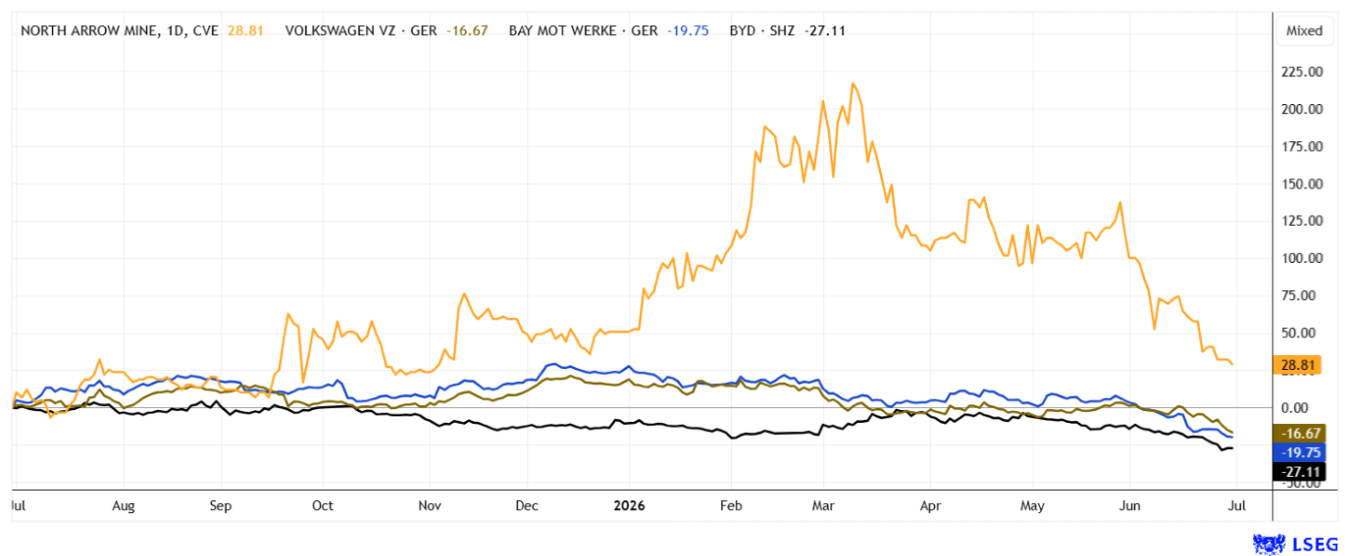
The battle in the automotive sector is being fought with hard elbows in the EU. While BYD is now also stumbling on its home turf, VW and BMW are announcing major restructuring plans to get the groups back on track. At North Arrow Minerals, the recent weeks of consolidation caused by weak gold prices could now end abruptly. Those who diversify well significantly reduce their portfolio risk over the long term.
Conflict of interest
Pursuant to §85 of the German Securities Trading Act (WpHG), we point out that Apaton Finance GmbH as well as partners, authors or employees of Apaton Finance GmbH (hereinafter referred to as “Relevant Persons”) currently hold or hold shares or other financial instruments of the aforementioned companies and speculate on their price developments. In this respect, they intend to sell or acquire shares or other financial instruments of the companies (hereinafter each referred to as a “Transaction”). Transactions may thereby influence the respective price of the shares or other financial instruments of the Company.
In this respect, there is a concrete conflict of interest in the reporting on the companies.
In addition, Apaton Finance GmbH is active in the context of the preparation and publication of the reporting in paid contractual relationships.
For this reason, there is also a concrete conflict of interest.
The above information on existing conflicts of interest applies to all types and forms of publication used by Apaton Finance GmbH for publications on companies.
Risk notice
Apaton Finance GmbH offers editors, agencies and companies the opportunity to publish commentaries, interviews, summaries, news and the like on news.financial. These contents are exclusively for the information of the readers and do not represent any call to action or recommendations, neither explicitly nor implicitly they are to be understood as an assurance of possible price developments. The contents do not replace individual expert investment advice and do not constitute an offer to sell the discussed share(s) or other financial instruments, nor an invitation to buy or sell such.
The content is expressly not a financial analysis, but a journalistic or advertising text. Readers or users who make investment decisions or carry out transactions on the basis of the information provided here do so entirely at their own risk. No contractual relationship is established between Apaton Finance GmbH and its readers or the users of its offers, as our information only refers to the company and not to the investment decision of the reader or user.
The acquisition of financial instruments involves high risks, which can lead to the total loss of the invested capital. The information published by Apaton Finance GmbH and its authors is based on careful research. Nevertheless, no liability is assumed for financial losses or a content-related guarantee for the topicality, correctness, appropriateness and completeness of the content provided here. Please also note our Terms of use.
Stockhouse does not provide investment advice or recommendations. All investment decisions should be made based on your own research and consultation with a registered investment professional. The issuer is solely responsible for the accuracy of the information contained herein. For full disclaimer information, please click here.