
Hensoldt: Endangered Sovereignty in High-End Sensor Technology
For Germany’s leading defence electronics manufacturer Hensoldt, antimony is an indispensable raw material for its optronic and sensor-based product range. The company generates over 70% of its revenue in the highly profitable Sensors segment, which includes air-defence radars such as the TRML-4D and state-of-the-art infrared search systems. Antimony forms the technological basis for advanced semiconductor compounds such as indium antimonide, which is used as detector material in cooled infrared focal-plane arrays in the mid-infrared range. These detectors offer outstanding thermal sensitivity and a significant increase in range. Because advanced detectors are subject to strict defence export controls, a shortage of antimony leads directly to delays and threatens Europe’s technological sovereignty.BASF: Flame Retardancy Acutely at Risk
Outside the defence sector, German industry is also highly dependent on antimony imports. At BASF in Ludwigshafen, the raw-material bottleneck primarily affects the Performance Materials division and the group’s strategic realignment in the field of electromobility. BASF uses antimony trioxide as a synergist for halogenated flame retardants to achieve the strict, legally mandated fire-protection certifications for engineering thermoplastics such as polyamides and polyester. While the industry is searching intensively for antimony-free alternatives based on tin, zinc, or phosphorus compounds, these require significantly higher dosages and reduce mechanical strength and flowability during processing. A complete substitution of antimony is therefore likely to remain economically and technically hardly feasible for BASF in the short to medium term.Antimony Resources: Hope From Canada
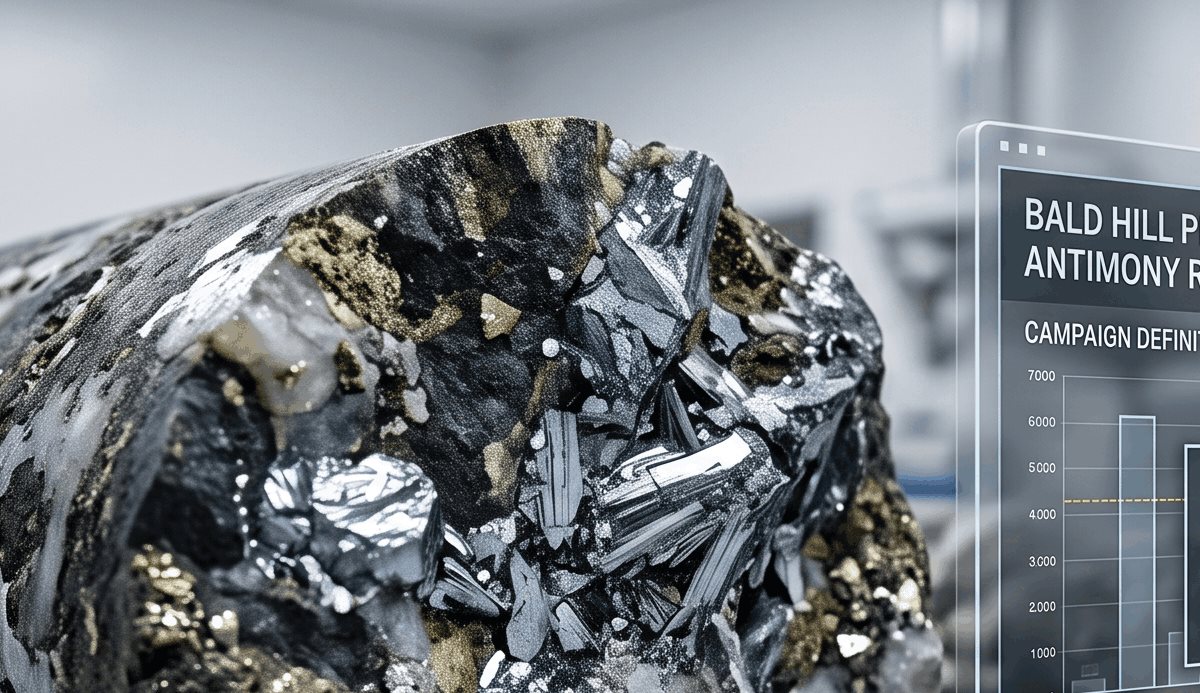
The Canadian exploration company Antimony Resources is increasingly regarded as a strategic winner of the antimony emergency. The flagship Bald Hill project in the Canadian province of New Brunswick benefits from excellent infrastructure and mining-friendly legislation. Drilling has so far already delivered remarkable results. The core area shows average grades of between 3% and 4% antimony over a width of four to five metres, well above the economic mining grades of other projects. The 12,500 m definition drilling program was completed in April this year and was immediately followed by another 11,000 m drilling campaign. The objective is to further evaluate new target areas, including the Marcus Zone. The drilling results to date underscore why Antimony Resources is regarded as one of the sector’s most promising exploration stories. Highlights include 4.38% antimony over 7.05 m, including a higher-grade interval of 9.76% antimony over 3.15 m—results widely considered highly encouraging.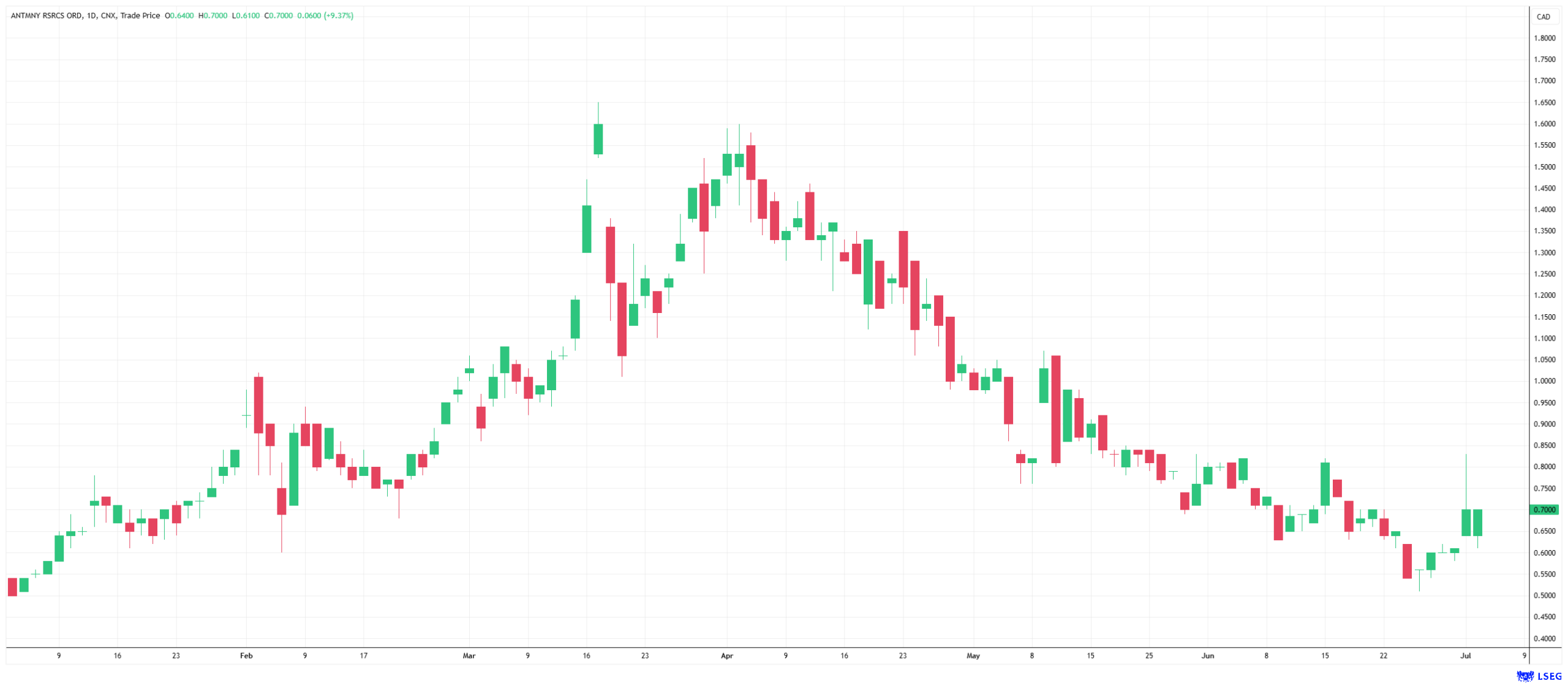
Side Projects and Strategic Groundwork Pave the Way to Production
Meanwhile, Antimony Resources is advancing exploration on its surrounding properties. Additional soil sampling at the Second Run block, located 3 km south of the main zone, returned antimony concentrations exceeding background levels by as much as fortyfold, with peak values of 450 ppm. To accelerate the path toward production, the company has already commissioned local engineering firm GEMTEC to carry out the environmental and social impact assessments. Early engagement with the Mi’kmaq and Maliseet Indigenous communities is also intended to help secure formal permitting by late 2026 or during 2027. By then, the company could be in a position to move toward production.Antimony Resources: Analysts See Potential
The analysts at GBC Research rate Antimony Resources in their current study as one of the most promising answers to the Western antimony deficit. The analyst rating is “Buy,” with a price target of CAD 3.00. As key drivers, the experts cite the excellent geology, indirect support from German-Canadian raw-materials cooperation, and the two-price system, in which non-Chinese antimony has already reached a historic record high of around USD 60,000 per tonne. Risks lie primarily in delays to permitting procedures and possible price fluctuations should China loosen its export restrictions again. However, since the Bald Hill project is well positioned thanks to its advanced development and high local acceptance compared with European competitors such as Trojárová — which, surprisingly, had its license revoked in May 2026 — investors should definitely take a closer look at Antimony Resources.Conflict of interest
Pursuant to §85 of the German Securities Trading Act (WpHG), we point out that Apaton Finance GmbH as well as partners, authors or employees of Apaton Finance GmbH (hereinafter referred to as “Relevant Persons”) may hold shares or other financial instruments of the aforementioned companies in the future or may bet on rising or falling prices and thus a conflict of interest may arise in the future. The Relevant Persons reserve the right to buy or sell shares or other financial instruments of the Company at any time (hereinafter each a “Transaction”). Transactions may, under certain circumstances, influence the respective price of the shares or other financial instruments of the Company. In addition, Apaton Finance GmbH is active in the context of the preparation and publication of the reporting in paid contractual relationships. For this reason, there is a concrete conflict of interest. The above information on existing conflicts of interest applies to all types and forms of publication used by Apaton Finance GmbH for publications on companies.Risk notice
Apaton Finance GmbH offers editors, agencies and companies the opportunity to publish commentaries, interviews, summaries, news and the like on news.financial. These contents are exclusively for the information of the readers and do not represent any call to action or recommendations, neither explicitly nor implicitly they are to be understood as an assurance of possible price developments. The contents do not replace individual expert investment advice and do not constitute an offer to sell the discussed share(s) or other financial instruments, nor an invitation to buy or sell such. The content is expressly not a financial analysis, but a journalistic or advertising text. Readers or users who make investment decisions or carry out transactions on the basis of the information provided here do so entirely at their own risk. No contractual relationship is established between Apaton Finance GmbH and its readers or the users of its offers, as our information only refers to the company and not to the investment decision of the reader or user. The acquisition of financial instruments involves high risks, which can lead to the total loss of the invested capital. The information published by Apaton Finance GmbH and its authors is based on careful research. Nevertheless, no liability is assumed for financial losses or a content-related guarantee for the topicality, correctness, appropriateness and completeness of the content provided here. Please also note our Terms of use.Stockhouse does not provide investment advice or recommendations. All investment decisions should be made based on your own research and consultation with a registered investment professional. The issuer is solely responsible for the accuracy of the information contained herein. For full disclaimer information, please click here.