

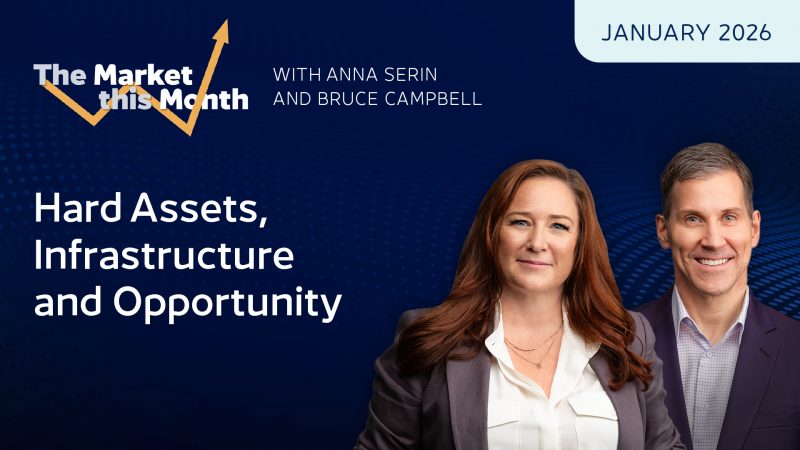
The first episode of The Market This Month for 2026 opens with a clear theme: strength across commodities and renewed momentum in Canada’s growth markets. What began with gold, silver, and copper has broadened into lithium and iron ore, signalling a potentially structural shift driven by global demand, supply constraints, and long-term infrastructure investment.
Host Anna Serin is joined by Bruce Campbell to unpack what this broadening commodity rally means for junior and small-cap markets, investor risk appetite, and capital formation. The conversation explores US dollar weakness, China’s potential reacceleration, and why oversubscribed financings are becoming increasingly common.
The episode also examines sector rotation away from mega-cap dominance, volatility in Canadian energy linked to geopolitical headlines, and why access to US capital remains a critical advantage for Canadian issuers. Together, Anna and Bruce outline what investors should be watching as 2026 gets underway. The full transcript is below.
Anna Serin
Welcome back to The Market This Month. I’m Anna Serin. Each episode, we step back from the daily headlines to look at the bigger forces shaping capital markets, particularly across Canada’s growth sectors and the public companies accessing capital both at home and abroad.
This month, one of the most consistent signals in the market is continued strength across commodities. What began with gold, silver, and copper has expanded further, with renewed momentum in lithium and iron ore. The breadth of this move suggests something more structural is underway, with investors positioning for long-term supply constraints, infrastructure investment, and the role of hard assets in an increasingly uncertain macro environment.
At the same time, market leadership is broadening. There is less focus on the mega-cap names that dominated headlines last year and more attention shifting toward mid-cap and small-cap companies. For Canadian markets, this matters. Historically, these are the areas where active capital allocation, disciplined execution, and access to financing can translate into outsized returns.
We’ve also seen volatility in Canadian energy, driven in part by geopolitical developments, including US involvement in Venezuela. Whether those reactions are fully justified remains an open question when weighed against underlying fundamentals and longer-term global energy demand.
Overlaying all of this is an ongoing macro debate. Markets continue to move higher even as economic data sends mixed signals. Consumer sentiment remains cautious, central bank commentary continues to evolve around rates, inflation, and Federal Reserve leadership, and yet risk appetite persists.
That disconnect between economic perception and market performance is something investors are watching closely and, in some cases, treating as a contrarian indicator. Despite the uncertainty, capital formation remains active, and increasingly Canadian issuers are raising meaningful sums in the United States, aligned with dominant global themes.
On the CSE this month, new listings included Upside Gold, advancing gold and copper exploration in British Columbia, and PredictiveAI, applying artificial intelligence and data analytics to real-world fleet and asset management challenges.
On the issuer news front, Trulieve completed a US$140 million upsized private placement, reflecting renewed investor interest in US cannabis amid political momentum toward decriminalisation. Norsemont closed an oversubscribed financing with a strong strategic partner. Aduro Clean Energies completed a US$20 million underwritten IPO in the United States, Nextech3D.ai announced an acquisition expanding its enterprise AI event solutions, and Sol Strategies launched a sizable US at-the-market offering tied to blockchain infrastructure and the Solana ecosystem.
All of this is unfolding alongside major political developments in the United States and ongoing instability in regions like Venezuela, factors that continue to shape sector sentiment, capital flows, and investor positioning.
With that context in mind, let’s take a closer look at what’s driving markets this month and how investors are navigating these themes.
Welcome, and thank you for joining us for the first episode of 2026. I’m joined by my wonderful co-host, Bruce Campbell of StoneCastle Investment Management. Thanks for being here, Bruce.
Bruce Campbell
I can’t believe it’s 2026 already. Time is flying.
Anna
I went through my calendar for the year and somehow ended up in December already. It feels like I’ve lived the year, but here we are in January. January is usually quiet, but this has been a busy month, hasn’t it?
Bruce
It certainly has.
Anna
There’s been a lot to pay attention to, and much of it feels fairly positive. We’re going to talk about commodities again this month, a trend we discussed throughout last year. This has been great for junior and growth markets in Canada.
We’re continuing to see strength in gold, silver, and copper, with lithium and iron ore also showing momentum. What is this telling us about the broader market?
Bruce
The strength in commodities has been fantastic. From a capital markets perspective, it’s brought life back into areas that have been quiet for some time. I’ve spoken with many CEOs and people involved in public companies, and their tone and demeanour are completely different now.
Commodity prices are stronger, it’s easier to raise capital, and companies have the funding and news flow to advance projects. Commodities often move in sequence, and we’ve seen that again. Gold moved first, silver took charge late last year and into early 2026, copper followed, and now iron ore and lithium are breaking out.
To me, that suggests the slowdown in China over the past year and a half may be coming to an end, with demand starting to re-emerge. At the same time, the US dollar has been in a steady downtrend since tariff announcements. When the dollar weakens, commodities typically move higher.
Anna
We talked last year about the dollar weakening intentionally. Is that helping commodity growth?
Bruce
I don’t think commodities are the direct target, but a weaker dollar affects pricing power and global trade. It also reinforces gold and other metals as alternative currency reserves. Central banks are increasingly holding these assets in that context.
Anna
January is a busy month for resources in Canada, with AME Roundup, the Vancouver Resource Investment Conference, and the Metals Investor Forum, followed by PDAC in March. We’re also seeing large, oversubscribed financings in the sector, which suggests strong sentiment.
Bruce
Absolutely. Not only are financings oversubscribed, but their sizes are being increased due to demand.
Anna
Let’s talk market leadership. There’s been less focus on the Magnificent Seven recently. What are you seeing?
Bruce
The Mag Seven led markets for about 18 months, but now we’re seeing bifurcation. Nvidia remains strong, but less dominant. We’re seeing broadening into industrials, transportation, and rail stocks. That rotation is the lifeblood of bull markets.
Anna
Is that a sign of increased risk appetite?
Bruce
Yes. Moving away from a US$4 trillion company like Nvidia naturally means moving down the market-cap spectrum, which is positive for broader markets.
Anna
Let’s turn to Canadian energy. We saw a sell-off linked to Venezuela headlines. What’s your take?
Bruce
It was a knee-jerk reaction. Replacing Canadian oil with Venezuelan supply would require massive infrastructure investment, likely over a decade, and at least a trillion dollars. Canadian producers will continue operating profitably for many years.
Anna
So you expect that to correct?
Bruce
Over time, yes. If global demand continues to grow, oil should benefit from supply-demand dynamics.
Anna
Looking south, rates are trending lower and leadership changes at the Fed are expected. What should investors watch?
Bruce
Inflation trends are key. Data suggests a downward trajectory over the next six months, which supports lower rates. In May, we’ll also see a new Fed chair appointed. Markets will quickly assess that individual’s policy stance, and expectations are that they’ll be more rate-friendly.
Anna
US capital access has been top of mind for Canadian issuers. We’re seeing oversubscribed financings and strong US participation. Were you expecting that?
Bruce
Yes. As markets broaden, investors look for value, and Canada is increasingly on that radar. Investors are always searching for the next ten-bagger.
Anna
Canada’s fungibility with US markets remains a big advantage.
Bruce
It’s huge. Stocks can trade seamlessly across borders using the same CUSIP, making settlement easy in either country.
Anna
That access has historically benefited sectors like cannabis and continues to open doors for growth issuers today.
Anna
As we head into February, what should investors focus on?
Bruce
Sector rotation remains key. We’re seeing leadership move down the market-cap spectrum. Gold and silver will remain volatile, creating both risk and opportunity for shorter- and intermediate-term investors.
Anna
I’m excited to start another year of conversations with you, Bruce. Thanks again for your insights.
Bruce
Great to get episode one in the books.
Anna
And thank you for joining us on The Market This Month.
Join the discussion: Check out Stockhouse’s stock forums and message boards.
Stockhouse does not provide investment advice or recommendations. All investment decisions should be made based on your own research and consultation with a registered investment professional. The issuer is solely responsible for the accuracy of the information contained herein. For full disclaimer information, please click here.