
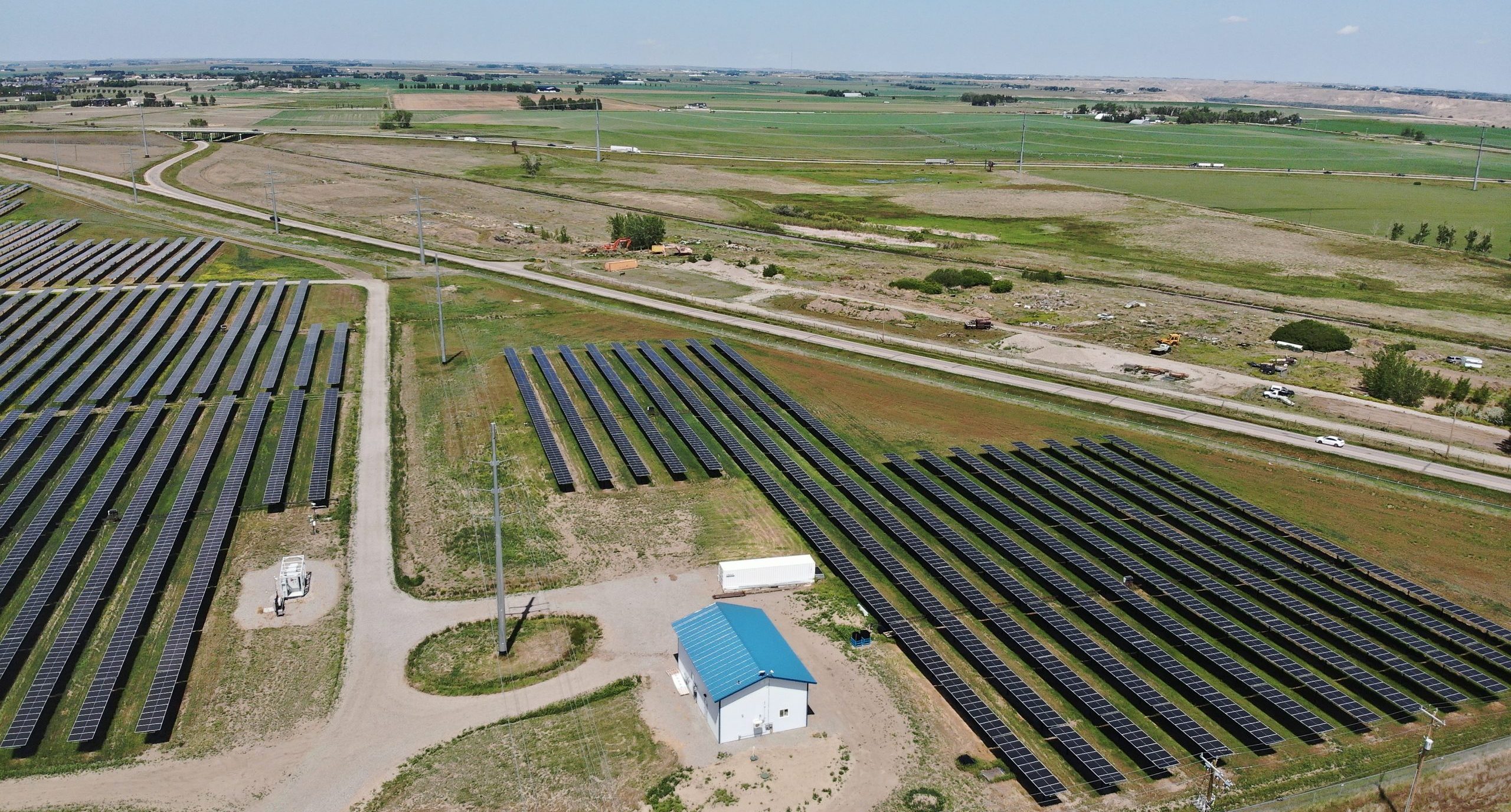

As global energy demand continues to rise, with the International Energy Agency (IEA) predicting 3.5 per cent growth annually through 2030, the push towards electrification is gaining momentum, propelled by estimated demand growth of 8.75 per cent annually – a 2.5x difference – driven by population growth, the renewable energy transition, the proliferation of artificial intelligence (AI) and the data centers that power the technology’s increasingly complex models. Low-emission projects will play a particularly pronounced role here, growing from a 42 per cent share of electricity production today to about 50 per cent by 2030, representing just over 20 per cent of overall energy supply.
This trend is expected to continue over the coming decades, according to Visual Capitalist, with fossil fuels’ share of energy demand shrinking from 80 per cent in 2024 to 67 per cent by 2050, while renewable electricity grows to provide about one third or 33 per cent of the world’s energy needs over the period.
That being said, a major obstacle stands in the way of global electrification and the United Nations’ goal of net-zero emissions by 2050, and that’s a bottleneck in renewable energy supply caused by traditional single-project funding models.
Early-stage renewable energy development is inefficient
A recent whitepaper from Paces, as reported by PV Magazine, finds that a staggering 70-90 per cent of renewable energy projects fail because of early-stage risks related to land acquisition, permitting, public and political sentiment, environmental studies, interconnection and construction design, resulting in chronic underfunding and undervaluation. Concurrently, competition for heavily or fully de-risked projects is intensifying, leading to inflated premiums and diminished investor upside.
The whitepaper characterizes these failures as the result of a lack of expertise, specifically, the lack of development systems suitable for projects that require bespoke diligence, concluding that, “by concentrating spend on the milestones that remove the most uncertainty, projects can progress more efficiently toward the Notice to Proceed stage.” The challenge, in other words, is to improve productivity by standardizing the assessment of risk.
This state-of-play is strongly incentivizing companies to identify undervalued renewable energy projects, devise a more efficient way to scale them and resolve the supply chain bottleneck, simultaneously fostering shareholder value while ensuring renewables can continue displacing fossil fuels in this generation and the next.
NU E Power’s systematic solution
A prime candidate putting our renewable energy thesis in action is NU E Power (CSE:NUE), market cap C$8.91 million, an energy infrastructure origination and development platform building an institutional-grade portfolio – currently spanning renewables, grid, gas and battery storage – that differentiates itself in the market precisely by taking early-stage growing pains out of play for potential capital sponsors.
This article is disseminated in partnership with NU E Power Corp. It is intended to inform investors and should not be taken as a recommendation or financial advice.
To this end, NU E practices what it refers to as its ‘stage-gated’ model for energy infrastructure origination and development in early-stage value creation. This disciplined process emphasizes iterability and controlled spending as projects advance through site positioning, feasibility, permitting, contracting and financing, before breaking ground on construction, in effect requiring that they earn their next development dollar before receiving it. Concurrently, investors are welcomed to step in and make an acquisition or partner with the company at any point in the process. Key principles underpinning NU E’s approach include:
- A bargain-hunter’s mentality, reflected in identifying projects with low-cost entry points and efficient paths to asset monetization.
- Prudent capital allocation, increasing resistance to policy changes and energy price volatility, while reducing frictional costs for sponsors, who will assume development costs in exchange for compensation through project milestones, thus reducing capital and option risk for NU E and its shareholders.
- A healthy respect for risk, achieved through portfolio diversification across energy sources, geographical markets, capital sponsors and offtake partners.
With a focus on bringing clarity and scale to the renewable energy supply chain, NU E’s model is built to look beyond the legacy single-project model, optimizing it by rapidly and systematically de-risking projects across communal, commercial and geopolitical realities.
In so doing, the company plans to build a diversified pool of early-stage opportunities – purchased at private equity multiples, but developed for more robust public market valuations – whose significant upside is squarely aligned with long-term energy demand.
A sound model proven in practice
News of NU E’s first real-world success with its stage-gated model hit the wire in January 2026, announcing a letter of intent with private equity firm Green Harbor Partners, formerly Sprott Korea, contemplating the development and acquisition of three of NU E’s solar assets in Alberta (namely, Lethbridge 2, Lethbridge 3 and Hanna Solar) combining for 503.5 MWac in institutional-quality capacity, plus integrated battery energy storage systems. Progress was recently updated with the completion of phase 1 due diligence on the Lethbridge assets and the securing of a long-term land option at Hanna. Here’s a breakdown:
- Lethbridge Two, 12.5 MW gross, 50 per cent net working interest (NWI), is a modular, fast-track project with grid connectivity through Fortis.
- Lethbridge Three, 155 MW gross, 50 per cent NWI, is a utility-scale asset with a grid connection through AltaLink suitable for long-term power offtake.
- Both projects became fully permitted under the Alberta Utilities Commission (AUC) in December 2024, following stakeholder engagement, detailed technical assessments, as well as environmental and wildlife studies. Application to the Alberta Electric System Operator (AESO) for grid interconnect is expected by the Cluster 3 deadline of August 6, 2026.
- The Hanna Solar project, 336 MW gross, 50 per cent NWI, is in its early design phase, with an application to AESO anticipated alongside the Lethbridge assets, and an infrastructure construction and operation application expected to be filed with the AUC by Q1 2027.
The LOI lays the foundation for NU E to monetize its projects through a series of mutually beneficial development milestones, while retaining a long-term interest, leveraging Green Harbor’s global track record managing and advising on over 2.5 GW in solar and wind assets, as well as one of Canada’s major and most supply-constrained power markets – where new project approvals are few and far between, not to mention increasingly aligned with the renewable energy transition – positioning NU E to redeploy capital into an expanding pipeline of growth initiatives, which we’ll discuss at the end of this article.
The completion of phase 1 due diligence means the parties are now progressing towards an anticipated definitive agreement. Under the terms of the LOI, NU E stands to earn an exponential return on investment across the three solar projects, totaling US$2.6 million (C$3.6 million) or US$5,150 per MW, according to the following conditions:
- Under phase 1, NU E will collect US$50,000-US$150,000 per MW, having secured the associated milestones of AESO queue position alongside the completion of environmental and feasibility studies associated with the AUC approval.
- Under phase 2, NU E would need to secure a power purchase agreement equivalent to 70 per cent of combined capacity to increase its consideration to US$158,000-US$395,000 per MW.
- Under phase 3, upon the projects reaching shovel-ready status, the company’s return would climb one final time to up to US$700,000 per MW, representing an up to 135x return on its initial investment.
- NU E’s leadership team, who we’ll introduce in the next section, estimates that the deal could provide the company with up to US$25 million in non-dilutive capital to put to work.
NU E retains the flexibility to liquidate during any of these phases, while aligning itself with Green Harbor’s long-term interests, in accordance with its stage-gated model, by staggering compensation based on project milestones, with 10 per cent of achieved consideration payable upon signing a definitive acquisition agreement, 50 per cent payable upon fulfilling all closing conditions, 30 per cent payable until a Notice to Proceed is issued, followed by the final 10 per cent due upon commercial operations.
In line with NU E’s mission to optimize and accelerate renewable energy projects from the ground up, the LOI also leaves room to bolster the company’s capacity through a long-term partnership with Green Harbor to develop, finance and operate large-scale renewable and hybrid power assets in strategic global markets.
As Hanna, Lethbridge Two and Lethbridge Three advance along their development journeys, NU E can now point to market validation, by an established institutional player, no less, of its stage-gated model, whose initial success is positioned to deliver substantial returns as the company seeks to grow its portfolio and capital sponsor network.
A leadership team curated for energy, financial and technological prowess
NU E’s ambitious growth plans are backed by a leadership team whose extensive experience, underscored by proven successes across the company’s target markets, makes it an ideal fit to unlock value across the market cycle. Let’s meet them now:
- Broderick Gunning, Director and Chief Executive Officer, previously served as CEO of Aegis Critical Energy Defence (CSE:QESS; OTCQB:QESSF), a company focused on Indigenous-partnered LFP battery manufacturing for grid storage and critical infrastructure resilience, and CEO of Electrum Charging, where he scaled one of Canada’s largest EV infrastructure companies to 6,000+ chargers deployed. Before energy, Gunning spent nearly two decades founding and exiting ventures across digital media, crypto infrastructure, payments and hardware, including The Media Merchants, an award-winning digital agency. His operating and capital networks span Canada, the US, Mexico, the Middle East and East Asia.
- Soheil Sharifi, Head of Corporate Development, is an investment banker of more than 15 years, having completed more than C$2.5 billion in transactions spanning clean technology, energy and the renewable energy transition.
- John Meekison, Chief Financial Officer, CPA, NACD.DC, P.LOG, is a 35-year veteran in the worlds of corporate finance, governance and capital markets with a specialty in early-stage and mid-market cleantech companies in Canada, Europe and the United States. Meekison’s complementary expertise in investment banking, AI governance, emerging technology and board leadership makes him an invaluable asset to guide NU E’s future endeavors.
- Arshia Noori, Vice President of Strategic Finance and Investor Relations, has been creating value in the areas of institutional equity research, private debt and executive leadership for more than 15 years, with an emphasis on energy and IP-backed ventures. He previously led a tech-based consumer goods company through to a joint venture exit.
- AJ Kiani, Senior Project Manager, has been active in renewable energy development and project delivery for more than 15 years, having completed more than 150 solar and energy infrastructure projects throughout his career, overseeing site control, permitting, commercial structuring and construction.
- Eugene Hodgson, Director, boasts a more than 30-year track record of senior leadership in government and industry, highlighted by his tenure as VP Western Region at Corpfinance International from 2005–2017, where he specialized in green power and infrastructure finance. Hodgson is a director of multiple TSX/NYSE-listed energy and resource companies including Timmins Gold and Sea Breeze Power. He complements his professional expertise with vast volunteer governance experience with the Vancouver Board of Trade, CANWEA, IPPBC, as well as with Indigenous economic development boards.
- Bold Batsukh, Director, is a former senior FX and precious metals trader and the founder and CEO of LS Finance, a Peterson Investment Inc. subsidiary. He also co-designed the 2 GW SkyTower Zero Carbon Industrial Park with Energy Vault (NYSE:NRGV) and has secured silica mining permits for global photovoltaic supply chains. Batsukh has spent more than a decade in Mongolia’s energy and mining sectors, granting NU E an edge as it develops its Darkhan Energy Park in the East Asian nation, which we’ll cover in the final section of the article below.
Now that we’ve established the soundness of NU E’s development model, followed it into the marketplace with what is shaping up to be a lucrative initial transaction, and delineated how leadership is well-equipped to the task of replicating that success with future projects, the question prospective investors should be asking is, ‘How has the market responded to NU E’s clear path towards exponential scale?’
Optimized energy infrastructure development at a deep-value price
The soaring demand for electricity, handily outpacing industry’s ability to keep up, places the onus on energy companies to adopt sustainable practices that grant humanity the best chance at a reliable power supply. And as we’ve shown in this article, NU E has answered this call, stepping forward with a proven model designed to usher diverse projects across the development lifecycle more efficiently than ever before.
NU E Power stock, however, has yet to accurately reflect the success of the Green Harbor deal, saddling investors with a 10 per cent loss year to date, and the company with a market cap of only C$8.91 million, despite its working interest in 253 MW across Hanna, Lethbridge Two and Lethbridge Three, calculated using the minimum US$50,000 per MW under the deal, working out to US$12.65 million (C$17.26 million) – nearly twice the company’s current size – entailing a vast margin of safety for new investors. That said, this figure is likely conservative, as it does not account for:
- NU E’s 25 per cent NWI in the 8.75-MW Lethbridge One, in operation since December 2024.
- The company’s 100 per cent interest in the 600-MW Darkhan Energy Park project in Mongolia, where feasibility studies for grid power and HELE thermal generation are now underway, to be overseen by a new company under a joint development agreement with Tsegtskharaa LLC, a Mongolian partner who will earn into the project as permitting advances.
Investors are then positioned to benefit from what could be an exponential re-rating, as NU E continues to follow through on disciplined infrastructure development, increasing scale, pricing power and institutional visibility, allowing it to more efficiently capitalize on energy tailwinds as our electrified future comes into view.
In terms of near-term catalysts, look for NU E’s financial results, which are likely to improve once the Green Harbor deal hits its income statements, and numerous ongoing discussions with prospective capital sponsors, which are progressing at a promising clip, to increase awareness of the company’s vastly untapped potential and encourage a turnaround in investor sentiment.
Join the discussion: Find out what investors are saying about this energy infrastructure stock on the NU E Power Corp. Bullboard and make sure to explore the rest of Stockhouse’s stock forums and message boards.