



The world’s security architecture is no longer what it once was: the future of defense is autonomous, networked, and energy-hungry. Military superiority is no longer determined primarily by the sheer number of deployed units, but by the synergy of autonomous mobility, sensor intelligence, and the corresponding energy capacities. In this environment, players such as Rheinmetall are equipping the next generation of military equipment with autonomous vehicles and drones. At the same time, Hensoldt is providing the necessary intelligence for today’s battlefield through high-performance sensor technology and AI-supported radar systems such as the TRML-4D. According to reports from platforms such as Radartutorial.eu, these systems are capable of detecting up to 1,500 targets simultaneously within a radius of 250 km and processing data in fractions of a second. In the field of power supply for unmanned aerial systems, the Canadian-South Korean company NEO Battery Materials is positioning itself to drive a potential breakthrough.
This article is disseminated in partnership with Apaton Finance GmbH. It is intended to inform investors and should not be taken as a recommendation or financial advice.
Defense industry: Innovative developments, but one problem remains – for now
Despite much progress, developers at Rheinmetall and Co. are reaching a physical limit: the energy density of conventional batteries measurably limits the operating time and range of many systems. A battlefield radar requires considerable amounts of energy to operate the integrated gallium nitride modules, which, according to analysts at McKinsey in their study “The hard stuff 2025,” often necessitates the use of diesel generators or large battery storage systems. Autonomous ground vehicles such as Rheinmetall’s Mission Master SP also see their electrical operating time reduced as soon as active protection systems and processors for AI navigation are integrated. For reconnaissance drones, which form the backbone of modern battlefield surveillance, flight time is the key limiting factor, as military systems with standard batteries can often only remain in the air for 20 to 30 minutes. This is where NEO Battery Materials comes into play.
NEO Battery Materials as a problem solver
NEO (TSXV:NBM) has developed a technology that increases the energy performance of batteries, thereby expanding the military options available to Western countries. The innovation consists of a patented silicon anode technology called NBMSiDE™, which increases the energy density of conventional lithium-ion batteries. A specialized nanocoating process addresses the problem of silicon volume expansion during charging cycles and enables high cycle stability even at sub-zero temperatures. This solution, developed by NEO Battery Materials, pushes the boundaries of conventional energy storage and creates the conditions that make many ideas in industry, from Rheinmetall to Hensoldt, fully possible.
The company recently demonstrated the concrete capabilities of this technology through the results of a live field test. In collaboration with a South Korean OEM drone manufacturer, NEO Battery Materials demonstrated how silicon anodes change the operational endurance of drone systems. A surveillance drone equipped with these cells achieved an average flight time of 59.2 minutes. In direct comparison to the 29.9 minutes achieved with Asian benchmark batteries, this represents a 98% increase in flight time. According to the company, the new cells delivered an energy capacity of 755 Wh and an energy density of 260 Wh/kg at the pack level, representing a 55% increase in capacity and a 29% increase in energy density over the previous industry standard.
Operational range and battlefield dynamics
For military practice, this step means an adjustment of operational parameters. In addition to extending flight time, silicon anodes enable 50% faster charging under standard conditions. Using ultra-fast charging protocols, charging cycles are accelerated by up to 150%. Flight time per capacity increased by 28% in tests, while flight time per weight improved by 80%. Since NEO has achieved these performance gains without changing the physical size of the cells, existing drone airframes can be equipped with the new energy storage devices directly without modifying the battery compartments.
Integrating these batteries into the system environment of renowned defense manufacturers could provide tactical advantages on the battlefield. When an autonomous ground vehicle is used as an advanced reconnaissance node and carries a drone for target acquisition, the amount of time it can remain in the air determines the progress of the mission. With a doubled flight time of almost 60 minutes, the drone needs to return to the vehicle less frequently, reducing the risk of detection for the entire ground unit. The reconnaissance drone can fly much lower, enabling Hensoldt’s networked radar systems to classify enemy targets earlier and coordinate appropriate countermeasures.
Sovereign supply chains and independence
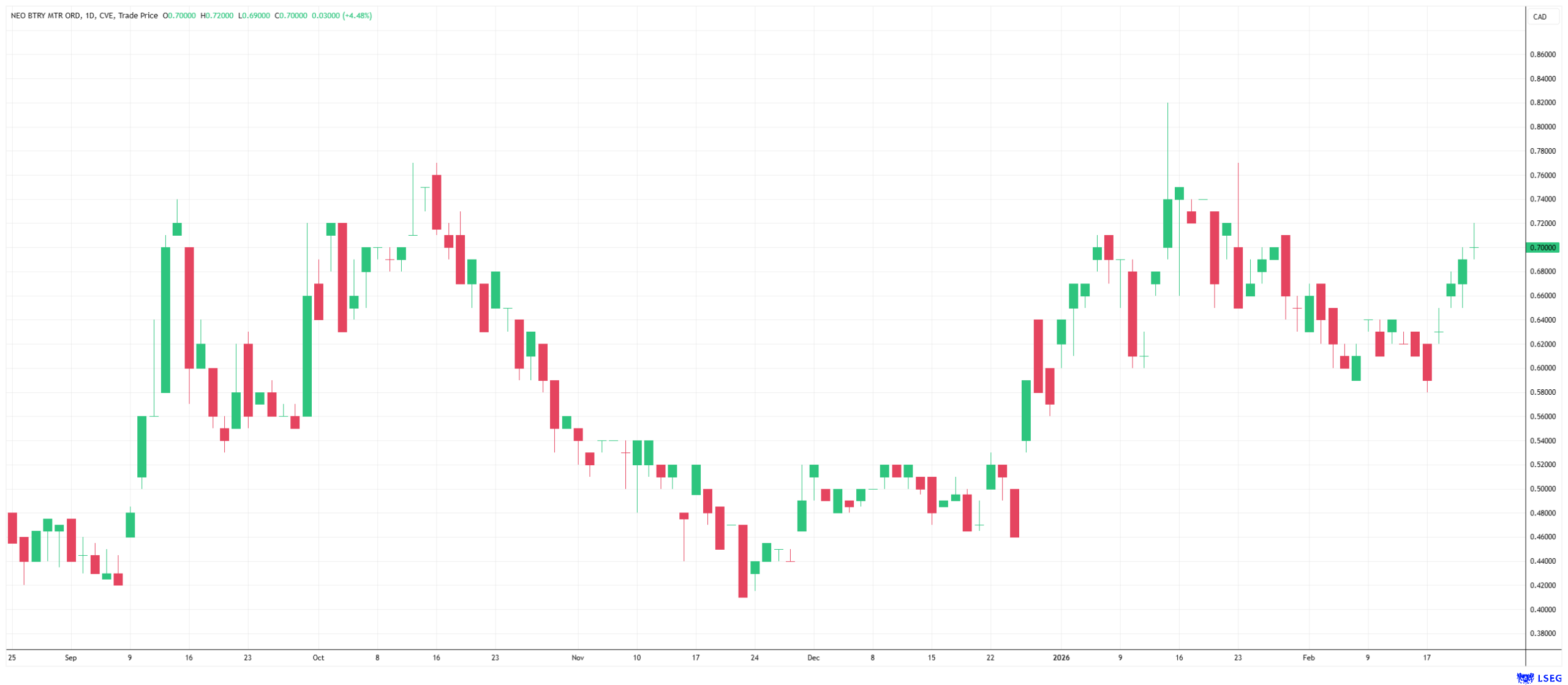
In addition to the technical aspects, the strategic vulnerability of the West in the current geopolitical landscape is fueling demand for NEO Battery Materials’ solution. Studies by the Bruegel think tank and the European Commission document that China will continue to control over 80% of global battery cell production in early 2026. This asymmetry means that Western defense systems are dependent on components manufactured by a potential rival. Analyses by McKinsey and the International Energy Agency in their “Global Energy Perspective 2025” outlook point out that the creation of allied supply chains for energy storage is a top priority for defense capabilities. In this context, NEO Battery Materials is positioning itself as a central building block for an independent Western supply chain for energy storage and is driving the shift away from Asian imports. As NEO is also listed as a supplier to two Fortune 500 automotive manufacturers and yesterday announced its collaboration with robotics specialist ZIO Robot, the company is also well-positioned to benefit from growth in the civilian sector. NEO Battery Materials’ stock is currently gaining momentum and is perfectly in tune with the times. Investors with a speculative mindset should take note of this stock.
Conflict of interest
Pursuant to §85 of the German Securities Trading Act (WpHG), we point out that Apaton Finance GmbH as well as partners, authors or employees of Apaton Finance GmbH (hereinafter referred to as “Relevant Persons”) currently hold or hold shares or other financial instruments of the aforementioned companies and speculate on their price developments. In this respect, they intend to sell or acquire shares or other financial instruments of the companies (hereinafter each referred to as a “Transaction”). Transactions may thereby influence the respective price of the shares or other financial instruments of the Company.
In this respect, there is a concrete conflict of interest in the reporting on the companies.
In addition, Apaton Finance GmbH is active in the context of the preparation and publication of the reporting in paid contractual relationships.
For this reason, there is also a concrete conflict of interest.
The above information on existing conflicts of interest applies to all types and forms of publication used by Apaton Finance GmbH for publications on companies.
Risk notice
Apaton Finance GmbH offers editors, agencies and companies the opportunity to publish commentaries, interviews, summaries, news and the like on news.financial. These contents are exclusively for the information of the readers and do not represent any call to action or recommendations, neither explicitly nor implicitly they are to be understood as an assurance of possible price developments. The contents do not replace individual expert investment advice and do not constitute an offer to sell the discussed share(s) or other financial instruments, nor an invitation to buy or sell such.
The content is expressly not a financial analysis, but a journalistic or advertising text. Readers or users who make investment decisions or carry out transactions on the basis of the information provided here do so entirely at their own risk. No contractual relationship is established between Apaton Finance GmbH and its readers or the users of its offers, as our information only refers to the company and not to the investment decision of the reader or user.
The acquisition of financial instruments involves high risks, which can lead to the total loss of the invested capital. The information published by Apaton Finance GmbH and its authors is based on careful research. Nevertheless, no liability is assumed for financial losses or a content-related guarantee for the topicality, correctness, appropriateness and completeness of the content provided here. Please also note our Terms of use.
Stockhouse does not provide investment advice or recommendations. All investment decisions should be made based on your own research and consultation with a registered investment professional. The issuer is solely responsible for the accuracy of the information contained herein.
For full disclaimer information, please click here.