
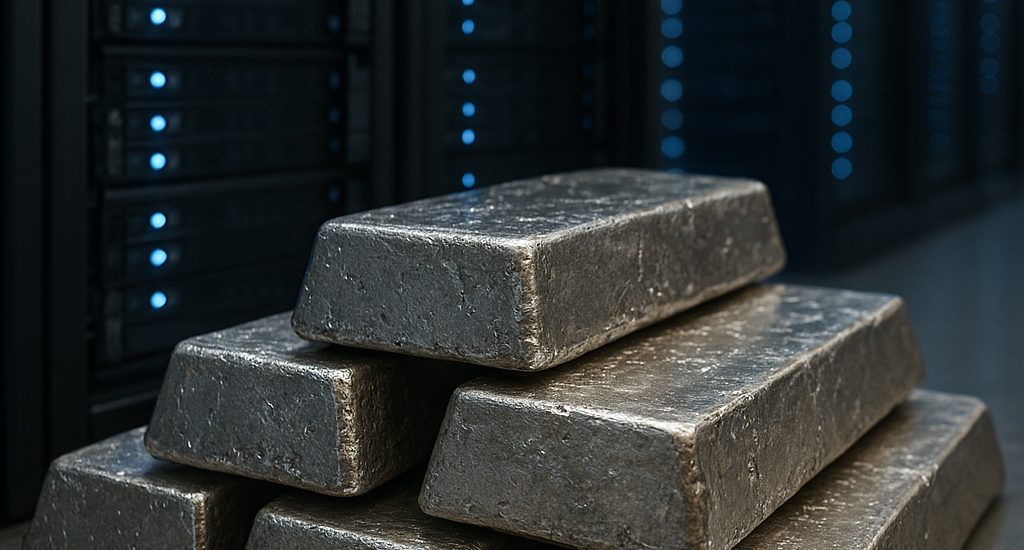

- Silver demand is exploding—AI data centres, solar, EVs, and advanced electronics are consuming silver faster than mines can supply it, deepening multi‑year structural deficits
- Global mine supply is struggling, with declining ore grades, ongoing closures, and inelastic by‑product production unable to respond to rising prices
- Prices have surged, more than doubling in 2025 and breaking above US$90/oz in early 2026 as inventories hit multi‑decade lows and physical tightness fueled investor demand
- Producers like Silvercorp Metals (TSX:SVM) stand out, delivering record FY‑2025 silver output and guiding further growth into FY‑2026—positioning them to benefit from tight supply and strong industrial demand
Silver spoons
Silver is undergoing a structural re‑rating. Five plus years of market deficits, eroding mine supply, and the rapid build‑out of AI data‑centre infrastructure are colliding to create an unusual setup: inelastic supply versus fast‑growing, price‑insensitive demand. Prices more than doubled in 2025 and pushed to fresh records in early 2026 as inventories thinned and physical tightness spilled into pricing. In this environment, well‑run primary and by‑product silver producers offer investors differentiated ways to gain exposure to a theme that now spans precious‑metal hedging and the electrification/AI hardware stack.
1) The setup: A persistent global silver deficit
Industry surveys show the silver market has been in consecutive structural deficit, with above‑ground inventories drawn down to multi‑decade lows. The Silver Institute’s 2025 review documented another deep shortfall after only a modest year‑over‑year lift in mine output, and outlooks into 2026 still flag a deficit even as the gap narrows. In other words, demand continues to exceed readily available supply.
At the same time, long‑term production forecasts point to declining global mine supply by 2030 as legacy orebodies mature and mines close—especially in Mexico and parts of Latin America/Eurasia—despite occasional one‑off gains in certain years or by specific companies. This is why the market “feels” tight even when headline output blips up: the structural base keeps eroding.
2) Why supply can’t respond quickly: Inelasticity by design
Unlike copper or iron ore, roughly 70 per cent-plus of silver comes as a by‑product of mining other metals (lead, zinc, copper, gold). That means even triple‑digit silver prices don’t automatically incentivize new silver tons—operators prioritize the primary metal’s economics and development timelines are measured in years to decades. This inelasticity helps explain why higher prices in late‑2025/early‑2026 did not suddenly balance the market.
Brokerage and research outlooks adjusted sharply to this reality. For example, Peel Hunt boosted its 2026 silver forecast and long‑run price deck, explicitly citing a structurally undersupplied market where mine growth remains weak despite big price moves.
3) The new demand engine: AI data centres (and why it matters to silver)
AI data centres are materials‑dense infrastructure: GPUs/accelerators, ultra‑fast interconnects, power distribution, switchgear, advanced PCBs and connectors. Silver, the most conductive metal, is embedded across this hardware stack. As hyperscalers scale clusters, global power demand tied to data centres is projected to rise dramatically this decade, pulling through ever more high‑reliability components that can’t easily substitute away from silver without performance penalties. The result is an additional, relatively price‑insensitive demand pillar joining solar PV, EVs, and semiconductors.
Zooming out, PV manufacturers already accounted for 25 per cent-plus of annual supply in 2024–2025, and the broader electronics/auto grid continues to expand. AI is now compounding these trends at the margins, tightening the physical market precisely as inventories are thin.
4) Price action confirms the thesis
The market’s verdict has been swift: silver broke out in 2025, rising ~147 per cent as deficits and inventory drawdowns became impossible to ignore, and pushed above US$90/oz in early 2026 amid signs of physical tightness and surging investor demand. While near‑term volatility is likely, a growing chorus—from mainstream outlets to specialist research—projects elevated average prices through 2026 and beyond, even under conservative scenarios.
Importantly, analysts differ on how high prices can go, but the directional consensus is that structural deficits plus industrial pull argue for sustained strength versus past cycles. Even cautious takes frame 2026 averages materially above pre‑2025 norms.
5) What this means for miners (and how to be selective)
Because supply is constrained, the “winners” are not just whoever owns ounces—they’re the operators with cost control, permitting clarity, and near‑term throughput to meet demand into tight markets. Note how company results have bifurcated:
- Fresnillo (OTC Pink:FNLPF)—the world’s largest primary silver producer—reported lower silver output in Q1‑2025 due to planned closures and grade variability, highlighting industry headwinds even at scale.
- First Majestic (TSX:AG) delivered record Q4‑2025 silver as specific assets ramped, proving that company‑level execution can outshine the global trend in the short run.
- Hecla (NYSE:HL) set a record 2025 and remains the largest producer in the U.S./Canada, yet its 2026 guidance still baked in a modest dip—grades and mining realities matter even in bull markets.
Key takeaway: stock picking matters. Look for quality ounces, margin resilience, and runway for organic growth.
6) A silver lining
Why it’s on the radar: Silvercorp Metals Inc. (TSX:SVM) is a profitable, multi‑metal producer (silver‑lead‑zinc with gold by‑product) with long‑life underground mines and a track record of free‑cash‑flow generation. In fiscal 2025 (year ended March 31, 2025) the company posted record revenue (~US$299M, plus 39 per cent y/y) and record silver output (~6.9 Moz, above 12 per cent y/y), landing within prior guidance. Q4‑FY25 alone saw 1.6 Moz silver (more than 42 per cent y/y) on a 46 per cent jump in ore processed, driven largely by the Ying district in China.
Forward look: For FY‑2026 (ending March 31, 2026), Silvercorp guided 7.38–7.6 Moz of silver (≈6–9 per cent growth y/y) alongside increases in lead and zinc, supported by capex focused on Ying and the GC Mine. Later updates reiterate the 2026 production plan and capex allocation aimed at sustaining and modestly growing output—at a time when the market rewards reliable, near‑term tons.
Why it fits the theme: In a structurally tight market where supply response is slow, companies that incrementally lift production and maintain cost discipline can compound operating leverage to price. Silvercorp’s combination of organic growth, underground vein flexibility, and multi‑metal revenues can help buffer volatility while preserving exposure to silver’s upside.
Other names to watch for context:
- First Majestic for its Mexico/Nevada footprint and recent step‑ups in attributable silver
- Hecla for North American scale and operating depth, despite normal grade cycles
7) Investment implications and portfolio construction
The intersection of AI‑driven hardware demand, PV/EV electrification, and constrained mine supply supports a sustained period of above‑trend silver prices—with periodic volatility as financial flows ebb and flow.
How to express the view:
- Producers with near‑term ounces
Seek names with clear 12–24 month production visibility, strong balance sheets, and assets that can squeeze out extra throughput without massive capex. (E.g., Silvercorp’s FY‑2026 plan to lift silver output while investing in Ying/GC.) - Jurisdiction diversification
With regulatory shifts driving mine closures in key regions (notably Mexico), diversify across North America and Asia to mitigate single‑country risk. - By‑product leverage
Because much silver is produced as a by‑product, consider operators where lead/zinc/gold revenues lower all‑in silver costs—an advantage in volatile tape. - Physical/ETP Allocations (tactical)
Tightness in reported inventories and repeated deficits make a case for partial physical exposure or ETPs for liquidity—tempered by the understanding that flows can amplify volatility.
8) Key risks to watch
- Macro whiplash: Rapid shifts in rates, the U.S. dollar, or recession risk can swing precious metals quickly—even if structural deficits persist.
- Thrifting/substitution in PV & electronics: Engineering progress can reduce silver loadings per unit, partially offsetting demand growth (though absolute volumes can still rise with capacity expansions).
- Operational hiccups: Underground mining carries grade and development risk; even best‑in‑class operators report periodic downticks. Diversify across a basket of producers.
9) What could extend the upside
- AI data‑centre acceleration: If hyperscaler build‑outs outpace power‑grid expansions, the silver‑intensive electrical hardware curve steepens.
- Policy “strategic metal” framing: Agencies and exchanges signaling scarcity (e.g., critical‑mineral designations, tightening inventories) can attract long‑duration capital into the metal and the miners.
- Delayed mine response: If closures and permitting hurdles outstrip new starts, the market may remain undersupplied longer than current base cases assume.
Investor’s corner
Silver’s bull case is no longer only about “monetary metal” narratives. It is an AI plus electrification plus scarcity story. Structural deficits, by‑product supply inelasticity, and new demand from AI data centres form a durable foundation for elevated prices—with tactical volatility. In this landscape, operators that can grow or sustain production at competitive costs are positioned to capture outsized operating leverage. Silvercorp Metals Inc., with record FY‑2025 results and guided silver growth into FY‑2026, is one such name to evaluate alongside other quality producers.
Join the discussion: Find out what investors are saying about these aviation stock on the silver mining Bullboards and make sure to explore the rest of Stockhouse’s stock forums and message boards.
Stockhouse does not provide investment advice or recommendations. All investment decisions should be made based on your own research and consultation with a registered investment professional. The issuer is solely responsible for the accuracy of the information contained herein.
For full disclaimer information, please click here.