
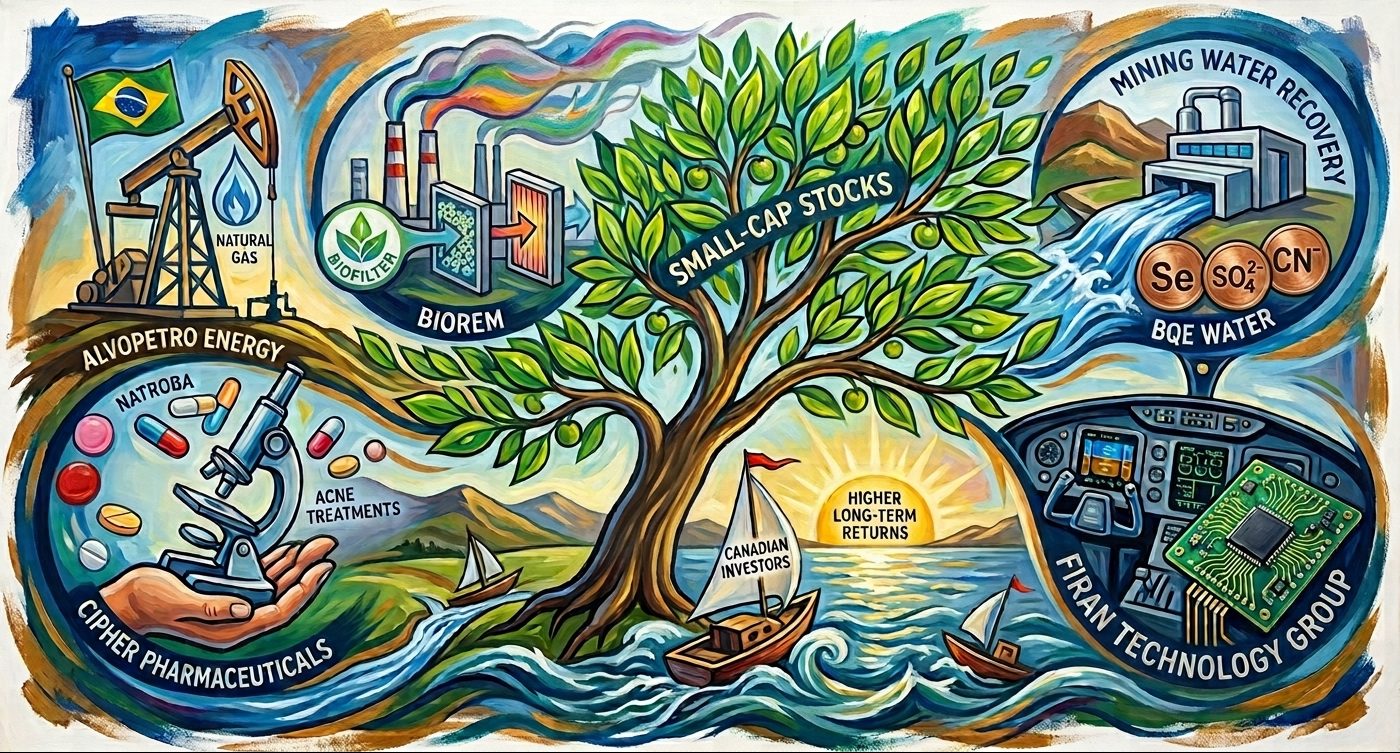

- Adding small-cap value stocks to a portfolio can enhance long-term returns, though they introduce higher tracking error and short-term volatility.
- Investors can mitigate these risks by screening for earnings growth, sustainable profitability and minimal debt burdens.
- Among Canadian small-cap stocks, standouts from an income statement perspective include Alvopetro Energy, Biorem, Cipher Pharmaceuticals, BQE Water and Firan Technology Group.
The academic data about small-cap stocks is clear: If you add tiny companies to your portfolio, especially those trading at the lowest prices relative to their profitability, your expected return goes up.
We see this phenomenon in action when we compare the TSX Index, which has returned about 5.2% since December 2000, compared to the MSCI Canadian Small-Cap Value Index, whose 8.24% return has lined investors’ pockets far more effectively over the period.
This article is a journalistic opinion piece on the best Canadian small-cap stocks written based on independent research. It is intended to inform investors and should not be taken as a recommendation or financial advice.
A major caveat to this thesis, however, is that the more your portfolio deviates from the global stock market – which you can invest in through index funds – the greater its tracking error will be, and there’s only a certain amount of volatility investors are willing to take in pursuit of higher returns.
Accordingly, the size of your tilt towards small-cap value stocks depends on how effectively your research process is able to pick out underlying companies worth putting your hard-earned capital to work, despite their often lower trading volume, scant analyst coverage and less-established, higher-risk operations, which may require years of patience before catching up to your assessment of fair value.
How we screened for the best Canadian small-cap stocks
Canadian investors keen on ramping up their exposure to small-cap value stocks, as opposed to growth stocks, might begin with the value portion of the equation, defining the companies in the best financial position to progress to mid-cap and hopefully large-cap status over a long-term holding period.
An intuitive constraint to start with is earnings growth, demonstrating a leadership team’s ability to foster shareholder value on the income statement. Ideally, this growth should be generating profits in the form of net income or free cash flow, as opposed to lower losses, though exceptions can be made for companies with truly differentiated products or services.
Debt considerations should follow, favoring companies with the lowest combination of current (CD) and long-term debt (LTD), rendering their earnings power the least encumbered by interest payments.
Finally, we’ll need to institute a market cap limit, taking a stand as to the ultimate meaning of “small cap” among the multitude of ranges and opinions on the topic. An even C$1 billion, roughly in between the common C$50 million threshold for micro-cap stocks and the C$2 billion threshold for mid-cap stocks, will work just fine.
After inputting these metrics into The Globe and Mail’s screener, I compiled the top five stocks in the list, ordered from highest to lowest five-year earnings growth (FYEG), while controlling for profitability and debt load:
- Alvopetro Energy: 30.69% FYEG, C$21.44 million CD, C$16 million LTD.
- Biorem: 39.06% FYEG, C$16.49 million CD, C$1.26 million LTD.
- Cipher Pharmaceuticals: 43.93% FYEG, C$25.04 million CD, C$5 million LTD.
- BQE Water: 45.38% FYEG, C$4.37 million CD, C$0.61 million LTD.
- Firan Technology Group: 54.03% FYEG, C$39.17 million CD, C$13.89 million LTD.
Let’s get our hands dirty and see exactly why these companies stand out in the small-cap space.
The best Canadian small-cap stocks
5. Alvopetro Energy
Taking fifth place in our survey of the best Canadian small-cap stocks is Alvopetro Energy, market cap C$348.45 million, a natural gas company active in Canada and Brazil, notable for being the South American country’s first onshore natural gas producer.
Alvopetro aims to invest half of its cash flow into organic growth, while returning the other half to shareholders. Its Q3 dividend is set at C$0.12, representing a 7% yield, with the payout doubling from C$0.06 in 2021.
The company’s flagship 56.2%-owned Caburé natural gas field and 100%-owned Murucututu natural gas field, strategically located in the state of Bahia near major industrial demand, benefit from 100%-controlled infrastructure (pipelines plus plant), which reduces costs and facilitates development to capitalize on market conditions. The fields will generate exploration and development news flow into 2028 and beyond.
A hop across the Atlantic, Alvopetro’s 50%-owned Mannville Stack in Saskatchewan hosts multiple large zones of original oil in place across 43,471 net acres, amounting to 735,000 barrels of oil equivalent (boe) valued at C$12.1 million, enhanced by the resource’s shallow depth and ensuing low drilling costs.
From an income statement perspective, the company’s operations produced 3,067 boepd in Q2 2026, up from 2,523 boepd in all of 2025 and 1,794 boepd in all of 2024, generating C$19.2 million and C$14.1 million in funds flow from operations, respectively.
Including Brazil’s more substantial barrel count, Alvopetro’s consolidated resource reaches 13.1 million boe valued at C$312.4 million, about in line with the aforementioned market cap at the time of writing, offering investors the company’s value-creation engine essentially for free.
To this end, leadership sees multiple years of growth ahead in Brazil and Canada, according to the October 2026 investor deck, a runway most recently catalyzed by a prospective 462.4-square-kilometre acquisition to the north of the company’s core Brazilian assets.
Alvopetro’s high-margin business is in the hands of a leadership team of energy industry veterans, spanning exploration, development, finance and engineering, meaningfully aligned with shareholders at 8% insider ownership.
Alvopetro Energy stock (TSXV: ALV) last traded at C$9.10, adding 40.43% year-over-year (YoY) and 80.20% since 2021.
4. Biorem
Moving along, we turn our attention to Biorem, market cap C$59.03 million, a vertically integrated clean technology company specializing in air emissions control systems that eliminate odors, volatile organic compounds and other hazardous pollutants for a variety of government and enterprise clients active in the waste management, food & beverage, chemical and petroleum industries, among others.
Biorem operates sales and manufacturing sites across North America, in conjunction with an in-house research facility and a global sales representative network, having installed more than 2,000 of its environmental purification systems across the world.
The company’s financial results speak to its growing and diversified customer base, pulling in revenue of C$15.7 million in Q2 2026, up from C$6.8 million in Q1 2026, following C$42.36 million in 2025, C$37.42 million in 2024 and C$25.17 million in 2023.
Net income for Q2 reached C$2.69 million, up from C$201,000 in Q1 2026, building upon C$4.8 million earned in all of 2025, C$3.04 million in 2024, C$2.18 million in 2023, C$1.61 million in 2022 and C$1.30 million in 2021, hammering home the fact that we’re dealing with a well-oiled machine of a business.
Looking ahead, Biorem’s backlog sits near an all-time record at C$75.5 million as of June 30, 2026, up from C$35.6 million in 2020, bolstered by 20 new projects added to its books during Q2 alone – plus a large number progressing through its pipeline.
Biorem is guided by a leadership team with more than half a century of experience in business development and gas and air abatement solutions, including a CEO who has been with the company for more than 20 years.
Biorem stock (TSXV: BRM), the only penny stock featured in this article, last traded at C$3.59, adding 85.05% YoY and 332.53% since 2021.
3. Cipher Pharmaceuticals
Occupying the middle spot among the best Canadian small-cap stocks is Ontario-based Cipher Pharmaceuticals, market cap C$343.10 million, whose diversified prescription drug portfolio, from early-stage clinical development to commercial sales, is anchored by an unwavering focus on unmet medical needs.
Cipher’s solutions treat some of the most serious and/or least glamorous conditions around, including Epuris, for severe nodular acne, Vaniqa, for hair growth, Aggrastat, for Acute Coronoary Syndrome, and the company’s flagship Natroba, a proven head lice and scabies treatment under an exclusive patent through 2033. These are complemented by a product pipeline targeting the nail fungus, plaque psoriasis and tattoo removal markets.
The company’s disciplined focus on royalties, out-licensing, strategic marketing and conservative capital allocation has resulted in revenue more than doubling from US$21.9 million in 2021 to US$50.5 million in 2025, justified by net income that has climbed from US$7.76 million to US$27.33 million, respectively, and adjusted EBITDA that has more than doubled from US$3.1 million in Q2 2024 to US$6.8 million in Q2 2026.
Concurrently, the company’s debt level has been falling fast, from US$40 million in Q3 2024 to debt-free as of Q1 2026, as detailed in the May 2026 investor deck, leaving virtually all of a US$65 million revolving credit facility with National Bank of Canada – plus a US$25 million accordion option and US$9.1 million in cash as of Q2 2026 – for leadership to pursue value-added acquisition, licensing and cross-selling opportunities.
Interim CEO, Craig Mull, whose family owns 41% of Cipher’s issued and outstanding shares, served as Chief Operating Officer of CML Healthcare, a medical diagnostics company, from 1989-2004, helping to usher it from $20 million to $235 million in annualized revenue and into a public listing.
Cipher Pharmaceuticals stock (TSX: CPH) last traded at C$13.35, giving back 11.88% YoY, while adding 438.31% since 2021, leveraged by a tight 25.42 million shares outstanding at the time of writing.
2. BQE Water
Our runner-up, BQE Water, market cap C$89.77 million, is a Vancouver-based water treatment services provider for the mining, smelting and refining industries, whose proprietary technologies, spanning selenium, sulfate and cyanide removal and metals recovery, have afforded it a multi-decade track record of enhancing client regulatory compliance, sustainability and social acceptance. This includes major miners Jiangxi Copper, China’s largest integrated copper producer, a client for 19 years, and Glencore, a client for the past 21 years.
BQE, squarely aligned with the ubiquity of environmental preservation, has built a powerhouse of a business for potential investors to consider, including 32 water treatment plants designed and built across the world, representing:
- 20 million cubic metres of wastewater treated annually.
- 1,700 tons of sodium cyanide recovered and recycled annually.
- 4,200 tons of metals recovered from waste every year.
According to the company’s Q3 2026 investor deck, its profitability stems from a dual focus on booking non-recurring revenue that leads to recurring revenue, in the form of technical services preceding water treatment operations, and booking recurring revenue grounded in intellectual property monetization.
On the income statement, this looks like revenue growth from about C$10 million in 2019 to nearly C$25 million through the first nine months of 2025, with working capital growing by 7x to C$20 million over the period, supported by net income and adjusted EBITDA compound annual growth rates (CAGR) of 16% and 33%, respectively.
BQE closed out 2025 with record net income, up by 68% YoY, setting high expectations for accelerating momentum in 2026, which the company proceeded to deliver on with strong showings in Q1, focused on growth investments, and in Q2, marked by operations at five new sites in Canada, China and the United States, putting the company on track to earn higher full-year revenue YoY.
A leadership team with more than a century of wastewater treatment, chemical processing and environmental sector experience has proven itself worthy of investor conviction, as the company continues to transform the natural resource industry into a vital component of a sustainable future.
BQE Water stock (TSXV: BQE) last traded at C$69, adding 31.40% YoY and 128.10% since 2021, reporting only 1.3 million shares issued and outstanding.
1. Firan Technology Group
And now, taking the top spot in our list of best Canadian small-cap stocks, we have Firan Technology Group, market cap C$814.11 million, an acquisitions-focused aerospace and defence technology company with a global footprint across two divisions. Here’s a brief breakdown:
- FTG Circuits manufactures circuit boards for top aviation and defence companies through operations in Canada, China and the US.
- FTG Aerospace designs, manufactures and services illuminated cockpit products, electronic assemblies and other avionics products for OEMs and equipment operators through facilities in Canada, China, India and the US.
As the most profitable and least encumbered company in our screener, Firan paints a powerful financial picture, including a 25% revenue CAGR from C$79.3 million in 2021 to C$190.9 million in 2025, paired with a 35% adjusted EBITDA CAGR from C$9.6 million in 2021 to C$17.75 million in Q2 2026, and a 167% adjusted net income CAGR from C$256,000 in 2021 to C$8.62 million in Q2 2026, granting the company ample flexibility to self-fund future growth.
Firan’s recently completed Q3 2026 ended no less impressively, with C$64.1 million in revenue, up by 34.3% YoY, net income of C$10 million, up by C$7.2 million YoY, and a backlog of C$220.7 million, up by 49% YoY, amid record bookings and numerous orders carrying price premiums for expedited delivery.
Looking ahead, the company is in a compelling position to foster shareholder value through intelligent capital allocation, bolstered by only C$8.9 million in government debt on its books, recently added customers in Europe and Australia, further diversifying and de-risking operations, plus an ongoing stock buyback program for up to 5% of outstanding shares.
Firan’s leadership team, anchored by 30% insider ownership, is more than qualified to put internally generated cash flow to work, drawing on global aerospace, defence, sales and manufacturing experience, including tenues with industry leaders Spar Aerospace, Dexterra Group, Exco Technologies and Magna International.
Firan Technology stock (TSX: FTG) last traded at US$32.94, adding 221.05% YoY and 1,147.73% since 2021, leveraged by only 25.17 million shares issued and outstanding.
Takeaway
Investors keen to boost their probability of higher long-term returns are certainly looking in the right place among small-cap stocks, whose generally younger underlying companies, whose growth is mostly ahead of them, are more likely to trade at steep discounts to their future potential.
The key point to remember, however, is that a probability, regardless of likelihood, may not occur when you expect it to, or at all, requiring that investors risk-adjust their portfolios based on conservative assumptions about what the stock market will deliver over their investment lifetimes.
In other words, it’s best to prepare for underperformance by saving more and taking reasonable risk, opening yourself up to an upside surprise, as opposed to shooting for the moon and potentially forcing your future self to tighten their belt.
All this is to say that small-cap stocks have their place in a portfolio, so long as their high-risk, high-reward nature is diversified by other assets, such as large-cap, mid-cap and international stocks, as well as bonds and real estate, as your particular life plan might call for, such that your investments remain perennially tied to the fulfillment of your financial goals.
Join the discussion: Find out what investors are saying about the best Canadian small-cap stocks on the Alvopetro Energy Ltd., Biorem Inc., Cipher Pharmaceuticals Inc., BQE Water Inc. and Firan Technology Group Corp. Bullboards and explore the rest of Stockhouse’s stock forums and message boards.