

In the spring of 2026, the gold market is in a phase of extreme volatility that sends shivers down the spines of traders. Following a spectacular all-time high of over USD 5,400 per troy ounce in January, gold is now trading sideways in a volatile range of roughly USD 5,000–5,200. Investors are watching intently the players who extract this precious metal from the earth. At the centre of this is the exciting question of whether “smaller companies” like Desert Gold Ventures will outpace the sluggish giant producers. While Barrick Mining struggles with an unprecedented cost spiral, Desert Gold Ventures is already poised in Mali for its first production. This picture is complemented by a strategic look at K+S, which is currently benefiting from the war in Iran, as 30% of fertilizers pass through the Strait of Hormuz. Who is betting on the right commodity stocks now and will profit from them in 2026?
This article is disseminated in partnership with Apaton Finance GmbH. It is intended to inform investors and should not be taken as a recommendation or financial advice.
Desert Gold’s Path to Production
There are moments, even in mining, when mere promises and geological maps turn into tangible reality. Desert Gold Ventures (TSXV:DAU) appears to be standing at precisely this turning point. The company is focusing with almost surgical precision on the Senegal-Mali Shear Zone project, or SMSZ for short, and controls a land area of a remarkable 440 km² there. Anyone familiar with the region knows that this is no ordinary patch of land. Here, the company is in the immediate vicinity of industry’s heavyweights, such as B2Gold’s Fekola Mine or Barrick’s Loulo-Gounkoto mines. That Desert Gold is now venturing the leap from explorer to producer here is a bold and, at the same time, strategically wise move.
The Barani East project stands out in particular. Here, the goal is clearly defined: oxide gold production is set to become a reality as early as 2025. To achieve this, the management team led by Jared Scharf recently completed an impressive financing round. Despite the usual market turbulence, Desert Gold was able to raise gross proceeds of approximately CAD 7.18 million through a private placement. The fact that this offering was even slightly oversubscribed and that a minor correction was subsequently made due to a clerical error demonstrates investor confidence. This fresh capital will now be used to finance the first phase of a gravity plant. It is this combination of low entry barriers and the prospect of short-term cash flow that currently makes Desert Gold so attractive.
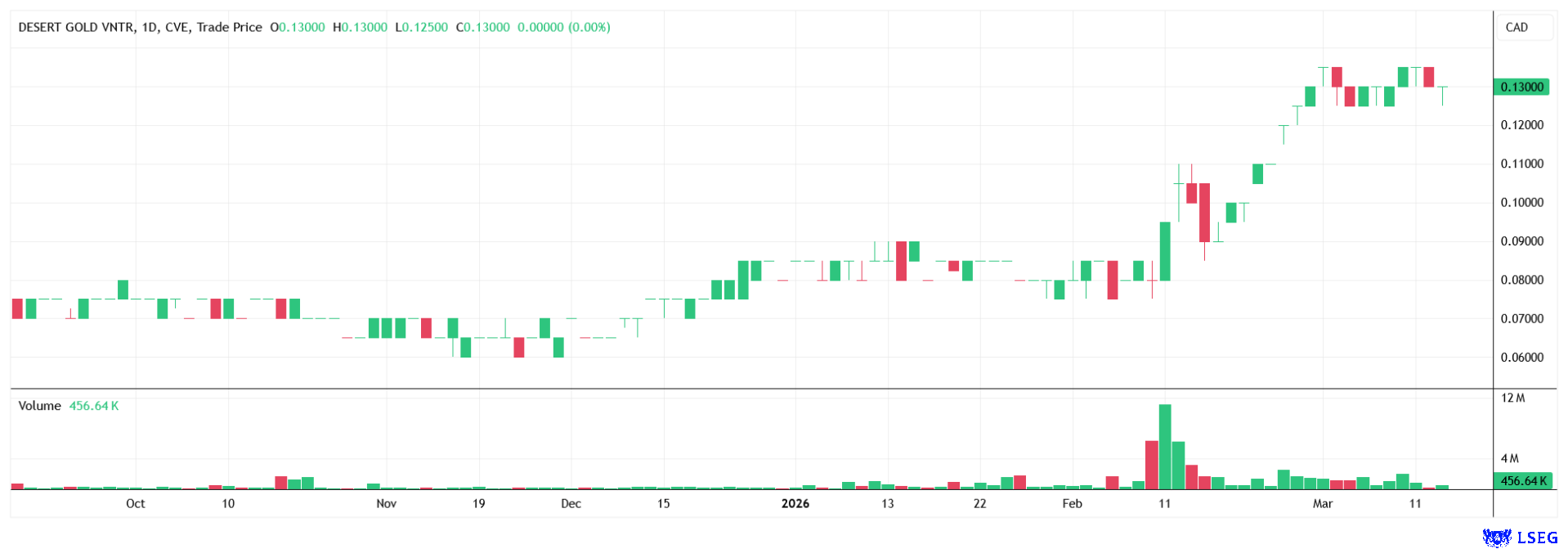
However, Mali is only one side of the coin. In Côte d’Ivoire, the company has secured another hot prospect with the Tiegba Gold project. Initial soil samples there yielded values of over 900 ppb gold, which is certainly generating interest among experts.** The experienced management team, which collectively boasts over 15 years of success in West Africa, knows exactly how to turn such anomalies into tangible discoveries. With a current share price of about CAD 0.13 and an already defined resource of over 1.1 million ounces of gold (measured, indicated, and inferred), the risk-reward ratio looks almost inviting for bold investors. This is the appeal of a company that has done its homework and is now on the verge of reaping the rewards of years of exploration work. For speculative investors, this price level presents a compelling entry point, with strong momentum indicating the likelihood of higher prices ahead.
Barrick Mining’s Battle Against Rising Costs
While a sense of optimism dominates at Desert Gold, a much more sober atmosphere prevails at industry leader Barrick Mining. At first glance, the figures for the 2025 fiscal year look like a success story. Free cash flow of USD 1.62 billion in the fourth quarter alone and earnings per share that have skyrocketed by a whopping 88% are sure to make dividend hunters’ hearts beat faster. In fact, management has set the quarterly dividend at USD 0.42 per share, representing a 140% increase. One might think Barrick is swimming in gold, but a closer look at the reports reveals cracks in the gold producer’s performance.
**The dark side of this success story is the massive rise in production costs. Barrick projects All-in Sustaining Costs (AISC) of USD 1,760-USD 1,950 per ounce for 2026, up from USD 1,581 at the end of 2025. Inflation in operating supplies and skyrocketing energy costs are eroding margins, while production is stagnating or even declining slightly. Barrick expects gold production of between 2.90 and 3.25 million ounces for 2026. This represents a significant decline compared to previous years and raises the question of how long the generous dividend policy can be sustained amid falling output and rising costs.
The political situation in Mali, in particular, remains a double-edged sword for Barrick. Although the company was able to regain control of the Loulo-Gounkoto complex following the recent upheavals, restarting production there ties up enormous financial and human resources. The planned IPO of the North American copper division should be viewed as a strategic move to break free from these constraints. With this, Barrick aims to unlock value potential that is currently being lost within the overall group. Copper is in global demand due to the energy transition, but for the traditional gold investor, Barrick remains, for now, a bet on a permanently extremely high gold price. With a gold price currently stable above USD 5,000, the safety margin at an AISC of nearly USD 2,000 is narrower than the record profits might suggest.
K+S as a Beneficiary of the Iran War
If the gold market becomes too much of a roller coaster ride, it is worth looking at commodities that are more closely tied to the basic necessity of feeding the world. This is where K+S comes into play. As one of the world’s leading suppliers of potash and magnesium products, the company occupies a niche that operates fundamentally differently from the precious metals sector.
While gold mining operators like Barrick or Desert Gold are driven by geopolitical crises and currency fluctuations, K+S’s fortunes hinge on global agricultural markets.
In the current 2026 scenario featuring the Iran War, it becomes clear that there are beneficiaries outside the defense industry as well. K+S benefits from robust global demand for fertilizers, as securing crop yields is a top priority in the face of a growing global population. Thirty percent of fertilizer production passes through the Strait of Hormuz. For investors, the stock offers a welcome anchor. While the potash market is cyclical, it follows different patterns than the often speculatively driven gold price. In a portfolio characterized by Desert Gold’s dynamic prospects and Barrick’s high-dividend but cost-burdened shares, K+S could serve as a stabilizing element and a beneficiary of geopolitical tensions. K+S does not sell dreams of gold but delivers tangible results from underground mining to feed the world’s hungry. The stock is currently performing exceptionally well, as potash prices are also rising. The momentum also currently points to further price increases.
Looking at the three stocks presented, a mixed picture emerges for the current year. Barrick Mining remains the major producer, attracting investors with impressive dividends, but losing flexibility due to its rigid cost structure and declining production volumes. Investors here are betting that the group’s market power can offset its operational weaknesses in the long term. K+S, on the other hand, offers the necessary stability and independence from the gold price, which can be invaluable in a balanced portfolio, especially right now. K+S is a war profiteer.
Desert Gold Ventures currently offers one of the most exciting profiles. Over the past few months, the company has consistently prepared to take the decisive step toward becoming a producer. The successful financing of over CAD 7 million and the focus on near-surface oxide deposits in Mali are clear signs of a well-thought-out strategy. Desert Gold is on the verge of a transformative phase. With a solid resource base and projects in the world’s best gold corridors, the company is, objectively speaking, exceptionally well-positioned to benefit disproportionately from the next phase of the gold cycle. For investors with a healthy dose of optimism, this West African explorer could be the surprise of 2026.
Conflict of interest
Pursuant to §85 of the German Securities Trading Act (WpHG), we point out that Apaton Finance GmbH as well as partners, authors or employees of Apaton Finance GmbH (hereinafter referred to as “Relevant Persons”) currently hold or hold shares or other financial instruments of the aforementioned companies and speculate on their price developments. In this respect, they intend to sell or acquire shares or other financial instruments of the companies (hereinafter each referred to as a “Transaction”). Transactions may thereby influence the respective price of the shares or other financial instruments of the Company.
In this respect, there is a concrete conflict of interest in the reporting on the companies.
In addition, Apaton Finance GmbH is active in the context of the preparation and publication of the reporting in paid contractual relationships.
For this reason, there is also a concrete conflict of interest.
The above information on existing conflicts of interest applies to all types and forms of publication used by Apaton Finance GmbH for publications on companies.
Risk notice
Apaton Finance GmbH offers editors, agencies and companies the opportunity to publish commentaries, interviews, summaries, news and the like on news.financial. These contents are exclusively for the information of the readers and do not represent any call to action or recommendations, neither explicitly nor implicitly they are to be understood as an assurance of possible price developments. The contents do not replace individual expert investment advice and do not constitute an offer to sell the discussed share(s) or other financial instruments, nor an invitation to buy or sell such.
The content is expressly not a financial analysis, but a journalistic or advertising text. Readers or users who make investment decisions or carry out transactions on the basis of the information provided here do so entirely at their own risk. No contractual relationship is established between Apaton Finance GmbH and its readers or the users of its offers, as our information only refers to the company and not to the investment decision of the reader or user.
The acquisition of financial instruments involves high risks, which can lead to the total loss of the invested capital. The information published by Apaton Finance GmbH and its authors is based on careful research. Nevertheless, no liability is assumed for financial losses or a content-related guarantee for the topicality, correctness, appropriateness and completeness of the content provided here. Please also note our Terms of use.
Stockhouse does not provide investment advice or recommendations. All investment decisions should be made based on your own research and consultation with a registered investment professional. The issuer is solely responsible for the accuracy of the information contained herein. For full disclaimer information, please click here.