

Here Lie the Problems Facing High-Tech Companies
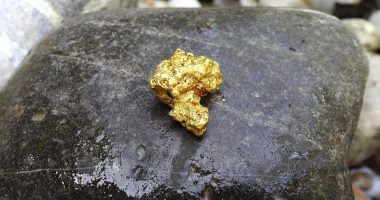
When people talk about future technologies today, they think of algorithms, plasma confinement, or three nanometers. Tungsten? For a long time, it was considered a “war metal”—good for filaments and armor, but lacking in future potential. That calm has come to an abrupt end. Three completely different megatrends are simultaneously hitting the same physical limits. And all three require the same material to move forward.
-
The problem with AI is no longer pure computing power—it is the waste heat. A single high-end AI GPU generates over 1,000 watts. Air cooling is useless at these scales; the industry relies on direct liquid cooling. But pure copper plates expand differently when heated than the silicon chip beneath them. The result is stress cracks—right in the expensive hardware. This is where tungsten comes into play. An alloy of copper and tungsten adapts its expansion almost perfectly to the chip. No warping, no cracks. At the same time, demand is growing for edge AI computers in vehicles, industrial plants, or mines that must operate reliably under extreme conditions. Anyone building AI infrastructure cannot do without this material.
-
Chips are shrinking to two nanometers—a scale at which copper wiring, reliable for decades, fails. Tungsten takes over where copper gives up. Its atomic stability and extremely high melting point make it the ideal material for vertical connections in the new three-dimensionally stacked chips. Without tungsten, there would be no two-nanometer semiconductors. And demand is growing rapidly: The number of AI applications outside the public cloud is rising, and every new chip requires this metal.
-
Nuclear fusion is considered humanity’s greatest hope for energy. The challenge is easy to describe. You have to heat a plasma to over 100 million degrees while simultaneously cooling the reactor walls. No ordinary material can withstand that. Tungsten, on the other hand, has the highest melting point of any metal—3,422 degrees Celsius. It is already being used in the divertors of experimental reactors like ITER, the parts that directly contain the hot plasma. Those who want to bring nuclear fusion to market cannot do without tungsten.
Three Megatrends, One Shortage
Three fields of the future, one solution. Demand is not arising from a single source, but from several parallel revolutions. That is what makes the situation so extraordinary—and so vulnerable, because this is where things get explosive.
China has been gradually curtailing its tungsten exports since February 2025. The result: The reference price for ammonium paratungstate has risen by over 500% within a year. A market that was artificially kept flat for three decades by Chinese subsidies is now breathing freely for the first time.
The industry speaks of a structural revaluation, not a short-term bubble.
Almonty Industries: The Western Producer in the Spotlight
This is precisely where a company comes into play that has operated in the industry’s shadow for years. Almonty Industries has quietly built one of the few Western tungsten platforms. At its heart is the Sangdong mine in South Korea, which resumed operations at the end of 2025 after more than three decades of inactivity. The facility is designed to process approximately 640,000 tons of ore per year, equivalent to about 230,000 MTU of tungsten. A second phase starting in 2027 is expected to double capacity. The company anticipates meeting approximately 40% of total tungsten demand outside of China by then. That would be a game-changer in a market with virtually no significant alternatives.
Three Continents, One Plan
But a single mine alone does not make for strategic scale. What sets Almonty apart from many single-project companies are three additional building blocks.
-
The Panasqueira Mine in Portugal has been in operation for 136 years and is a reliable source of cash flow. The company is driving an expansion there into deeper, higher-grade zones to extend the mine’s lifespan.
-
The Gentung Browns Lake Tungsten Project in Montana is scheduled to begin production as early as 2026. It would be the first domestic tungsten producer in the US in over a decade—a strategic advantage in an era of supply chain legislation.
-
A high-grade molybdenum deposit directly on the Sangdong property. A second commodity lever that broadens the company’s profile and opens up additional revenue streams.
Financial Buffers and Strategic Contracts
Management has also established an unusual hedge. For portions of production, there are long-term agreements with guaranteed minimum prices and no upper limit. The Sangdong output is committed to US defense customers for 15 years. These off-take agreements transform what is inherently a volatile commodity bet into a predictable business—no dependence on middlemen, no distress sales under unfavorable terms.
Financially, Almonty is prepared for the upcoming leap. Two capital increases last year brought in over USD 200 million gross. The balance sheet shows several hundred million in cash and cash equivalents at year-end. That is enough to handle the ramp-up without financial pressure. Last year’s high reported losses are largely non-cash effects from the revaluation of convertible bonds, triggered by the sharp rise in the stock price. Operationally, the picture remains significantly more stable.
The Geopolitical Clock is Ticking
The geopolitical dimension further exacerbates the situation. Starting in 2027, US defense agencies will no longer be allowed to source tungsten from China. At the same time, Beijing’s restrictions are hitting Western countries harder and harder. Japanese suppliers have already signaled production cuts because they are running out of raw materials. There are currently few alternatives for Western buyers. That is now changing thanks to Almonty Industries, which can at least partially meet the high demand.
Analysts have recognized the potential. Several firms have significantly raised their price targets in just the first few months of the year. The justifications are similar: structural supply deficit, unique asset quality outside of China, secured financing. The strategic logic is clear, and the market environment is supportive.
The stock is currently trading at USD 21.94 on the NASDAQ.
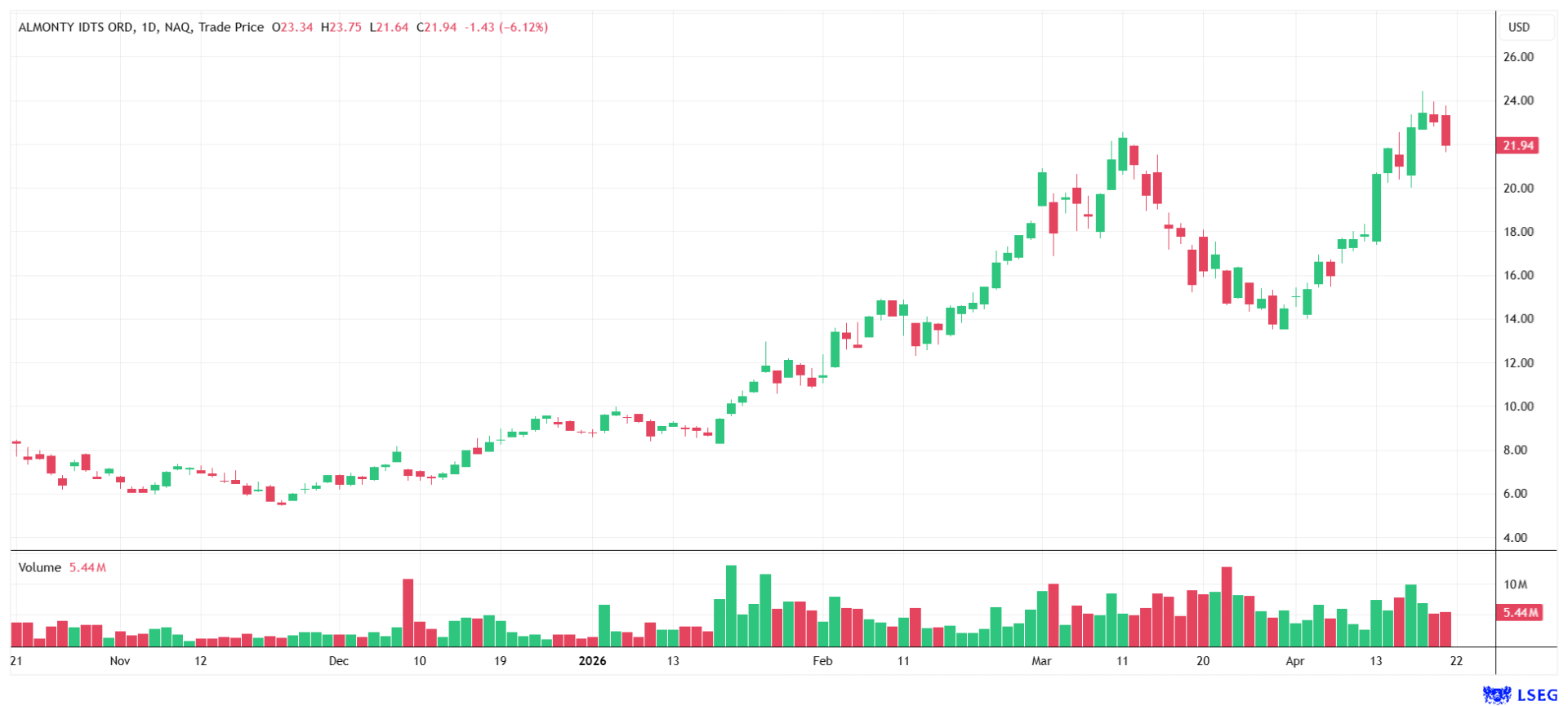
Tungsten has moved from a niche topic to center stage, not because of hype, but because defense, AI, semiconductors, and nuclear fusion have no alternative to it. Almonty Industries offers a rare combination: a rapidly ramping-up mine in a secure jurisdiction, long-term off-take agreements, and a well-funded war chest. The operational execution will become apparent in the coming quarters. Those who believe in the reorganization of Western supply chains will find one of the cleanest leverage opportunities here.
Conflict of interest
Pursuant to §85 of the German Securities Trading Act (WpHG), we point out that Apaton Finance GmbH as well as partners, authors or employees of Apaton Finance GmbH (hereinafter referred to as “Relevant Persons”) currently hold or hold shares or other financial instruments of the aforementioned companies and speculate on their price developments. In this respect, they intend to sell or acquire shares or other financial instruments of the companies (hereinafter each referred to as a “Transaction”). Transactions may thereby influence the respective price of the shares or other financial instruments of the Company.
In this respect, there is a concrete conflict of interest in the reporting on the companies.
In addition, Apaton Finance GmbH is active in the context of the preparation and publication of the reporting in paid contractual relationships.
For this reason, there is also a concrete conflict of interest.
The above information on existing conflicts of interest applies to all types and forms of publication used by Apaton Finance GmbH for publications on companies.
Risk notice
Apaton Finance GmbH offers editors, agencies and companies the opportunity to publish commentaries, interviews, summaries, news and the like on news.financial. These contents are exclusively for the information of the readers and do not represent any call to action or recommendations, neither explicitly nor implicitly they are to be understood as an assurance of possible price developments. The contents do not replace individual expert investment advice and do not constitute an offer to sell the discussed share(s) or other financial instruments, nor an invitation to buy or sell such.
The content is expressly not a financial analysis, but a journalistic or advertising text. Readers or users who make investment decisions or carry out transactions on the basis of the information provided here do so entirely at their own risk. No contractual relationship is established between Apaton Finance GmbH and its readers or the users of its offers, as our information only refers to the company and not to the investment decision of the reader or user.
The acquisition of financial instruments involves high risks, which can lead to the total loss of the invested capital. The information published by Apaton Finance GmbH and its authors is based on careful research. Nevertheless, no liability is assumed for financial losses or a content-related guarantee for the topicality, correctness, appropriateness and completeness of the content provided here. Please also note our Terms of use.
Stockhouse does not provide investment advice or recommendations. All investment decisions should be made based on your own research and consultation with a registered investment professional. The issuer is solely responsible for the accuracy of the information contained herein. For full disclaimer information, please click here.