
- Junior mining stocks offer exponential portfolio upside, but success requires rigorous due diligence to select companies with favorable project geology, prospective demand and capable leadership.
- Cora Gold is exemplary in this regard, as it’s fully funded for production at its Sanankoro project in Mali via a US$120 million gold stream, positioning it roughly 16 months from a first gold pour, supported by low pre-production costs and significant resource expansion upside.
- So too is URU Metals, whose Zebedelia project in South Africa sits on a substantial nickel-sulphide deposit adjacent to world-class assets, offering investors a high-conviction opportunity trading at a bargain-bin price.
Junior mining stocks grant your portfolio exposure to the risk frontier, where exponential returns can be earned for a reasonable amount of capital, contingent on the rare but achievable alignment of commodity demand, a prospective project and a leadership team capable of creating value through strategic exploration.
That said, whether your appetite for this risk moves you towards concentrated investments, or index funds with some sandbox trading money, the only way to optimize the money working for you in the junior mining sector is to be rigorous in your pursuit.
This article is disseminated in partnership with junior mining stocks Cora Gold Ltd. and URU Metals Ltd. It is intended to inform investors and should not be taken as a recommendation or financial advice.
In layperson’s terms, what we’re talking about here is making sure you’re investing in miners that have a good thing going. This is not a complex undertaking, but rather a cumbersome one, demanding that you comb through the literature on your chosen company to assess its path forward.
One you’ve compiled all the evidence, it should appear instinctually reasonable or off-putting to own the stock over the long-term, as its underlying company vies to advance along the mining lifecycle.
This is because operations will either be turning up encouragingly graded mineralization in a proven mining district suggestive of a discovery, or floundering in intermittent news flow headed in no direction in particular, with leadership changes rivalling exploration results in the number of news releases they are featured in.
In the newest edition of Stockhouse’s Weekly Market Movers, I’ll show you what I mean by profiling two junior miners active in Africa with particularly persuasive theses for value creation.
Cora Gold
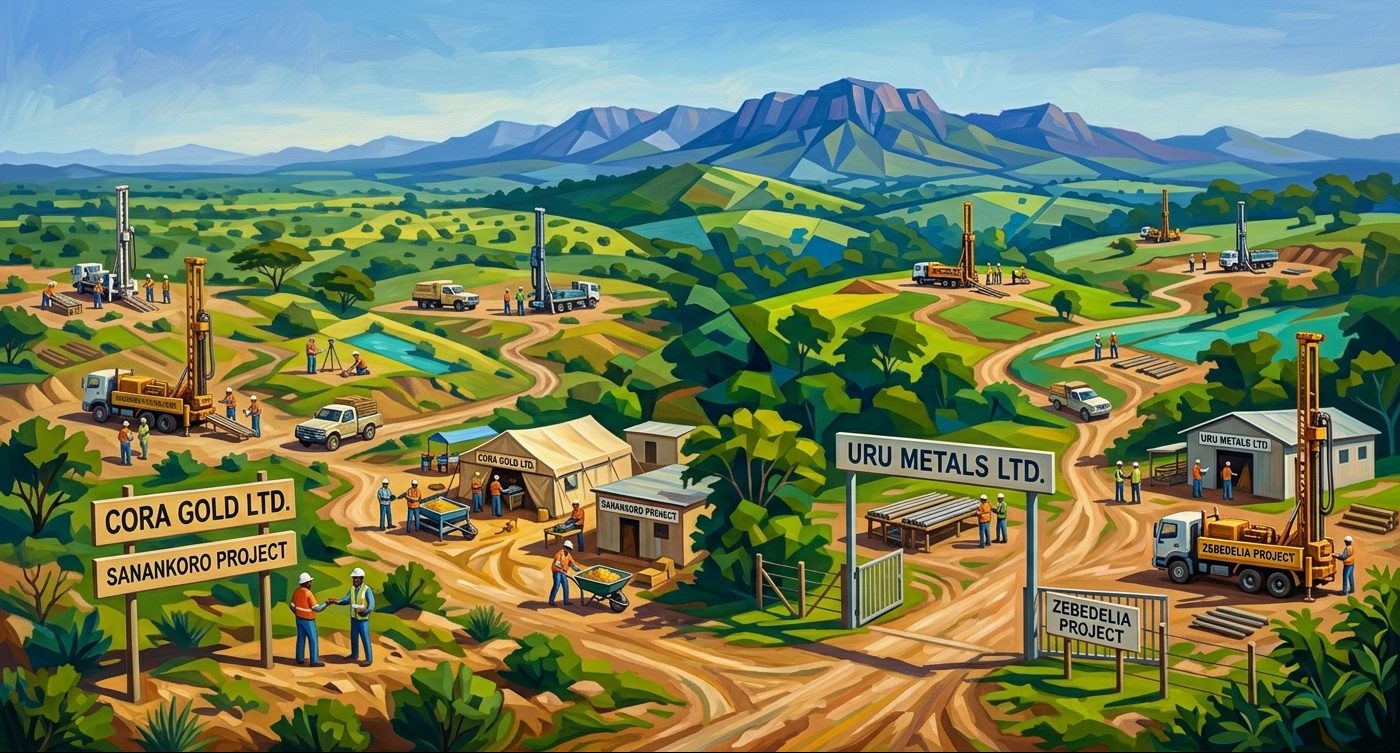
Our first junior miner, Cora Gold, market cap £77.68 million, has been fostering a tight connection between operational development and the recently soaring gold price through its flagship Sanankoro project in Mali.
The open-pit project, on track for near-term production, produced a 2025 definitive feasibility study detailing an efficient, low-cost mine, based on a conservative base case of only US$3,500 per ounce of gold. Here are the specs:
- 482,000 ounces in estimated production over a 10.2-year mine life.
- US$686 million in free cash flow over the life of mine.
- Only US$124 million in pre-production capital at a payback period of only 0.7 years.
- US$1,623 per ounce in average all-in sustaining costs.
The company recently pulled this framework from dream to reality through a binding term sheet with Eagle Eye Asset Holdings, its largest shareholder, for a US$120 million gold stream that fully funds Sanankoro to production.
The deal, subject to a definitive agreement, led Cora to move right into the project’s engineering phase, placing it about 16 months from an initial gold pour, contingent on permitting, which would immediately differentiate the company as a cash-flowing entity among its micro-cap peers.
Concurrently, Cora is moving forward with a drilling program to harvest more of the project’s upside, whose five gold-bearing structures, estimated to host a collective 1.04 million ounces, offer numerous targets with the potential to extend the mine life. A steady stream of exploration news flow is expected over the coming months.
With a leadership team behind numerous multi-million-ounce gold discoveries and subsequent mines in Africa calling the shots, Sanankoro is diligently progressing towards a construction decision in about four months time.
Cora Gold stock (LSE:CORA) has climbed by about 4x since the project’s updated resource estimate hit the wire in January 2025, which grew total contained metal by 13 per cent. Nevertheless, the company continues to trade at a fraction of future cash flow.
Bert Monro, Chief Executive Officer of Cora Gold, joined Ricki Lee to discuss Sanankoro’s development journey. Watch the interview here.
URU Metals
A second junior miner rapidly setting itself apart in the industry is URU Metals, market cap £3.78 million, whose majority-owned Zebedelia nickel property in South Africa, prospective for a metal at the core of the steel, aerospace and clean energy industries, is both significantly de-risked and priced like the most unreliable of speculations.
The 4,660-hectare project, operated by 74.4%-owned Zeb Nickel (TSX:ZBNI), is located near the platinum mining town of Mokopane in the prolific Bushveld complex, which hosts some of the world’s premier nickel (Ni), copper (Co) and platinum group element (PGE) deposits.
Zebedelia’s advanced nickel sulphide deposit, composed of four zones informed by nearly 14,000 m of drilling, is geologically similar to a pair of these tier-1 assets, Ivanhoe’s Platreef mine and Valterra Platinum’s Mogalakwena mine, with the latter ranking as the largest open-pit Ni-Cu-PGE operation in the world.
A 2012 preliminary economic assessment estimates 20,000 tons of annual nickel production over a 25-year mine life, total CAPEX of US$708 million and OPEX of US$3.35 per pound, all at a base-case of US$8.50 per pound, just below the US$7.27 spot price at the time of writing.
Leadership is after more mineralization and at higher grades after 2025 geophysics results unveiled multiple coincident conductors and accompanying targets with the potential to strengthen the relation between Zebedelia and its large-scale neighbors. A highlight among these results includes Ni-Cu-PGE-bearing rocks that run between zones 1 and 2 for more than 3.5 km along strike.
URU is currently making a final decision on a contractor in preparation for staged drilling, following the completion of a new 3D model, positioning investors for a procession of news flow in the months ahead.
To orchestrate these efforts, the company benefits from a long-term chief executive officer, John Zorbas, who assumed the role back in 2014, whose comprehensive business background specializing in metals exploration and development, while touching on operations, finance, planning, sales and marketing, makes Zebedelia one of South Africa’s highest-conviction junior mining plays.
Despite a flagship asset that’s slowly earning its place among giants, URU Metals (LSE:URU) has given back more than 70 per cent since 2021, offering investors a pessimistic entry point to build a position.
Richard Montjoie, Vice President of Exploration, who has led several Ni-PGE projects from exploration to development, spoke with Ricki Lee about how the company is improving its understanding of Zebedelia’s mineralization to optimize upcoming drilling. Interview forthcoming.
Thanks for reading! I’ll see you next Monday for a new edition of Weekly Market Movers, where I delve into companies that joined Stockhouse for an interview over the past week. Here’s the most recent article, 2 junior mining stocks striking a chord with investors, in case you missed it.
Join the discussion: Find out what investors are saying about these junior mining stocks on the Cora Gold Ltd. and URU Metals Ltd. discussion threads on ADVFN.