
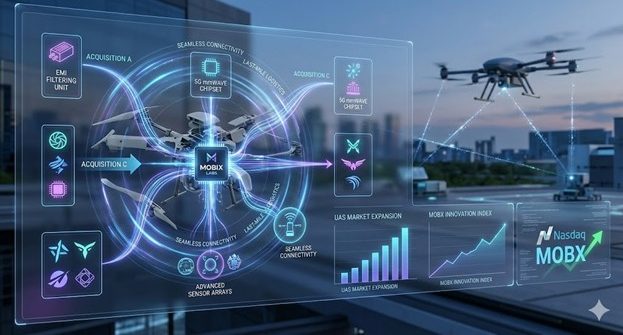

As the Unmanned Aerial Systems (UAS) sector transitions from a niche defense vertical into a projected multi-billion-dollar global industry, Mobix Labs (Nasdaq: MOBX) is positioning itself as a central infrastructure player. Following a strategic update on March 31, 2026, the fabless semiconductor company has signaled a sharpened focus on the drone market, fueled by a calculated Mergers and Acquisitions (M&A) strategy.
For retail investors, the story isn’t just about the drones themselves—it’s about the essential components that keep them in the air and connected.
This article is being disseminated on behalf of a third-party issuer and is intended for informational purposes only.
The strategic pivot: Why drones?
Mobix Labs’ recent announcement highlights a series of “UAS wins” that have validated its technology in the high-stakes drone sector. While many companies in this space focus on building the airframes, Mobix is targeting the “nervous system” of the aircraft.
By leveraging its expertise in mmWave 5G connectivity and EMI (electromagnetic interference) filtering, Mobix addresses the two primary points of failure for modern drones:
- Connectivity latency: The need for real-time, high-bandwidth data transfer for autonomous flight.
- Signal interference: Ensuring that the dense electronics within a drone don’t interfere with its own navigation or communication systems.
The M&A playbook: Growth by aggregation
A key takeaway for the market is Mobix’s “roll-up” approach to M&A. Rather than relying solely on internal Research and Development (R&D), which can be capital-intensive and time-consuming, the company identifies and acquires smaller, specialized firms with “sticky” intellectual property.
Benefits of the M&A strategy
- Instant market entry: Acquisitions allow Mobix to bypass lengthy certification processes required for defense and aerospace contracts.
- IP consolidation: Each acquisition brings new patents and engineering talent under one roof, creating a “one-stop-shop” for drone manufacturers.
- Revenue synergy: By integrating its existing filtering tech into newly acquired UAS platforms, Mobix can increase the “content per vehicle”—essentially earning more on every drone sold by their partners.
Technical edge: What’s under the hood?
In modern electronic warfare and industrial environments, drones face significant “noise.” Mobix’s technology ensures that a drone remains operational even in high-interference zones. This has made them an attractive partner for government agencies and logistics firms looking for reliability in “last-mile” delivery and reconnaissance missions.
The retail perspective: Risk vs. reward
While the growth trajectory in the drone market is steep, retail investors should maintain a balanced view of the operational hurdles inherent in a high-growth M&A model.
The opportunity
- High barriers to entry: Defense contracts provide a “moat” against low-cost competitors.
- Market tailwinds: Increasing global demand for autonomous systems in defense and logistics.
- Design-in wins: Once a component is part of a drone’s blueprint, it is rarely replaced.
Looking ahead
The March 31st update suggests that Mobix Labs is evolving into a specialized military and defense supplier. For investors watching the UAS space, the metric to track will be the integration efficiency of their new acquisitions.
If Mobix can successfully cross-sell its connectivity solutions across its expanding portfolio, it may well become the silent engine behind the next generation of autonomous flight.
Join the discussion: Find out what the Bullboards are saying about Mobix Labs and check out Stockhouse’s stock forums and message boards.
Stockhouse does not provide investment advice or recommendations. All investment decisions should be made based on your own research and consultation with a registered investment professional. The issuer is solely responsible for the accuracy of the information contained herein. For full disclaimer information, please click here.