

When the cost of goods and services, aka inflation, inevitably starts to run up again, whether that’s because of US tariffs, a more widespread trend towards deglobalization in the name of national security, or some other exogenous force, the products to do business in are those for which customers will pay a higher price without hesitation.
This content has been prepared as part of a partnership with Canada Goose Holdings Inc., and is intended for informational purposes only.
On the flipside, if consumer demand has been plummeting, unemployment is high, and belt-tightening is increasingly the norm for most people, the products you’d want to do business in are those customers will pay full price for, opting to make their budget cuts elsewhere.
In both cases, it’s brand power that keeps customers coming back, justifying a buying decision thanks to how a product is perceived and the loyalty it inspires. We can divide brand power any number of ways, but key pillars would include production quality, widespread availability, advertising reach and company values, granting the brand pricing power to strategically look out for its bottom line while meeting customer expectations.
A brand is then one of the ultimate hedges for high-risk economies, whether inflation or recession, making the companies that own them, and by association the stocks that track them, evergreen considerations towards a potential investment.
Keeping the planet cold and the people on it warm
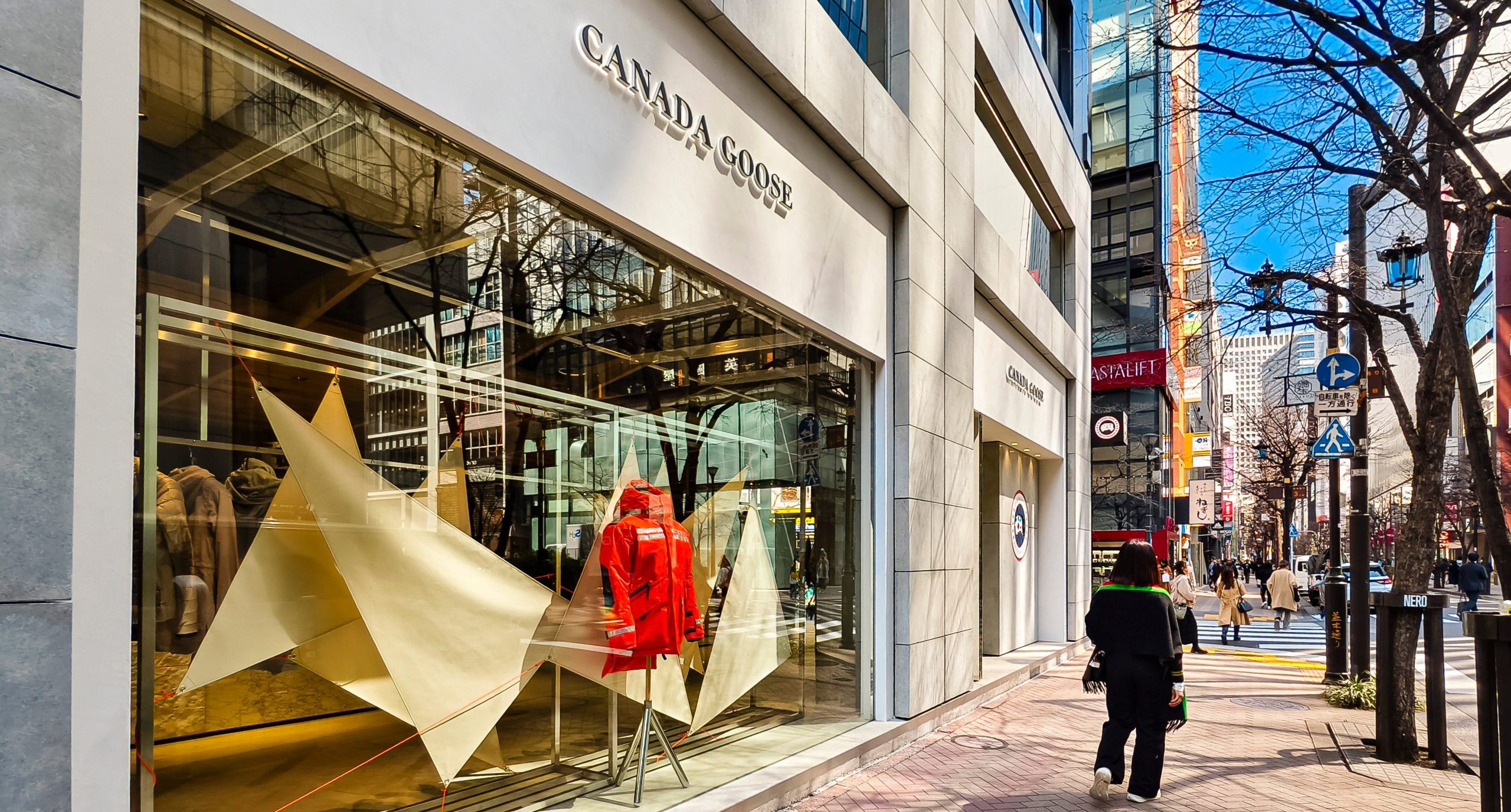
One household name with the right elements to outperform across the economic cycle is Canada Goose Holdings, market capitalization C$1.83 billion, a luxury outerwear, apparel, footwear and accessories brand, beloved for its Canadian-made parkas, that has become synonymous with the intersection of sportiness and style driven by its mission of keeping the planet cold and the people on it warm.
The company, founded back in 1957, has had its highs and lows, including perceived overreliance on the Chinese market, but has managed to claim an enduring spot in luxury fashion by cultivating an image of elegance, ruggedness and social consciousness, with a focus on community and sustainability, attracting everyone from celebrities to soccer moms to the aura of exclusivity a C$2,000 parka can provide.
Canada Goose bounced back from the COVID pandemic and has endured post-reopening inflation with aplomb, increasing revenue every year from C$903.70 million in fiscal 2021 – down only slightly from C$958.1 million in fiscal 2020 – to C$1.348 billion in fiscal 2025, supported by strong average annual net income of C$78.14 million, all while:
- Expanding the brand’s global footprint into Europe and Japan.
- Expanding product offerings to broaden luxury appeal across a greater range of price points, as evidenced by Canada Goose’s first creative director, Haider Ackermann, and his first two capsules released in 2024 and 2025.
The company’s Q4 2025, ending March 30, was a strong one, generating higher revenue concentrated in North America (C$165.4 million) and the Asia-Pacific region (C$170.4 million), with a meaningful presence in Europe (C$48.8 million), supported by C$27.1 million in net income, up from C$5 million year-over-year. Operations also improved net debt leverage from 2x to 1.3x and direct-to-consumer revenue by 12 per cent to C$314.1 million year-over-year, increasing the potential for higher near-term margins.
These encouraging metrics set the tone for a fiscal 2026 during which Dani Reiss, Canada Goose’s chief executive officer, expects the company to “execute bolder marketing initiatives, expand and enhance our product offering and elevate consumer experience,” each priority “focused, proven and designed to keep driving long-term growth.”
While results for Q1 fiscal 2026, slated for July 31, 2025, will be investors’ first glimpse into how Trump’s tariff regime has affected operational performance, I see any share price pessimism as a deeper discount for the long-term investor who recognizes the company’s multiple reasons for conviction. These include:
- The mote of membership in the zeitgeist, with Canada Goose having long become a luxury status symbol.
- A demonstrated ability to integrate substantial price increases as part of long-term growth, with parkas going for approximately C$800-US$1300 in 2017 to C$1,300-C$2,200 in 2025, traversing both the COVID recession and ensuing inflation.
- Management’s profitable track record, fortified by the difficult decisions that are sometimes required to respond to the changing economic climate while remaining aligned with shareholder value. These include a 17 per cent layoff in 2024 and eschewing financial guidance for fiscal 2026 given tariff uncertainty, even though the company is for the moment exempt thanks to its products complying with the United States-Mexico-Canada Agreement.
Despite the choppy waters that may lie ahead, management echoes my optimism about Canada Goose’s near-term prospects, stating in the Q4 2025 investor deck that it “remains confident in the strength of the brand, the company’s solid financial position and its ability to adapt to changing conditions.”
Investors broadly agree, having lifted Canada Goose stock (TSX:GOOS) by 28.68 per cent year-to-date and by 16.41 per cent year-over-year, though shares remains down by 38.14 per cent since 2020, leaving a considerable runway for a re-rating more in line with the company’s proven ability to deliver profitable growth despite elevated macroeconomic uncertainty.
Join the discussion: Find out what investors are saying about this resilient luxury retail brand on the Canada Goose Holdings Inc. Bullboard and make sure to explore the rest of Stockhouse’s stock forums and message boards.
Stockhouse does not provide investment advice or recommendations. All investment decisions should be made based on your own research and consultation with a registered investment professional. The issuer is solely responsible for the accuracy of the information contained herein. For full disclaimer information, please click here.