

Rheinmetall and TKMS: Blockbuster Contract with Canada Sets the Course
There is cause for celebration at thyssenkrupp’s corporate headquarters in Duisburg. That is because TKMS, its 51% naval subsidiary, has secured a historic defence contract from Canada. Under the terms of the contract, up to twelve Type 212CD submarines will be delivered over a period of 10 years. With an order value of over EUR 15 billion for the construction phase and a potential total package of around EUR 62 billion, including maintenance and operation over decades, this is the largest single contract in TKMS’s history. The deal sets Rheinmetall back in its ambitious shipyard expansion strategy, after the group recently acquired several warship yards and was on the verge of taking over the F-126 frigate program. By opting for a NATO partnership model with Germany and Norway instead of a South Korean supplier, Canada is giving strong geopolitical expression to the Canadian Navy’s strategic ties to the transatlantic defence bloc.
With this order, along with the 12 submarines already committed to Germany and Norway, as well as deliveries to Israel and Singapore, TKMS’s order book now totals 29 planned submarines, expanding its order backlog to a historic level. Production is to take place entirely in Germany, at the Kiel and Wismar shipyards. It will create up to 1,500 additional jobs there, thereby strengthening local industrial policy and the employment situation in maritime regions. With this blockbuster contract, Rheinmetall loses not only the F-126 project but also potential revenue and technology transfer opportunities that would have arisen from the planned submarine program. For TKMS, however, the recent order momentum means not only a short-term increase in volume but also long-term maintenance and service contracts that will stabilize revenue over the submarines’ entire service life and improve the cash flow forecast. TKMS is gaining strategic relevance and order book diversification, while Rheinmetall is facing pressure to adapt in the shipbuilding segment.
Over the past 6 months, Rheinmetall’s stock has consolidated from around EUR 1,900 to a low of EUR 902, while TKMS, after a temporary dip to EUR 72 EUR, has continued to head toward previous highs in recent days, trading at EUR 92.80. On the LSEG Refinitiv platform, 22 analysts recommend buying Rheinmetall shares with an average 12-month price target of EUR 1,730—representing upside potential of around 70%. Experts are also bullish on TKMS, with a consensus price target of EUR 96. Given the strong order momentum, this target could well be raised in upcoming updates.
Hensoldt: A New Push in the Defence Cycle
Hensoldt is also at the start of a structural upswing. Order intake in Q1 of EUR 1.48 billion is more than double that of the previous quarter and marks yet another historic record. The order backlog of EUR 9.8 billion represents a 41% increase over the previous year and now covers four years’ worth of revenue. This confirms that German and European defence strategy is not only sending a signal but is already being translated into concrete procurements. With the nearly EUR 1 billion order for the sensor suite and the Ceretron mission system for the “Luchs 2” reconnaissance tank, Hensoldt is positioning itself as a key supplier for the future nationwide reconnaissance and tank platform. In addition, the major contract from Ukraine, worth over EUR 340 million for TRML-4D and Spexer-2000 radars, secures the Group’s international relevance and underscores its role within the European security architecture.
The book-to-bill ratio of 1.9x in 2025 (previous year: 1.3x), along with confirmed targets for revenue, an EBITDA margin of 18.4%, and free cash flow, demonstrate that operating profitability is growing in tandem with volume. The capital market reaction, however, remains comparatively subdued. From the consolidation level of EUR 63 in June, the stock has so far risen only to EUR 77. Analysts’ consensus estimate stands at EUR 89.97. Compared to defence companies TKMS and Rheinmetall, Hensoldt benefits more as a driver of digital and networked defence capabilities—a sector characterized by high margins. The stock therefore remains attractive during correction phases.
Kobo Resources: Far from Defence, but Very Close to Gold
While Europe is expanding its defence budgets and reassessing supply chains for security-critical raw materials, regions with significant mineral resources are coming increasingly into focus for international investors. West Africa is increasingly emerging as one of the world’s most exciting commodity corridors, as—in addition to strategic metals—gold, in particular, is playing an ever-greater role for nations, companies, and capital markets. With solid GDP growth of 6%, Côte d’Ivoire ranks among the world’s top performers. Notably, gold production is steadily rising, fueled by improved infrastructure.
In this context, Kobo Resources is positioning itself through its Kossou Gold project in a region that has repeatedly demonstrated exceptional geological potential, and where new metal discoveries are drawing the attention of international investors. With each additional drilling program, Kobo Resources is solidifying the profile of a gold project that is increasingly taking on the character of a serious deposit development. High-grade gold intervals were once again identified in the Road Cut and Jagger zones, including 7 m grading 5.67 g/t gold as well as spectacular peak grades of up to 150 g/t over 1 m, which impressively underscores the potential of the mineralized system. At the same time, broader mineralized intervals indicate that mineralization continues both along strike and at depth and is far from reaching its limits.
IIF host Lyndsay Malchuk interviewed CEO Ed Gosselin about Kobo’s projects in Côte d’Ivoire.
With more than 42,000 m of drilling from over 220 drill holes to date, the company has a robust data set that will be incorporated into its first resource estimate in the second half of 2026. Recently published metallurgical studies provide additional momentum, as independent tests have confirmed average gold recovery rates of around 97%, with individual samples achieving up to 99%. At the same time, two drill rigs are advancing the definition of additional resource areas while expanding the exploration potential along the more than 9 km long structural corridor. Kobo is currently preparing to launch its first drilling program at the Kotobi project, which, as a second pillar, opens up additional discovery opportunities and meaningfully broadens the project pipeline. The company most recently received financial support through a capital raise of approximately CAD 5.5 million, in which a strategic Asian investor acquired just under 10% of the shares. Kobo is thus gaining significant operational momentum. The share price, however, tells a different story. Due to consolidation in the gold market, shares can even be purchased below the price at which the latest financing round was completed. Investors will, however, look back on these prices with tears in their eyes over the next 3 years, as the upcoming resource estimate this fall presents short-term return potential of over 500%. Time to buy!
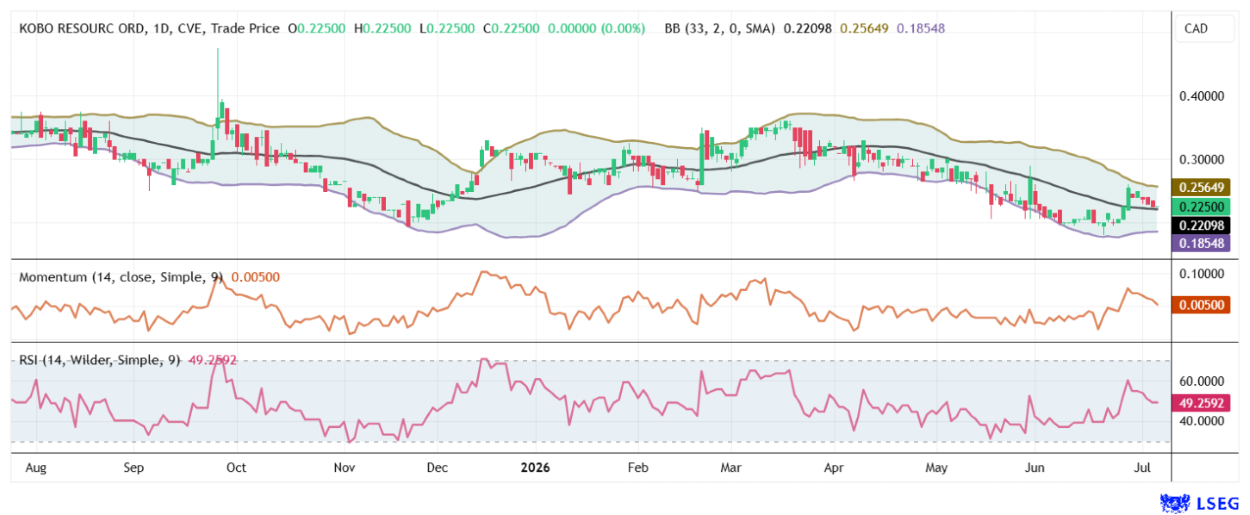
The year-to-date performance of gold and silver comes as no surprise. The steep rise in January had already anticipated the annual performance. The defence sector, however, is a different story—it saw a monumental rally between 2024 and Q1 2026. Until last week, the pronounced consolidation kept these stocks in check as well. With the NATO summit in Ankara, they are once again at the top of investors’ lists. A well-balanced portfolio protects against excessive volatility.
Conflict of interest
Pursuant to §85 of the German Securities Trading Act (WpHG), we point out that Apaton Finance GmbH as well as partners, authors or employees of Apaton Finance GmbH (hereinafter referred to as “Relevant Persons”) currently hold or hold shares or other financial instruments of the aforementioned companies and speculate on their price developments. In this respect, they intend to sell or acquire shares or other financial instruments of the companies (hereinafter each referred to as a “Transaction”). Transactions may thereby influence the respective price of the shares or other financial instruments of the Company.
In this respect, there is a concrete conflict of interest in the reporting on the companies.
In addition, Apaton Finance GmbH is active in the context of the preparation and publication of the reporting in paid contractual relationships.
For this reason, there is also a concrete conflict of interest.
The above information on existing conflicts of interest applies to all types and forms of publication used by Apaton Finance GmbH for publications on companies.
Risk notice
Apaton Finance GmbH offers editors, agencies and companies the opportunity to publish commentaries, interviews, summaries, news and the like on news.financial. These contents are exclusively for the information of the readers and do not represent any call to action or recommendations, neither explicitly nor implicitly they are to be understood as an assurance of possible price developments. The contents do not replace individual expert investment advice and do not constitute an offer to sell the discussed share(s) or other financial instruments, nor an invitation to buy or sell such.
The content is expressly not a financial analysis, but a journalistic or advertising text. Readers or users who make investment decisions or carry out transactions on the basis of the information provided here do so entirely at their own risk. No contractual relationship is established between Apaton Finance GmbH and its readers or the users of its offers, as our information only refers to the company and not to the investment decision of the reader or user.
The acquisition of financial instruments involves high risks, which can lead to the total loss of the invested capital. The information published by Apaton Finance GmbH and its authors is based on careful research. Nevertheless, no liability is assumed for financial losses or a content-related guarantee for the topicality, correctness, appropriateness and completeness of the content provided here. Please also note our Terms of use.
Stockhouse does not provide investment advice or recommendations. All investment decisions should be made based on your own research and consultation with a registered investment professional. The issuer is solely responsible for the accuracy of the information contained herein. For full disclaimer information, please click here.