
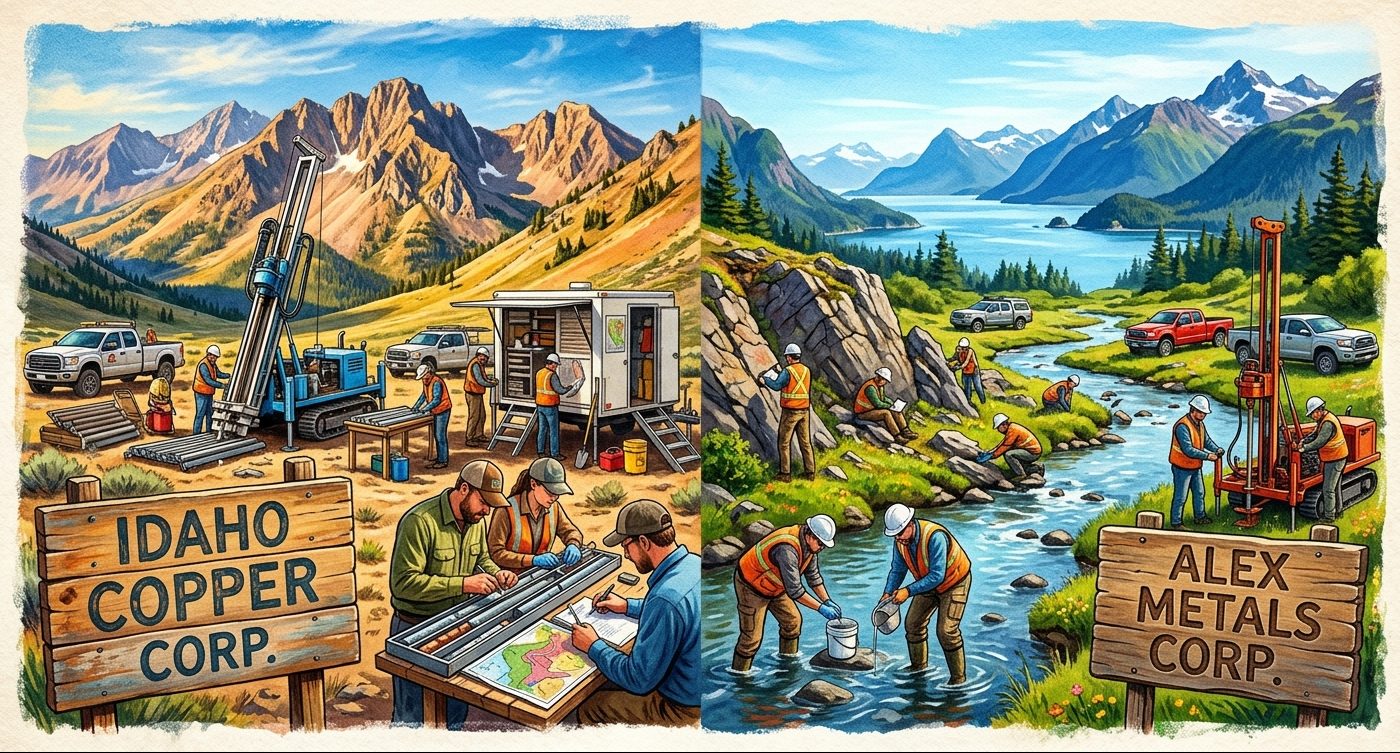

Investors in junior mining stocks are, in essence, prospectors from the comfort of their computer screens, requiring that they take a realistic approach to the pursuit of differentiated returns.
Realism, in this case, means realizing that miners create shareholder value through exposure to commodity prices, leveraged by project quality, plus leadership’s skill at raising capital and demonstrating this quality to investors through sampling, drilling, economic studies and strategic partnerships.
This article is disseminated in partnership with junior mining stocks Idaho Copper Corp. and Alex Metals Corp. It is intended to inform investors and should not be taken as a recommendation or financial advice.
Immediately, we should note major contingencies, in that exploration data is not, on its own, economically viable, while economic studies carry degrees of uncertainty that are only meaningfully sidestepped when reaching the bankable feasibility study stage – which still carries a 10-15% margin for error – at which point, supposing funding is in place, much of a company’s upside may already be priced into its stock.
The upshot here is that the potential for junior miners to progress across the mining lifecycle is unavoidably paired with the risk of significant capital losses, should prospects turn out to be little more than holes in the ground.
A broadly diversified, rigorously researched approach then presents itself as the only rational way forward, where each investment is viewed as a venture-type option on exponential returns, which may end up worthless, should an asset sale to a major miner or a pathway to production fail to present itself.
In the latest edition of Stockhouse’s Weekly Market Movers, I’ll help you populate your watchlist by digging into two junior mining stocks whose long-term prospects are looking assuredly up.
Idaho Copper
Idaho Copper, market cap US$46.76 million, substantiates investor conviction through the exploration and development of its 2,640-acre CuMo copper, silver, rhenium, tungsten and molybdenum project, located 36 miles from Boise, Idaho. The project is one of the largest undeveloped copper deposits in the United States, and what leadership believes to be one of the largest undeveloped molybdenum deposits in the world.
CuMo backs up its resource, diversified across some of the most in-demand critical minerals of our time, through a recently updated preliminary economic assessment (PEA) sporting some properly impressive specs:
- Estimated production of 1.748 billion pounds of copper, 906 million pounds of molybdenum and 6.869 billion pounds of copper equivalent over a 46-year mine life.
- Initial costs of US$1.17 billon paid back after only 5.9 years.
- Operating costs, reflecting by-product credit calculations, including C1 cash costs of US$7.06 per pound of molybdenum and negative US$4.30 per pound of copper, as well as all-in sustaining costs of US$7.82 per pound of molybdenum and negative US$3.91 per pound of copper.
- This all works out to an after-tax net present value of US$1.88 billion (8%) using base-case metals prices of US$5 per pound of copper, US$25 per pound of molybdenum and US$50 per ounce of silver, all well short of spot prices at the time of writing.
When we add the fact that CuMo is de-risked by easy access to water, roads, rail, power and a trained workforce, we begin to understand the project’s potential to blow the company’s diminutive market cap out of the water.
That said, we must remember that a PEA’s 30-50% margin for error leaves a lot to be desired, especially if you’re the US Government or a major miner contemplating whipping out their checkbook.
According to Idaho Copper’s October 2026 investor deck, the company intends to knock this margin for error down a level through a pre-feasibility study expected to hit the wire in 2028, with a long list of tasks toward this end, including leaching studies, tungsten recovery work, ore sorting enhancements and initial baseline environmental studies, positioning the company to stoke investor sentiment and strengthen its standing as it seeks financial development partners over the months ahead.
Idaho Copper’s differentiated asset is in the hands of a veteran leadership team headed by Andrew Brodkey, CEO and COO, whose more than 35 years in mining C-suites include a stint as Vice President of Business Development at BHP Copper, and Robert Scannell, Executive Chairman, whose more than 35 years on Wall Street include a specialization in the natural resources hedge fund space. These gentlemen are supported by a board reinforced by tenures at Cargill and Glencore, as well as deep experience in Idaho’s mining industry.
Idaho Copper stock (NYSEAM: COPR) last traded at US$2.68, giving back 35.4% since its uplisting in July 2026.
Brodkey spoke with Ricki Lee about CuMo’s updated PEA. Watch the interview here.
Alex Metals
Rounding off our pair of junior mining stocks is the newly-listed Alex Metals, market cap C$28.80 million, which is after gold, silver, zinc and copper in Southeast Alaska, with a particular focus on volcanogenic massive sulphide (VMS) deposits, whose typically polymetallic nature offers investors single-deposit diversification.
Let’s profile the company’s trio of projects, each of which combines strong mineralization at surface with limited historical drilling:
The KSO Project, spanning 3,492.9 acres, hosts the historical Khayyam and Stumble On mines, yielding a collective 78,700 tons at a reported average grade of 2.9% copper and 1.3 g/t gold from 1901 to 1907.
The Wodski Project, spanning 3,346 acres, is located about 10 km south of Petersburg in the Alexander Triassic Belt, home to Hecla Mining’s Greens Creek mine 170 km to the north, one of the world’s highest-grade VMS deposits globally. This is in addition to the 17-million-ton Palmer Project, one of the region’s most significant recent polymetallic discoveries, currently under the care of Vizsla Copper (TSXV:VCU), and Windy Craggy, among the largest VMS deposits in the world, proving Wodski to be in enviable company.
The project yielded at least 10 prospects in the 1980s and 1990s, with historical drilling at the Mad Dog prospect in 2004 intercepting between 1.7-17.7 metres grading from 112-565 g/t silver, 8-22% zinc and 0.5-5% lead.
The Frenchie Property, also within the Alexander Triassic Belt, nestled on Zarembo Island, features a zinc and gold trend 3-5 m thick exposed for 180 m along a creek, substantiated by electromagnetic surveys, prospecting, and soil and stream sediment sampling in the 1970s, drilling in the 1980s and 1990s reportedly confirming VMS mineralization, plus intermittent mapping, sampling and geophysical survey work.
A local group outlined a strong copper, zinc and lead soil anomaly beginning in 2006, adding another avenue for harvesting exploration upside. Historical chip samples in 2025 returned up to 2.9 g/t gold and 3% zinc over 1.5 m.
Alex has been hard at work on its 2026 field program designed to validate mineralization across its prospective projects, including more than 6,000 m of drilling at KSO and Wodski, as well as mapping, sampling and geophysical surveys across all three projects.
The company remains on track to deliver initial results to market only weeks after going public, marked by the high expectations earned by the combination of data-driven projects, C$16.1 million in capital raised since its September listing, and a leadership team awash in industry expertise.
Key members include President and CEO, Gwen Preston, a metals and mining analyst, investment leader, company executive, board member and journalist of almost 20 years. She previous served as Vice President of Communications for West Red Lake Gold Mines (TSXV:WRLG) and currently serves on the board of Onyx Gold (TSXV:ONYX).
Chairman, Darwin Green, is a mining executive and exploration geologist of more than 25 years specializing in the advancement of gold and base metal projects across North America.
Finally, bringing the technical acumen in Nathan Steeves, Vice President of Exploration, a geologist with more than a decade of experience leading exploration programs across Alaska, northern Canada and internationally. Steeves previously served as Chief Geologist at HighGold Mining, where he played a major role in the discovery of the Ellis deposit and in expanding the Johnson Tract deposit to more than 1 million ounces of gold equivalent. He also co-led the discovery of the AG silver and zinc deposit at the aforementioned Palmer VMS Project in Alaska.
Alex Metals stock (TSXV:ALX) last traded at C$0.64, giving back 20.99% since inception in September 2026.
Preston joined Ricki Lee to discuss the junior miner’s 2026 field program. Watch the interview here.
Thanks for reading! I’ll see you next Monday for a new edition of Weekly Market Movers, where I delve into companies that joined Stockhouse for an interview over the past week. Here’s the most recent article, 2 rare earth stocks curbing China’s market dominance, in case you missed it.
Join the discussion: Find out what investors are saying about these junior mining stocks on the Idaho Copper Corp. and Alex Metals Corp. Bullboards and explore the rest of Stockhouse’s stock forums and message boards.