

The market for tungsten, recognized as a critical mineral in both Canada and the United States, is in the midst of a mounting deficit, despite its multi-faceted role in the global industrial complex.
This article is disseminated in partnership with Almonty Industries Inc. It is intended to inform investors and should not be taken as a recommendation or financial advice.
From a user perspective, tungsten is at the heart of modern life, helping to:
- Run haptic motors and maintain connections between chips in your smartphone.
- Improve charging and reduce combustibility in electric vehicle batteries.
- Improving light absorption and operational efficiency in solar cells, while extending component life in wind turbines and the inner walls of nuclear fusion reactors.
- Stabilize and calibrate the center of gravity in airplanes.
- Facilitate the deposit of ultra-thin, high-purity metal layers onto silicon wafers during semiconductor manufacturing.
- Reinforce munitions and the armor designed to protect against them, among a host of other defense technologies used to maintain domestic sovereignty.
All of this, while providing virtually unequaled protection against structural stress and temperatures exceeding 100 million °C thanks to its high density and melting point.
From a governmental perspective, rising geopolitical tension stemming from major ongoing wars, as well as China’s control of around 80% of global tungsten production, protected by export restrictions aimed at Western nations spanning two dozen critical minerals, have made the task of securing a reliable tungsten supply both difficult and extremely pressing.
China’s tungsten dominance led the US to pass a defense procurement ban, beginning January 1, 2027, on select tungsten materials whose constituent ore was mined from conflict-prone nations, including China, Russia, Iran and North Korea, in an effort to reinforce national security and bolster its domestic supply chain.
The upshot here is that tungsten has become one of the most important critical minerals of our time, earning a spot not only in defense stockpiles, but across supply chains tied to the technologies of tomorrow, making its market one worthy of serious investor consideration. Let’s look at the facts supporting this thesis:
- Tungsten’s current demand profile only strengthens S&P Global‘s projection that demand will compound at about 2% annually from 2025 to 2035, driven by electronics, defense and semiconductor applications.
- Concurrently, an ex-China supply deficit has already pervaded the market and is expected to grow to at least 16,000 tons by 2030.
- Responding to market tightness, the tungsten price has risen near a historic high, with spot APT hitting US$2,950 per metric ton unit (MTU), or almost US$3 million per ton, as of September 4, 2026.
This dynamic highlights the dire need for reliable, ex-China tungsten aligned with Western nations and their allies, as they strive for defense readiness and critical mineral supply chain security.
A near-term leader in ex-China tungsten production
Global tungsten producer, Almonty Industries (NASDAQ:ALM), market cap US$2.94 billion, is answering the call to build a Western supply chain by advancing a portfolio active across the mining lifecycle, supported by offtake agreements in the US, EU and Japan, guided by a leadership team whose mining, regulatory and capital markets experience is tailored to the pursuit of shareholder value by democratizing access to tungsten.
The Montana-based company has been producing tungsten at its Panasqueira mine in Portugal since 2016, building upon continuous operations since 1896, making it one of the longest-producing tungsten mines in the world. A planned extension will significantly increase production to up to 124,000 MTUs (1,240 tons) per year.
Steadied by Panasqueria’s revenue and technical validation, Almonty has since turned its attention to restarting the Sangdong mine in Yeongwol, Gangwon Province, South Korea, which hosts one of the world’s largest and highest-grade tungsten deposits with probable reserves of 8.6 million tons at 0.42% WO3. Upon reaching full capacity of 460,000 MTU in 2027, the mine will become the largest producing tungsten operation outside of China, likely cementing Almonty’s leadership position in the critical minerals space.
As Sangdong progresses towards commercial production, the company is already vying to strengthen its near-term leadership position for the long-term, signing deals in Europe and Rwanda, which we’ll explore later in this article, designed to bring its tungsten expertise into markets strategically positioned for growth.
The Sangdong tungsten mine
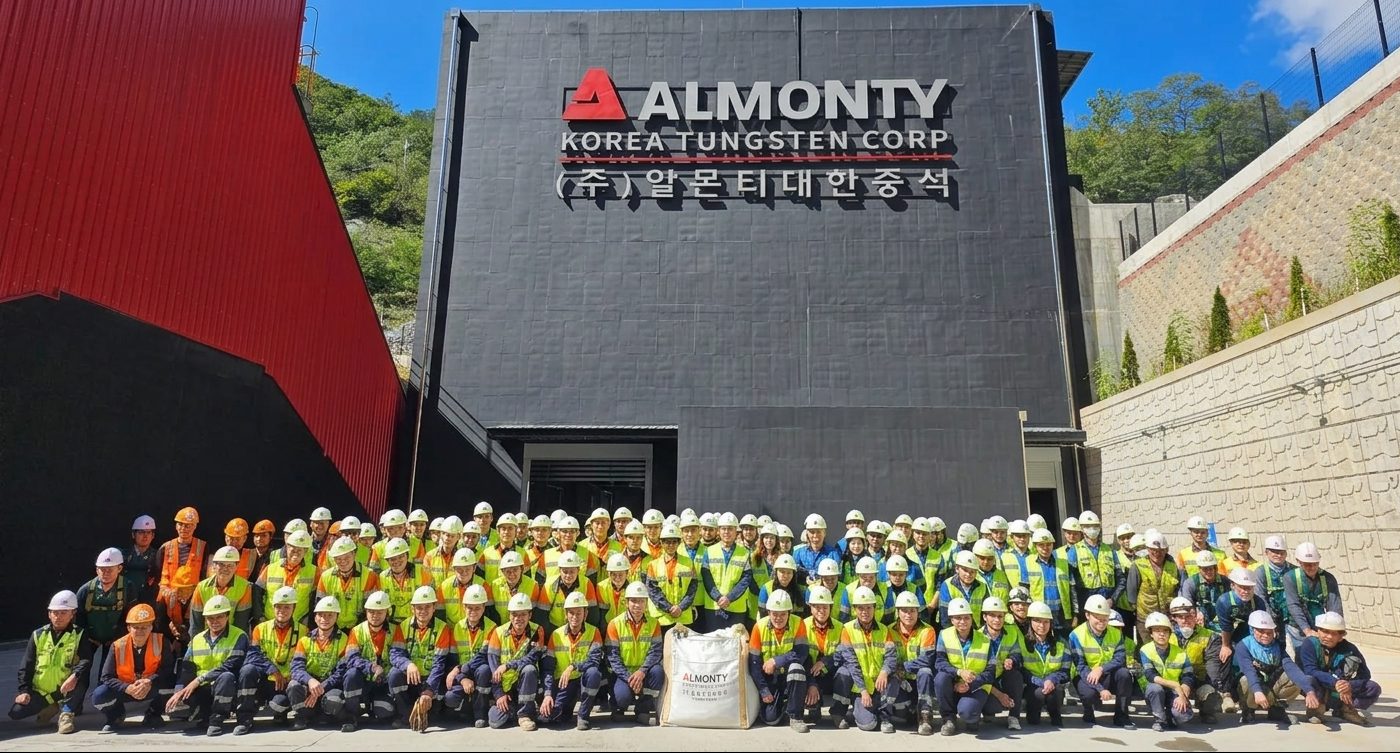
At the center of Almonty’s buttressing of the Western tungsten supply chain is its Sangdong mine, which recently yielded a first run of concentrate ready for export and domestic sale, complementing Panasqueira with a second allied nation in production.
The concentrate, part of phase-1 development, marks the mine’s first output in 33 years, following the receipt of mining facility inspection certificates for its crushing facilities and processing plant on September 17, 2026, allowing the company to officially kick off commercial operations.
Sangdong’s mill is running for 13 hours per day, as per Almonty’s shareholder letter on September 29, and will be ushered into a 24/7 schedule over the coming days, leveraging a 4.6-month ore stockpile built to facilitate the journey to full production.
Metso, a globally-recognized mineral processing technology company, is on site helping Almonty refine the phase-1 ramp-up, ensuring the streamlined delivery of phase-1 production that’s more than 90% contracted under a 21-year, 4.41 million MTU offtake agreement with US-based Global Tungsten & Powders.
Metso is also helping to lay the groundwork for fully-funded phase-2 underground development, overseeing initial equipment orders, including new mills, that will allow Sangdong to reach 1.2 million tons in annual throughput capacity by 2027, yielding about 460,000 MTU per year, elevating it into the largest ex-China tungsten mine in production.
Sangdong’s major contribution to the ex-China tungsten supply chain, providing the Western world with a sizable and reliable resource, will be supplemented by several global initiatives with the potential to generate meaningful shareholder value.
A pioneer in tungsten tailing processing
Almonty plans to diversify and accelerate top-line revenue by becoming the first Western company, to its knowledge, to produce tungsten from tailings, establishing a pathway to get the critical mineral to market and alleviate the Western supply imbalance far quicker than building a mine.
To this end, the company signed a long-term tungsten concentrate supply agreement with Wolfram Bergbau und Hütten AG (WBH), a vertically integrated producer of tungsten oxide, metal and carbide powders, establishing a framework for the recycling and reprocessing of an existing tailings stockpile at Almonty’s Los Santos mine in Spain, which it acquired in 2011.
Los Santos, on care and maintenance since 2020, is an open-pit scheelite skarn asset, located about 50 km south of Salamanca, that hosts tailings containing an estimated 1,720 tons WO3, making it a prime candidate for a fast-tracked source of EU supply amid rising concerns about Chinese dependence.
WBH, a subsidiary of the Sandvik Group, is the right partner for the job, given its recycling, refining and powder manufacturing complex in Austria – the only integrated tungsten smelting plant outside of Asia and Russia – where scheelite concentrate, a primary tungsten ore, is processed from its underground Mittersill mine and from clients around the world.
The agreement, in place from the first day of tailings production, includes an upfront US$3 million payment for the offtake rights and is structured on a take-or-pay basis, using index-linked pricing with an established floor, all while sharing initial capital expenditures.
Almonty’s plan is backed by in-house testing that achieved tungsten recovery rates of up to 50%, up from 35-40% during initial testing, with WBH’s upfront payment going towards restarting Los Santos’ on-site processing plant and near-term cash flow earmarked to streamline the mine’s path to production.
Should Almonty’s EU-based tungsten tailings operation prove successful, de-risking supply for Western industry, the company plans to replicate the model at Panasqueira, as well as other abandoned sites on the continent, to unlock further value while engaging in reclamation work for the benefit of the environment.
Rwanda, Africa’s tungsten titan
With a view to the future and further globalizing its market presence, Almonty recently took is first step into Africa through a joint venture with the Government of Rwanda, the only African country among the world’s top ten tungsten producers, focused on the Shyorongi tungsten concession, a greenfield exploration block spanning 32 square kilometres in the Rulindo District, Northern Province.
The 75-25 partnership, officially known as Almonty Rwanda, grants Almonty the majority stake, as well as a mobile tailings processing license, with ore, tailings and pre-concentrate to be sourced from licensed miners working today for upgrading and export, including the small-scale miners that make up most of Rwanda’s mining industry.
The company envisions initial production to stem from material shipped to and upgraded at its existing facilities, to be followed by mobile tailings processing near strategic dams, exploration at Shyorongi and the eventual construction of a centralized processing plant, subject to a binding investment and development agreement. The Government of Rwanda plans to introduce Almonty to mining operators, license holders and landowners to facilitate material purchases and land access.
In this way, Almonty intends to play a major role in expanding and modernizing Rwanda’s tungsten sector, instituting tier-1 infrastructure, rigorous training programs, and international social and environmental standards aligned with Western defense and technology end-users.
Concurrently, the partnership will reinforce trade and supply-chain security between Rwanda and the United States, building upon the US Department of State’s initial introduction of Almonty to the East African government, the 2025 US-Rwanda Framework for Shared Economic Prosperity, and the Regional Economic Integration Framework of the Washington Accords for Peace and Prosperity, all of which underpin the US’s keen interest in investing in Africa’s critical minerals sector.
Almonty Rwanda not only expands the company’s mission to create a Western tungsten supply chain, it also follows from a growing history of government cooperation, as highlighted by KfW IPEX-Bank, part of Germany’s state-owned KfW banking group, financing Sangdong’s construction under export credit cover issued by Oesterreichische Kontrollbank AG, Austria’s official export credit agency, as well as ongoing work with the South Korean Government since 2022 to fortify the country’s domestic tungsten supply chain.
A catalyst to Western tungsten independence
With China hoarding around 80% of tungsten production and restricting critical mineral exports, putting the Western world at risk of falling behind in its defense capabilities and technological development, the tungsten supply gap is worryingly wide and in need of an inflection point, and Almonty is in a position of strength to catalyze it.
At the outset, this tungsten market transformation will become apparent in Sangdong’s increasing output, which will soon hit the company’s income statements, reflecting the fact that the critical mineral is more readily available to Western nations than it’s ever been before.
Resulting cash flow should then firm up Almonty’s financial foundation, facilitating tailings processing at Los Santos, as well as initial shipments of Rwandan ore for upgrading and sale, significantly boosting the company’s contributions to the ex-China tungsten market.
That said, despite these globally relevant initiatives, Almonty’s strategic position at the heart of Western tungsten supply is only beginning to unfold, as highlighted in September’s corporate update, with numerous other plans in the works to quell demand and foster allied sovereignty.
Looking ahead, the remainder of the company’s portfolio also harbors significant upside when it comes to shoring up conflict-free tungsten supply, including the Gentung project in Montana, whose mineral resource of 6.833 million tons at 0.315% WO₃ is recoverable at a grade of more than 90%, and the Valtreixal project in Spain, which hosts robust resources and reserves of its own, laying before Almonty a long-term runway on which to strategically grow into its role as a trusted Western tungsten supplier.
The market, in turn, has responded to the company rising up tungsten’s ranks with increasing conviction, more than doubling Almonty shares since listing on the Nasdaq in July 2025, following an exponential run-up on the TSXV and the TSX since 2011, setting a prospective tone for the months and years ahead.
As the US institutes its defense procurement ban on Chinese tungsten in 2027, incentivizing domestic and allied explorers, developers and producers to address the supply deficit, look for Almonty to gradually step into the spotlight as new milestones under its global development pipeline prove the company’s potential to be substantially untapped.
Join the discussion: Find out what investors are saying about this tungsten mining stock on the Almonty Industries Inc. Bullboard and explore the rest of Stockhouse’s stock forums and message boards.