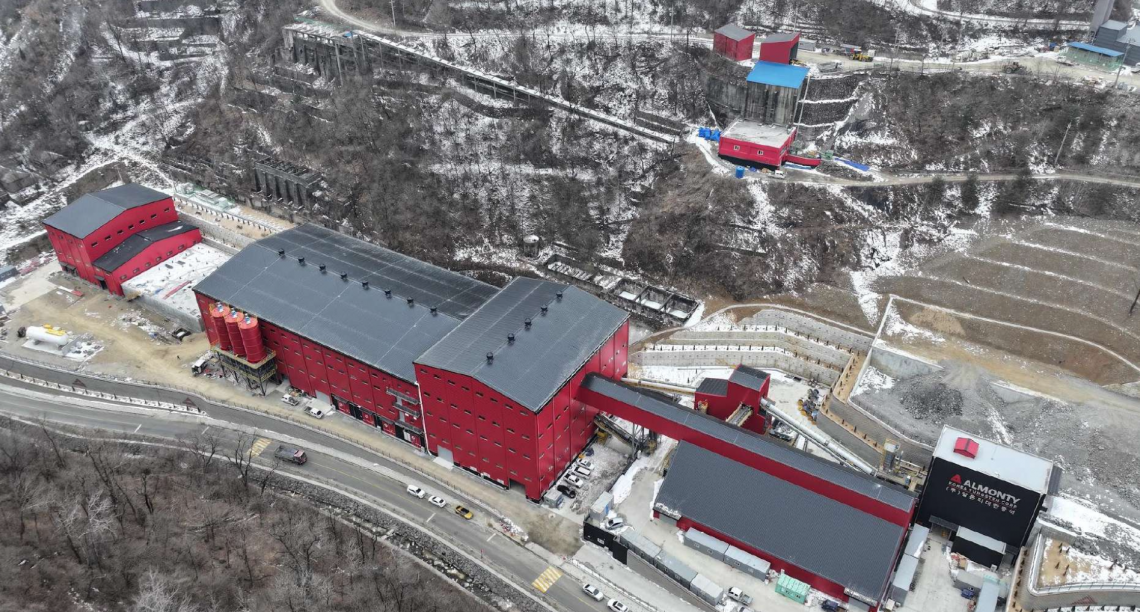


Tungsten has become a commodity of geopolitical importance. Its price has more than doubled since the beginning of the year. Small and medium-sized companies are groaning under high purchasing costs, and the industry is facing the threat of production lines coming to a standstill. The tug-of-war between West and East for the coveted heavy metal is in full swing. China controls around 80% of global production and is increasingly tightening the export screw. This presents a rare opportunity for investors, because there is no way around one stock: Almonty Industries. The company is on its way to becoming the most important tungsten supplier in the Western world.
This article is disseminated in partnership with Apaton Finance GmbH. It is intended to inform investors and should not be taken as a recommendation or financial advice.
Raw material supply reaches ARD broadcast
When the prices of gold or silver go through the roof, it is a big topic, even for public broadcasters. Less noble metals, such as tungsten, on the other hand, are hardly ever mentioned in the news. Since traditional light bulbs with their clearly visible tungsten filaments were replaced by energy-saving bulbs, the heavy metal has largely disappeared from public consciousness. So it was all the more surprising that the ARD program “Plusminus” sounded the alarm last week. Since the price of tungsten has more than doubled since the turn of the year, small and medium-sized companies in sectors such as toolmaking and the automotive supply industry are already struggling with liquidity problems. Worse still, supply bottlenecks threaten to bring production lines to a standstill in the foreseeable future. Even in Germany.
Tungsten was used in light bulbs primarily because of its heat resistance. It has the highest melting point of all metals: 3,422 °C. It is also considered particularly wear-resistant and is almost as hard as diamond. Tungsten carbide is therefore essential for the manufacture of drills, milling cutters, and cutting tools, as well as in welding technology and for the production of particularly robust steel alloys. The jewelry industry has also long since discovered this shiny white metal, and in sports it is used in high-quality darts or in the form of additional weights, for example in Formula 1 or sailing boats.
China as a factor of uncertainty
However, the immense price increase is mainly due to demand from the aerospace and defense industries. Here, the heavy metal is needed for rocket nozzles, heat shields, and armor-piercing ammunition, for example. The electronics and semiconductor industries, which are booming thanks to the AI hype, are doing their part to tighten supply on the global market, which is firmly in Chinese hands. 79% of global production comes from the People’s Republic. Although Beijing does not prohibit exports, exporters must obtain permission from the Chinese government. This results in massive delays or even rejections. Western industry is therefore desperately searching for secure sources of supply. In addition, tungsten is classified as a critical metal by both the EU and the US government because of its importance to the defense industry. In this respect, it is a declared political goal to reduce dependence on China. The US Department of Defense is even planning to build up strategic tungsten reserves.
One supplier in particular is being considered for this, one that even plans to produce in the United States: Almonty Industries (TSX:AII) (NASDAQ:ALM). Just last October, the Canadians acquired exclusive rights to explore, develop, and mine the Gentung Browns Lake tungsten project in Beaverhead County, Montana. According to Almonty, this is one of the most advanced but undeveloped tungsten deposits in the US. Production is scheduled to begin in the second half of 2026.
Anyone considering investing in tungsten cannot ignore Almonty’s stock. The heavy metal with the element symbol W and atomic number 74 is not traded on any futures exchange. In Rotterdam, one of the most important hubs for the import, storage, and transhipment of raw materials, the main commodity traded is the tungsten-containing powder ammonium paratungstate (APT) – privately and at prices currently averaging around USD 1,700 per metric ton (MTU). This sounds quite modest compared to the price of gold (USD 167 million per ton), but the immense price increase nevertheless presents processors and consumers with the problems described by “Plusminus.” The doubling of the APT price since the beginning of the year is only the tip of the iceberg. Since the beginning of 2025, the price has actually increased fivefold.
Almonty outperforms the commodity
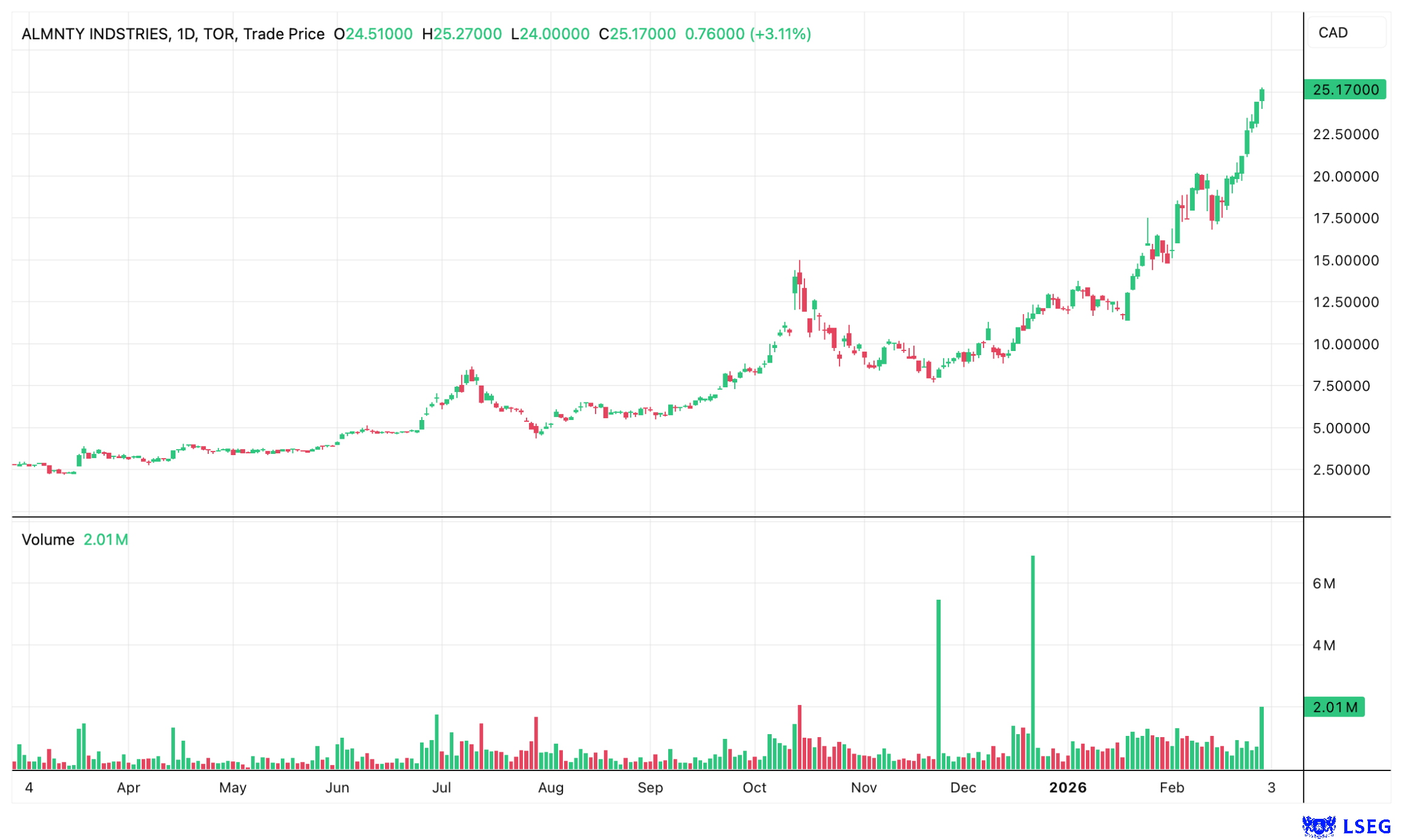
Almonty shares are not only mirroring this price trend, but have far outperformed the commodity. In the US, the price of the stock, which is now traded on the NASDAQ, has risen from USD 1 to more than USD 17 in the past 14 months. And that may not be the end of the story. With the market capitalization now exceeding USD 4 billion, renowned investment banks are taking an interest in the company. A study by Bank of America with a “Buy” rating caused a stir last week. Although the price target of USD 20 is unspectacular, analyst Lawson Winder predicts that the price of tungsten will continue to soar. He expects it to rise to USD 2,000 per ton of tungsten trioxide (comparable to APT) by 2027, at which point the situation could ease. However, whether this actually happens will depend on the uncertainty factor of China. The Middle Kingdom could export significantly less than estimated in the future. The government in Beijing has already closed environmentally harmful or inefficient mines and is now even importing tungsten from abroad. The excess demand could therefore continue beyond 2027.
However, Almonty’s leverage lies less in the price of the raw material and more in ramping up production. The Sangdong mine in South Korea is already the world’s largest tungsten mining site outside China and has enormous advantages over its competitors due to its highly productive deposits. Production costs are estimated at USD 300 per metric ton. Even if the price were to fall back to USD 500, the starting level of the recent tungsten rally, Almonty could still produce profitably in South Korea. Bank of America does not rule out such a decline between 2027 and 2031, but by then Almonty will have achieved a market position that secures the Canadians pole position, at least in the Western world. By 2027, CEO Lewis Black and his management team aim to double production capacity in South Korea to 1.2 million tons of ore. This would mean that Sangdong alone would account for around 40% of global tungsten production outside China.
Almonty also produces in Europe. The Panasqueira mine, located about 250 km northeast of the capital Lisbon, has been known since 1896 for its high-quality, low-impurity tungsten concentrate, making it one of the longest-operating mining sites in the world. Production capacity is set to be expanded from 600,000 to 800,000 tons in the coming years. Two projects in Spain offer additional growth potential, but like the mine in Montana, they are not yet in production.
The question remains: What happens if the industry tries to replace expensive tungsten with other raw materials? In most applications, this is not possible, but in some areas, such as aerospace, substitution with molybdenum would be conceivable. But here too, Almonty has an ace up its sleeve. Just 150 meters from the Sangdong mine, the company owns a molybdenum deposit that is scheduled to start production at the end of the year. The expected annual production of 5,600 tons has already been sold in advance in its entirety through long-term supply contracts with South Korea’s largest molybdenum processor, SeAH M&S.
Valuation remains favorable
Analyst Winder expects Almonty to generate revenue of CAD 338 million this year, which is expected to increase by more than 170% to CAD 916 million by 2027. Net profit is expected to almost triple to CAD 606 million by then, while free cash flow should be sufficient to largely reduce the current debt of CAD 261 million – provided that no new projects are acquired that further increase the company’s net asset value and market power. The net profit margin of 66% is more reminiscent of a high-tech giant than a mining company. Measured by this, Almonty is still very cheaply valued with a price-to-earnings (P/E) ratio of 11 based on current Bank of America estimates, despite the steep rise in its share price.
Conflict of interest
Pursuant to §85 of the German Securities Trading Act (WpHG), we point out that Apaton Finance GmbH as well as partners, authors or employees of Apaton Finance GmbH (hereinafter referred to as “Relevant Persons”) currently hold or hold shares or other financial instruments of the aforementioned companies and speculate on their price developments. In this respect, they intend to sell or acquire shares or other financial instruments of the companies (hereinafter each referred to as a “Transaction”). Transactions may thereby influence the respective price of the shares or other financial instruments of the Company.
In this respect, there is a concrete conflict of interest in the reporting on the companies.
In addition, Apaton Finance GmbH is active in the context of the preparation and publication of the reporting in paid contractual relationships.
For this reason, there is also a concrete conflict of interest.
The above information on existing conflicts of interest applies to all types and forms of publication used by Apaton Finance GmbH for publications on companies.
Risk notice
Apaton Finance GmbH offers editors, agencies and companies the opportunity to publish commentaries, interviews, summaries, news and the like on news.financial. These contents are exclusively for the information of the readers and do not represent any call to action or recommendations, neither explicitly nor implicitly they are to be understood as an assurance of possible price developments. The contents do not replace individual expert investment advice and do not constitute an offer to sell the discussed share(s) or other financial instruments, nor an invitation to buy or sell such.
The content is expressly not a financial analysis, but a journalistic or advertising text. Readers or users who make investment decisions or carry out transactions on the basis of the information provided here do so entirely at their own risk. No contractual relationship is established between Apaton Finance GmbH and its readers or the users of its offers, as our information only refers to the company and not to the investment decision of the reader or user.
The acquisition of financial instruments involves high risks, which can lead to the total loss of the invested capital. The information published by Apaton Finance GmbH and its authors is based on careful research. Nevertheless, no liability is assumed for financial losses or a content-related guarantee for the topicality, correctness, appropriateness and completeness of the content provided here. Please also note our Terms of use.
Stockhouse does not provide investment advice or recommendations. All investment decisions should be made based on your own research and consultation with a registered investment professional. The issuer is solely responsible for the accuracy of the information contained herein.
For full disclaimer information, please click here.