

The price of gold is rising, producers are earning record profits, and in the midst of it all, a small newcomer has emerged that has what it takes to shake up the industry. While the big players like Newmont Mining and Agnico Eagle are shining with record figures and cash flows in the billions, DRC Gold is creeping into the spotlight almost unnoticed. With a market capitalization of around CAD 30 million, the company has potential that fires the imagination. Three stocks, three stories, and all have just picked up speed. Those who are invested in the gold sector or want to be should take a closer look now.
This article is disseminated in partnership with Apaton Finance GmbH. It is intended to inform investors and should not be taken as a recommendation or financial advice.
DRC Gold – The “gold diamond” has been kissed awake
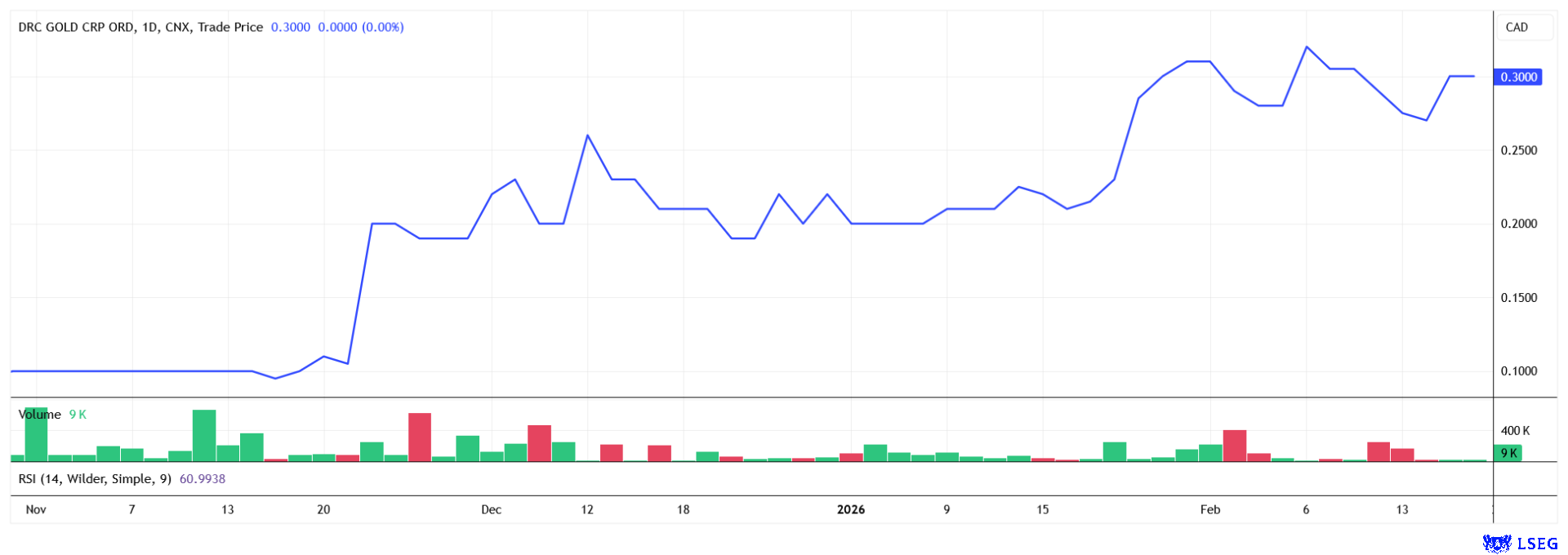
DRC Gold (CSE:DRC) is not yet an industry legend, but who knows. What is not yet may still become. DRC Gold, which until recently was known as AJN Resources, has virtually “reinvented” itself at the beginning of 2026. The name change is no coincidence, as it reflects the company’s clear focus on gold in the Democratic Republic of Congo and is intended to give the company greater visibility on the capital market. The first successes are already visible. As can be seen in the chart below, the share price rose significantly in a short period of time. Nevertheless, even after the increase, the market capitalization is still only around CAD 30 million. That still sounds like a bargain when compared to other stocks in the sector.
What is behind this? Essentially, it is a combination of experienced management and an exceptionally promising project. CEO Klaus Eckhof is no stranger to the scene; he is a geologist through and through with over 30 years of experience in industry, including over two decades in the Democratic Republic of Congo. This resume makes him something of a living legend. He was also instrumental in developing the Moto Gold project in Congo, defining over 20 million ounces of gold. The project was later acquired by Randgold Resources and developed into the Kibali Mine. Today, it is one of the most productive gold mines in all of Africa.
And this is precisely where the appeal lies, as DRC Gold is pushing ahead with the acquisition of a 55% majority stake in the Giro Gold project. This is located just under 39 km from the famous Kibali mine, putting it within striking distance. The sheer size of the area is impressive, covering almost 500 sq km in the Kilo-Moto greenstone belt. This “belt” is one of the most geologically productive areas in Africa. Two historic gold deposits with a potential of over one million ounces of gold are already known. The necessary mining permits are already in place, and production could and would like to start quickly here. After this step, a different valuation basis is likely.
But that is not all. The company is advancing two additional projects in Ethiopia, including the Okote Gold project in the south of the country, which lies along the same mineralized trend as the approximately 4.5-million-ounce Lega Dembi mine. Historical drilling has identified gold mineralization over a strike length of approximately 2,400 m, with grades of up to 13 m grading 8.71 g/t Au. Further drilling is scheduled to commence soon. Most recently, in January of this year, DRC Gold also completed a private placement of approximately CAD 550,000 to advance due diligence and the formal acquisition of the Giro project. Since then, David Wargo, CEO of SCP Resource Finance and an experienced investment banker with over 25 years in the mining industry, including 10 years in financing Congolese companies, has joined the board of directors. This should not be a disadvantage, but rather an advantage.
What makes DRC Gold particularly interesting is that members of its management team have previously been involved in advancing the Moto Gold project to a multi-million-ounce resource before its eventual sale to an industry giant. The key question for investors is whether DRC Gold can replicate similar value creation with its current asset portfolio.
Newmont Mining – A record year, but the stock market is looking ahead and wants more
From the top to even higher. That is Newmont Mining, the world’s largest gold producer. 2025 was the best year in the company’s history. Net income was USD 7.2 billion, and free cash flow was USD 7.3 billion. Both figures are unprecedented in the company’s history. In the fourth quarter, Newmont earned USD 2.52 per share, well above analyst expectations of around USD 2.00. Quarterly revenue of USD 6.82 billion was also well above estimates of USD 6.19 billion. The main driver behind this performance was the sharp increase in gold prices, which continued to reach new highs throughout the year. The average selling price per ounce rose 45% to USD 3,498. In the last quarter, it reached over USD 4,200. Newmont used USD 3.4 billion for dividends and share buybacks, and an additional USD 3.4 billion will be used to reduce debt. The quarterly dividend is also expected to rise to USD 0.26 per share.
And yet the stock market was less than enthusiastic. The reason lies in the outlook. For 2026, Newmont expects only 5.3 million ounces of gold, down from 5.89 million in the previous year. That is a decline of almost 10%. At the same time, production costs are expected to rise to USD 1,680 per ounce, compared to USD 1,358 in the previous year. Investors are not happy about this, and it is dampening the positive mood considerably. Management euphemistically refers to this as a deliberate “production dip.” Several mines are currently changing their mining phase, while others are being converted. The new Ahafo North mine is expected to cushion the decline at Ahafo South.
Major changes are underway at Penasquito and Cadia. From 2027, production is expected to rise again to around six million ounces per year. That sounds conciliatory and is balm for investors’ hearts. However, there is still a dispute smoldering with partner Barrick Mining. In early February 2026, Newmont officially accused the company of breach of contract in the joint Nevada Gold Mines project. The accusation is that Barrick is diverting resources from the joint venture to promote its own Fourmile project. Newmont holds 38.5% of the project, while Barrick holds 61.5%. Barrick has 30 days to rectify the situation, otherwise it could end up in a Nevada court. The explosive aspect of this is that Newmont has a right of first refusal, which could significantly complicate Barrick’s planned IPO of its North American gold division.
Those who are thinking long-term and continue to see gold as bullish are likely to see the recent price setback as an opportunity. The forward P/E ratio is around 13.5, which is favorable for a company of this size.
Agnico Eagle – Canada’s gold king builds on further growth
Between the small upstart DRC Gold and the industry giant Newmont, there is a third story: Agnico Eagle Mines. It is Canada’s largest gold producer, number two worldwide. The company also performed very well in 2025. And unlike Newmont, the stock market rewarded it this time.
Agnico Eagle operates mines in Canada, Australia, Finland, and Mexico. Last year, the company produced a total of 3.45 million ounces of gold – exactly in line with its own forecast. In the fourth quarter of 2025, 841,000 ounces were added. Adjusted earnings per share were USD 2.70, slightly above the expectation of USD 2.68. EBITDA reached USD 2.51 billion. Free cash flow in 2025 was a whopping USD 4.40 billion. Operating cash flow was even higher at USD 6.82 billion. At the end of December 2025, Agnico Eagle had cash reserves of USD 2.87 billion. And all this with a meager debt of USD 196 million. This is a very healthy balance sheet, not only for a mining company.
However, the money is not just sitting there; it is being put to use. The quarterly dividend has climbed to USD 0.45 per share. In addition, the company repurchased around 4.1 million of its own shares last year. And the buyback program is set to be increased again in May 2026 to up to USD 2 billion.
For the coming years (through 2028), Agnico Eagle aims to produce a stable 3.3 to 3.5 million ounces of gold per year. This is exactly what investors need and expect from a gold producer in terms of reliability. Between USD 565 million and USD 635 million will be available for exploration and project development in 2026. USD 43.4 million alone will go to the Hope Bay project in northern Canada, with another USD 34.2 million going to drilling and underground mining at the Detour Lake project. The big goal is set for the early 2030s with more than 4 million ounces of gold per year.
In line with this, Agnico Eagle has increased its stake in Maple Gold Mines, an exploration company with great geological potential, to around 13%. Those looking for solid quality with a clear strategy, Agnico Eagle is a good choice.
Conclusion: Three Gold Stocks, One Clear Trend for 2026
Gold is back on everyone’s lips. The price of gold is at historic highs, and the companies that extract the yellow metal from the ground are benefiting accordingly. Newmont Mining proved in 2025 how much money can be made in a gold bull market. The record year speaks for itself. Those who think beyond 2026 and see the planned dip in production for what it is, namely a strategic transition pause before renewed growth, will find a solidly valued basic investment here. Agnico Eagle, on the other hand, shows how to operate sustainably in the industry. Stable production, a strong balance sheet, growing dividends, and a clear plan for the coming years. Anyone looking to combine quality with continuity is certainly in good hands here. And then there is DRC Gold, perhaps the most exciting story of the three. A small company with a large network, proven management, and a project located right next to one of Africa’s most productive gold mines. With a market capitalization of around CAD 30 million, there is potential here that is hardly priced in. Investors who get in early on a discovery stand to benefit the most. The company has only just begun its story – and it could be a very promising one.
Conflict of interest
Pursuant to §85 of the German Securities Trading Act (WpHG), we point out that Apaton Finance GmbH as well as partners, authors or employees of Apaton Finance GmbH (hereinafter referred to as “Relevant Persons”) currently hold or hold shares or other financial instruments of the aforementioned companies and speculate on their price developments. In this respect, they intend to sell or acquire shares or other financial instruments of the companies (hereinafter each referred to as a “Transaction”). Transactions may thereby influence the respective price of the shares or other financial instruments of the Company.
In this respect, there is a concrete conflict of interest in the reporting on the companies.
In addition, Apaton Finance GmbH is active in the context of the preparation and publication of the reporting in paid contractual relationships.
For this reason, there is also a concrete conflict of interest.
The above information on existing conflicts of interest applies to all types and forms of publication used by Apaton Finance GmbH for publications on companies.
Risk notice
Apaton Finance GmbH offers editors, agencies and companies the opportunity to publish commentaries, interviews, summaries, news and the like on news.financial. These contents are exclusively for the information of the readers and do not represent any call to action or recommendations, neither explicitly nor implicitly they are to be understood as an assurance of possible price developments. The contents do not replace individual expert investment advice and do not constitute an offer to sell the discussed share(s) or other financial instruments, nor an invitation to buy or sell such.
The content is expressly not a financial analysis, but a journalistic or advertising text. Readers or users who make investment decisions or carry out transactions on the basis of the information provided here do so entirely at their own risk. No contractual relationship is established between Apaton Finance GmbH and its readers or the users of its offers, as our information only refers to the company and not to the investment decision of the reader or user.
The acquisition of financial instruments involves high risks, which can lead to the total loss of the invested capital. The information published by Apaton Finance GmbH and its authors is based on careful research. Nevertheless, no liability is assumed for financial losses or a content-related guarantee for the topicality, correctness, appropriateness and completeness of the content provided here. Please also note our Terms of use.
Stockhouse does not provide investment advice or recommendations. All investment decisions should be made based on your own research and consultation with a registered investment professional. The issuer is solely responsible for the accuracy of the information contained herein.
For full disclaimer information, please click here.